Why is the Strait of Hormuz so significant?published at 16:32 BST
Iran says it is closing the Strait of Hormuz and accuses the US and Israel of violating the ceasefire deal, after Israel continued strikes on Lebanon
What's in the 14-point agreement to bring an end to the war?
Meanwhile, the US Central Command says safe passage through the vital waterway "remained intact" and that 55 ships had transited
It comes as Israel and Hezbollah have both accused each other of violating a new ceasefire. Two dozen people have reportedly been killed in Israeli strikes in southern Lebanon since it came into effect on Friday
The deal was always fragile and there are signs it is unravelling. All eyes will now be on President Trump, writes the BBC's Jon Donnison
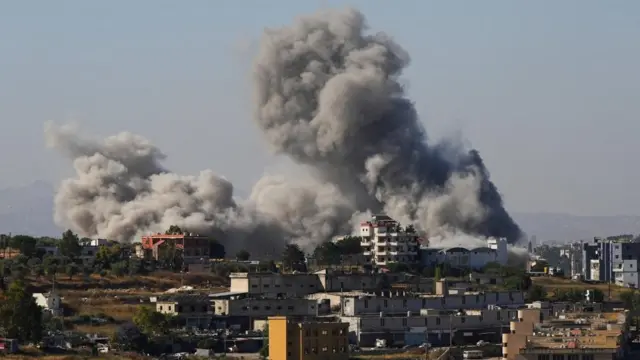 Image source, Reuters
Smoke billows from southern Lebanon on Saturday
As we've been reporting, the Iranian military says it is closing the Strait of Hormuz, blaming "America's blatant breach of promise" on the deal to bring about an end to the war.
It highlights the first paragraph of the 14-point deal, which declares an "immediate and permanent termination of military operations on all fronts, including in Lebanon".
It comes after reports that about two dozen people have been killed by Israeli strikes in southern Lebanon - less than 24 hours after a new ceasefire between Israel and Hezbollah was announced.
A US official said yesterday that Israel and Hezbollah had agreed a ceasefire, following concerns that continued clashes would undermine the deal to end the war between the US and Iran.
The Israeli military confirmed that a ceasefire was in effect, but later a spokesman said its forces would "continue to remove immediate threats".
A Hezbollah official told the BBC it does not recognise the ceasefire that was announced by US officials on Friday afternoon, and it rejects the Israeli objective to operate freely inside Lebanon.
Earlier today, local officials said 16 people have been killed in the Nabatieh district and seven in neighbouring Saida, in Lebanon.
The Israeli military said it had struck "dozens" of Hezbollah targets after the group fired more than 50 projectiles at Israeli forces in the region.
The Israel Defense Forces (IDF) and Hezbollah have both accused each other today of repeated ceasefire violations.
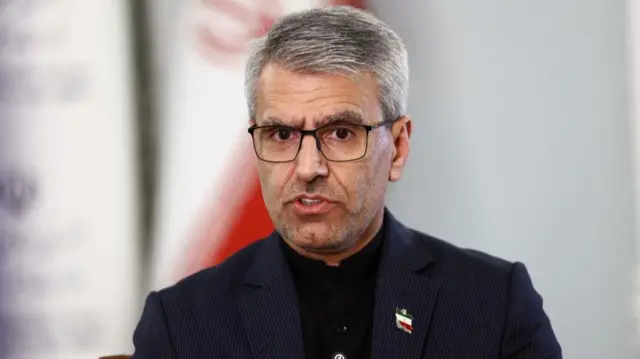 Image source, Reuters
Iran's Foreign Ministry spokesman Esmaeil Baghaei pictured earlier this year
Iran's foreign ministry spokesman Esmail Baghaei says his country's attendance at talks in Switzerland will be aimed at "demanding that the other side fulfil its commitments".
Mediator Pakistan said earlier that talks will be held in Bürgenstock in Switzerland tomorrow, attended by US and Iranian representatives.
"Negotiations for a final agreement will begin only when the commitments set out in paragraphs 1, 4, 5, 10 and 11 have started to be implemented and continue to be carried out," Baghaei says, referencing the 14-point US-Iran deal signed earlier this week.
He says this is not the situation at present, adding that Iran will be "pressing" the US to implement its commitments at the upcoming talks.
Here's a reminder of the US and Iran's agreement, signed by both parties on Wednesday, which centres around 14 points:
1. "The immediate and permanent termination of military operations on all fronts, including in Lebanon"
2. US and Iran to "respect each other’s sovereignty and territorial integrity and to refrain from interfering in each other’s internal affairs"
3. They "commit to negotiating and achieving the final deal in maximum 60 days, extendable with mutual consent"
4. Immediately, the US "will begin the removal of its naval blockade... and will fully end the naval blockade within 30 days"
5. In the Strait of Hormuz, Iran "will make arrangements using its best efforts for the safe passage of commercial vessels with no charge, for 60 days"
6. The US undertakes "with regional partners to develop a definitive, mutually agreed plan with at least USD $300 billion for the reconstruction and economic development of" Iran
7. US to "terminate all types of sanctions against" Iran
8. Iran "reaffirms that it shall not procure or develop nuclear weapons", but other parts of the programme are still to be negotiated. The two parties "agreed to discuss the issue of enrichment and other mutually agreed matters related to the Islamic Republic of Iran’s nuclear needs"
9. Pending the final deal, the US and Iran "agree to maintain the status quo"
10. Upon signing, and until the termination of sanctions, US Treasury will "issue waivers for the export of Iranian crude oil, petroleum products, and derivatives, and all associated services"
11. US undertakes "to make fully available for use the frozen or restricted funds and assets" of Iran
12. "An executive mechanism will be established to monitor the successful implementation" of this memorandum
13. After signing - subject to implementation of points 1, 4, 5, 10 and 11 - the US and Iran "will start negotiations regarding the final deal exclusively on the other paragraphs"
14. "The final deal will be endorsed by a binding UNSC (United Nations Security Council) resolution"
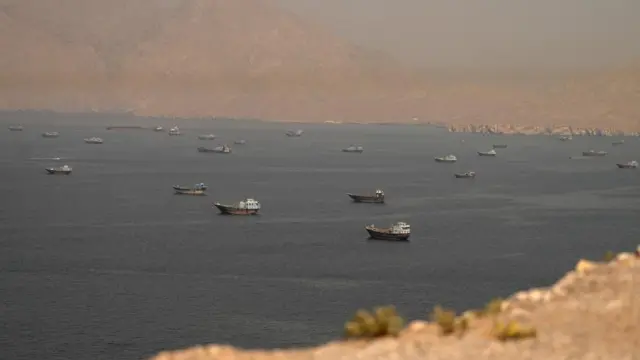 Image source, Reuters
Vessels near the Strait of Hormuz as seen from Musandam, Oman, on Thursday
US Central Command (Centcom) says commercial ship traffic in the Strait of Hormuz increased today and that 55 merchant ships transited.
In a statement on X posted after the Iranian military's announcement that it is closing the strait, Centcom says: "Commercial ship traffic in the Strait of Hormuz increased June 20 as US forces continued operating in the general area to support freedom of navigation.
"Safe passage through the international waterway remained intact today as 55 merchant ships transited, moving large amounts of cargo and more than 17 million barrels of oil to global markets."
It adds: "US forces remain present and vigilant to ensure all aspects of the agreement with Iran are adhered to, obeyed, and in full force and effect."
Iran's Islamic Revolutionary Guard Corps (IRGC) said earlier that the strait is closed to all vessels, citing US and Israeli ceasefire violations.

 Jon Donnison
Reporting from Jerusalem
The deal between Iran and the United States was always fragile and torturous in the making.
Already there are signs it is unravelling.
The partial reopening of the Strait of Hormuz, through which 20% of the world’s oil passes, was the principal achievement of the Memorandum of Understanding and a key priority for the United States seeking to avoid a global economic crisis.
Now after just a few days, the Iranian military says it’s closed again, with Iran citing "relentless and continuous" breaches of the ceasefire in Lebanon by Israel which continues to occupy a large chunk of the south of the country.
All eyes will now be on President Trump to see what pressure can be applied to its ally, Israel to force it to rein in its military operation in Lebanon.
It comes after a week of unprecedented criticism of Israel by the White House over its actions in Southern Lebanon, accusing the Israeli military of using excessive force.
Pakistan's foreign ministry says talks will be held in Bürgenstock in Switzerland on 21 June, attended by US and Iranian representatives.
Mediators from Pakistan and Qatar will also attend, with Pakistan facilitating the process as mediator, according to a statement on X posted after the announcement from the Iranian military that it is closing the Strait of Hormuz.
The aim of the talks is "advancing the understandings reached" in the 14-point memorandum of understanding, it adds.
It comes after talks in Switzerland - due to be attended by Vice-President JD Vance - were postponed earlier this week, with the White House saying the logistics had not been "simple or predictable".
Hours before the White House issued its statement, Hezbollah-linked Lebanese media reported that the talks had been suspended due to Israeli air strikes in Lebanon.
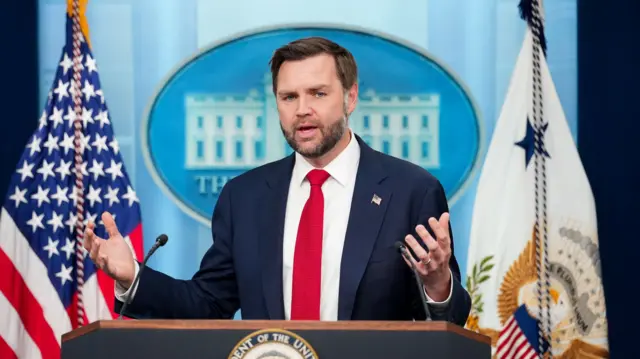 Image source, Reuters
US Vice-President JD Vance tells Fox News that the Strait of Hormuz remains fully open, after being asked about reporting in the Wall Street Journal suggesting the Iranian navy were turning away ships.
"We’re not seeing any evidence that the Iranians are still closing down the Strait of Hormuz," Vance says.
"We actually got 16 million barrels of oil out of the Strait of Hormuz yesterday," Vance says. "So you’re seeing those ships move."
Iran's Revolutionary Guard Corps Navy says the Strait of Hormuz is closed to all vessels, citing US and Israel ceasefire violations.
The Navy issued a strict warning to all vessels: "Do not approach the Strait of Hormuz; otherwise, your security will be jeopardized."
Iran's military says it is closing the Strait of Hormuz over continuing Israeli strikes in Lebanon.
It accuses the US and Israel of violating the ceasefire deal.
This is a breaking news story, stay with us for the latest.