First test as new Reform cabinet 'finds its feet'

 Aisha Iqbal/BBC
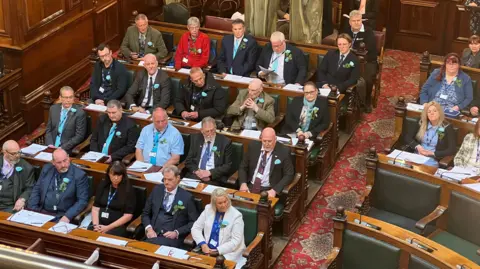
Bradford Council's new Reform UK leader has pledged to avoid "political point scoring" as his new cabinet faced scrutiny at its first full meeting since taking power.
The executive session offered an early glimpse of how the new leadership intends to govern, with councillors discussing an improved financial outlook, significant progress in children's services and the challenges that remain ahead.
However, council leader Stephen Place acknowledged that the administration was still getting to grips with its new responsibilities after taking control following May's local election
"We are three weeks in," he said. "We're just finding our way, finding our feet."
Much of the discussion on Tuesday focused on the authority's finances, after a turbulent recent period.
Interim director of finance Steven Mair told councillors the council had ended the last financial year with a £16.7m underspend against a budget of £591m.
He said additional government funding and an ongoing emergency support agreement had "considerably" strengthened the council's ability to plan over the coming years, although the authority continued to face major financial challenges.
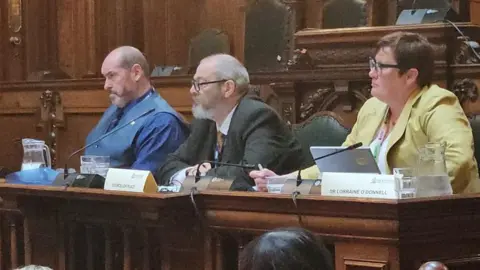
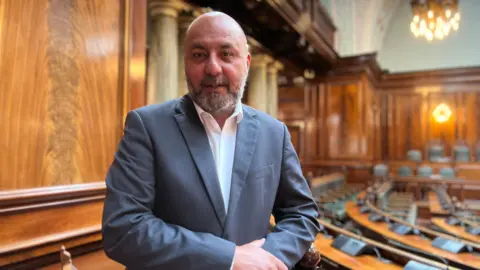
Labour group leader Imran Khan, formerly deputy leader of the council, highlighted the increase in funding and asked whether the administration would acknowledge the role played by the Labour government.
After initially asking for the question to be repeated because of difficulties hearing it, Place responded: "There has been significant improvement with funding. Thank you. Yes."
He added that the new administration was looking into its longer-term approach to the council's finances and would return with further detail in July.
The new-look decision making executive also received an update on children's services following a positive Ofsted inspection earlier this year.
Charlotte Ramsden, chief executive of Bradford Children and Families Trust, told councillors the report represented a major milestone for the district.
"It absolutely marks a turning point for Bradford in terms of its children's services," she said.
 Aisha Iqbal/BBC
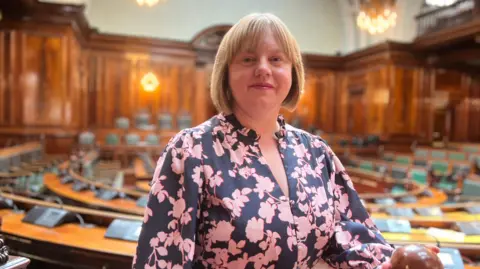
New executive member for children and families Sally Birch welcomed the findings but warned: "Nobody should pretend that the journey is complete."
"For too long, Bradford was associated with failure in children's services and the children of this district deserve better," she said.
Place added the administration would continue supporting the trust and pledged there would be "no political point scoring" from the executive.
 Aisha Iqbal/BBC
For all the attention paid to Bradford's election result last month, the most revealing aspect of the new administration's first executive meeting was perhaps not what it announced, but the tone it adopted.
Election campaigns are often built around promising change, but governing requires something different: understanding complex organisations, working through competing priorities and making decisions within constraints that are often less visible from outside the chamber.
That reality was palpable throughout the meeting.
The administration's two biggest agenda items – finances and children's services – both pointed towards areas where progress has already been made. The new executive did not seek to dismiss this or to "rewrite history" as one of the cabinet put it.
Instead, there was mention of "building" on existing progress, and Place referred to a "collegiate" way of working.
 Aisha Iqbal/BBC
The tone of the meeting was also noticeably more cautious and conciliatory than the rhetoric during the election campaign.
Perhaps the most telling moment came when Place reminded councillors that the administration had been in office for only three weeks. It was an acknowledgement that governing a council is a process of learning, understanding and decision-making.
However, after the meeting, Conservative group leader Rebecca Poulsen, who has ruled out rumours of a coalition with Reform UK, said the new administration "can't keep using that [we're new to this] line...decisions and priorities will have to come".
There is also a wider significance to what is happening in Bradford.
Across West Yorkshire, councils are still adjusting to the political shockwaves created by Reform's breakthrough. In some authorities the party has secured a clearer route to power. In others, political uncertainty remains unresolved.
Bradford sits somewhere between those positions. Reform leads the administration, but does so without an outright majority, making relationships across the chamber, and across the political divide, even more important.
Listen to highlights from West Yorkshire on BBC Sounds, catch up with the latest episode of Look North.