Your
experiences of the 1953 floods
Your
experiences of the 1953 floods |
|
 |
| Ron
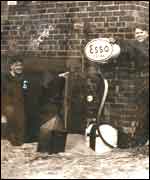
and Bud showing off the flood water |
Brian,
known as Bud, was 22 at the time and lived in Sutton
on Sea. He rescued someone from a house and saw part of the
beach hotel collapse. He also rescued a lady from a bungalow
and nearly dropped her. Since seeing all this he campaigned
for better defences.
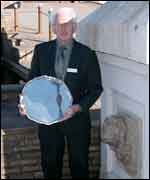 |
| Bud
Shields today |
He's been a councillor for 30 years, is on the flood defence
committee for the Environment Agency and has an MBE for his
services to the floods.
Bud
was given a silver plaque which say's, "To Brian Shields.
In Gratitude for saving the life of Emma Elizabeth Bray in the
floods of Sutton-On-Sea, January 31st, 1593". |
|
|
| Dave
was and is still living in Mablethorpe. The first thing he remembers
about the floods was seeing helicopters with search lights coming
over Mablethorpe. He worked in the garage trade at Grays and
Simons which is now David’s supermarket. |
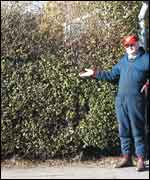 |
| Dave
Furmidge shows off the hedge he had to pull the butchers
van through |
"I
was on the breakdown fetching broken vehicles. To try and
get to Sutton you didn’t know where the edge of the road was.
The dyke was at the edge of the road so you had to be very
careful. I used the telegraph poles to find the road. We had
to fetch a car out of the garage. There was four foot of sand
in front of the garage which we had to dig out before we could
get to the garage. When we opened the garage it was full of
a sandcastle like block. We dug the sides of the car out.
When we opened the car it was full of sand. We couldn’t move
it as it was so heavy with sand even after attaching the chains.
Even the engine was just one block of sand. We managed to
get it out and even got it started. The oil seals managed
to keep the water out."
"Another
vehicle rescue was the butchers nice white van which was on
it’s side and had floated over a hedge on the high street.
We had to take it out through the hedge. I put a chain through
it and pulled the van back through to the high street. The
hedge still shows where this happened."
|
 Have your say on the floods - email lincolnshire@bbc.co.uk
|
|
 |
| Norman
Cox at work in 1953 |
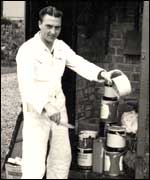
Norman
was 23 at the time of floods, and had just come out of the forces
after doing National Service. He was working at the Beach hotel
at the time decorating the palm lounge. Mr Ted Corey, Norman's
boss, came and paid Normans wages. Ted said not to work
too late as the wind was getting up. Norman worked till about
4.15pm. All of sudden the doors that led to the beach blew open.
The wind was so horrendous the wind blew him back. The sea was
at the highest Norman had ever seen. Norman tried to shut the
doors but they wouldnt. |
"
I tried to wedge them shut with a chair. With that I packed
all my stuff up which by this time was half past four. I set
off up the high street to get home to my wife and child, whos
birthday was the day after the floods. The wife said that the
pram had been blown over. Mr Copeland had helped her home with
it. She then said wed better get the baby bathed. The
bath being in the front room in front of the fire. The water
was starting down the passage of the house. I went out to try
and brush it back. All of a sudden the carpet in front of the
fire started to bubble up as water was coming through. I told
my wife to take the baby upstairs straight away. Within five
minutes there was a foot of water and the wife shouted could
I grab some food and a bottle of milk for the baby. I went into
the pantry to get the milk and by this time the water was at
the top of my knees. By the time I got to the staircase the
water was about four foot. All in a very short time. The baby
got some milk and I managed to get a small fire in the bedroom.
We got the baby to bed and kept an eye on the water all night
to see how high it was coming".
"The next morning, after a horrible night, I said to the
wife, "You stop here Im going down to see how my
parents are". I put waders on and set of in about four
foot of water - nearly up to my chest. It took a good hour to
do what was normally a seven minute walk to get to the bottom
of Trusthorpe road where my father, mother, and two sisters
lived in a three story house. Having got there freezing cold
theyd all been taken out and gone. I made my way back
to the beach hotel and went past Winters building lorry
stuck at the side of the road. I made my way home to look after
my own family". |
|
|
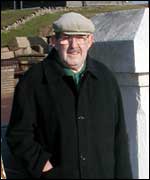 |
| Ronald
Michael Taylor |
He
was 18 years old at the time of the 1953 floods. He remembers
it as being horrendous!
Army Duks fitted electric pylons for workmen to do their work.
At
the time of the floods he was an electricity board employee apprentice
electrician trying to help restore power to the area.
|
|
|
Lillian
was living in Sutton at the time of 1953 floods. She was 23
at that time and lives in the same house today. With no warning
she realised at 7pm on the night that here house was under 4
feet of water. She went upstairs where she had two babies to
look after. The power had gone off and she had to search for
candles.
The water was still high the next day. The army were walking
around with long poles to find depth as they did not know where
the dykes were. The community were taken to the cinema for food
and drink and then evacuated to Alford. Lillian stayed in Alford
for 24 hours and was then taken to Nottingham. She remembers
people in Alford being very hospitable. |
Have your say on the floods - email lincolnshire@bbc.co.uk
|
|
|
He
was a part-time fireman in 1953. He was the first emergency
service down there with a crew of just 5. They thought they
were going to pump out a pub but it was a bit different when
they got there! Someone shouted "in here" from a bungalow, the
crew went in and there was an old man sat on a table. They rescued
him and then had to go back for his bottle of whisky! Altogether
he helped evacuate hundreds from Mablethorpe and Sutton to Alford
and Louth. |
|
|
|
Nev
was an RAF policeman stationed at Manby and Strubby. He remembers
taking people out of windows by ladders onto a flat back truck
- people were refusing to come out because they thought the
floods were safer than the truck! One man with a beard down
to the floor died from exposure after they rescued him. The
Cross Keys Inn became a temporary mortuary for those who died
- every time the tide came in the bodies would float around.
He also rescued 2 old ladies in a bungalow who were sat on top
of furniture - they'd been there for over 24 hours. He worked
solidly from Saturday night till Monday night without sleep. |
|