SPERM AND EGG DONATION - THE PROCEDURE
Donor eggs are in greater demand than sperm. Yet unlike sperm donation, the procedure offers no payment to donors and is
far more complicated.
Although there has always been a plentiful supply of sperm
donors in the form of students eager for the £12 payment, less sperm
is now needed.
Sperm versus the egg
There are new techniques which can extract a single healthy
sperm from a man with a low sperm count, thus reducing the need for donors.
Many clinics, including the University of Bristol Centre
for Reproductive Medicine, now buy sperm from a sperm bank rather than
from donors themselves.
This sperm is frozen for six months and then tested for
diseases before being used.
There is a great shortage of egg donors across the UK.
It is a more involved process and egg freezing has not yet been commercialised.
 |
| Sarah
attends this Bristol clininc for egg harvesting |
No financial gain
In America women are paid for their eggs, but in Britain
it is illegal to pay for eggs and clinics can only cover expenses.
It is not an easy process. The donor has to sniff a hormonal
nasal spray for around 4 weeks followed by self-administered injections
to stimulate the ovaries to produce lots of eggs.
Blood tests and internal scans are required before harvesting.
This is done while the donor is anaesthetized.
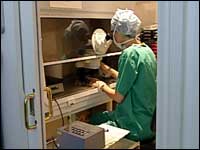
The harvesting is done with a hollow needle attached to
a pipe and a pump, guided by ultrasound. It pricks the follicles in the
ovary and sucks out the eggs.
The eggs are taken from the donor and if there are over
8 eggs they will be given to two recipient couples. These are then mixed
with the sperm and when fertilised, the embryo will be placed into the
womb of the recipient mother. |