


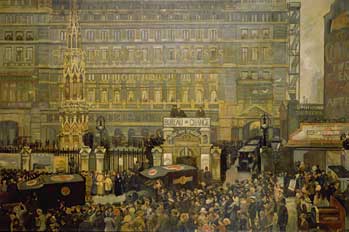
Wounded men from the Battle of the Somme arrive in London
Far from justifying the war effort, J Hodgson Lobley's view of the fighting gives a message that is the opposite of Butler's. He shows the defeated, often badly wounded, soldiers from the Battle of the Somme on their return home.
The scene is set in front of the classical facade of the Charing Cross Hotel, part of Charing Cross Station. The Gothic column in the courtyard is a recreation of the original Charing Cross built by Henry II. The Bureau de Change is damningly redundant - no holiday-makers from continental Europe will be arriving here for quite a while.
The crowds, despite this, wave flags and buy flowers to hand to the drivers of the ambulances carrying the wounded. On the right, signs by the newspaper vendor read ‘Victory on the Somme’ and ‘Great push on the Somme’.
What's going on? What can be relied on if moral and economic power has failed and the government and its mouthpieces proclaim victory, even when the evidence of their defeat is brought right under their noses?
The artist is posing a question, but the answer eludes him. The choice of location is deliberate. Charing Cross is in the very heart of London, a short distance from the seat of government. The station and the classical façade are signs of the economic power that was supposed to give overwhelming superiority in the war - the cross of the moral values that created the empire. The artist appears to be mesmerised by the façade, looking for an explanation of failure.
Published: 2005-03-15
