
|
http://www.bbc.co.uk/history/ |
| What was your locality like in the past? As you walk along the roads or streets near your home, what evidence can you see of changes that have taken place? Discover how to unlock the secrets of the past by looking at a picture postcard. | 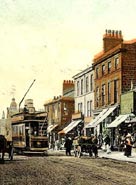 Darwen in Lancashire, around 1908
|
Postcards are attractive (usually) reminders of what life used to be like in the quite recent past - or of how it was for our parents, grandparents or great-granparents. Some can also provide unexpected insights into important events of the past - so they are worth taking seriously as historic source material.
'Postcards provide a rich source of pictorial evidence for the physical fabric of local life.'
In the late 19th and early 20th centuries picture postcards of local scenes, including urban street scenes, were produced in large quantities in every part of the country. Since many of them were kept by their recipients, they also survive in large numbers. But although they provide a rich source of pictorial evidence for the physical fabric of local life in Britain, the historian has to look at them objectively, to extract from them an accurate account of times gone by.
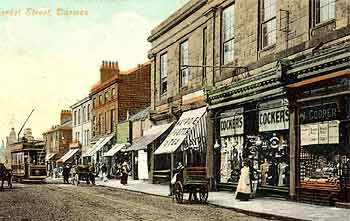
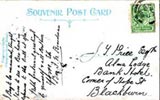
Look at the postcard of Market Street, Darwen, a small town just south of Blackburn in Lancashire. The precise date of the photograph is unknown, but it was sent to an address in Blackburn on 3 March 1908. The postage charge was one half penny.
A quick look at the photograph tells you a number of things about Market Street at that time:
Looking at pictures and commenting on what you see is an important part of working as a historian. For instance, you might infer from this scene that Darwen was quite a prosperous place in Edwardian times, with some high-quality shops and an impressively modern public transport system - electric trams, after all, had only begun to appear in the 1890s.
'Manchester had four times as many miles of electric tramway as London.'
And you'd be right. Darwen's wealth, like that of most Lancashire towns, was largely built on the thriving Victorian cotton industry. Here, as elsewhere, professionals and local businessmen sitting on the town council took a lead in municipal improvement, and the result was that the bustling towns and cities of the north were quick to embrace electric trams. At the turn of the 19th into the 20th century, for example, Manchester had four times as many miles of electric tramway as London.
But we also need to evaluate the reliability of the picture as a source of evidence. Why were these particular images chosen to put on the postcard? What impression were they designed to make?
Well, you might point out that only part of the street is shown - perhaps the smartest part. Some very respectable shoppers are shown (were they carefully posed?), and colour has been added to enhance the richness of the scene. What was the industrial part of town like? Or the residential streets where millworkers lived? These are not shown.
You might reflect that the makers of this postcard wanted to present a rather grand and prosperous image of the town, to impress the viewer, attract potential visitors and bring in more tram passengers and shoppers.
Look again at the road surface. The Market Street setts may appear a little uneven in places, but they seem to have provided an adequate surface for horses, carts and trams.
It would seem that setts were used as a road material from the mid-Victorian era onwards, even though newer methods of road construction using broken stone had been available since well before the mid-19th century.
Setts like these ones still lie buried beneath the tarmac roads of many English towns and cities. So why were they replaced during the later 20th century? Well, tarmac may not have looked as nice, but it was quicker and cheaper to lay and - just as important - much less of a headache when ever-increasing wear and tear, and the growing need for under-street services carried in pipes and cables, meant that road surfaces had to be regularly dug up and re-laid.
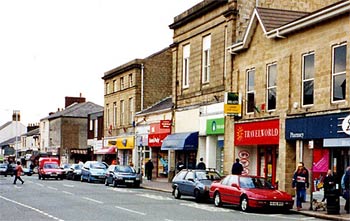
Now have a look at a photograph of the same street scene today. Of course, there have been some major changes. Part of the range of shops shown in the right foreground of the Edwardian photograph has been demolished and replaced by a much less impressive building. (A historian might ask what this suggests about the relative prosperity of the local economy in later 20th-century Darwen, or even about the changing role of municipal authorities.)
There are other obvious changes. Canvas awnings have given way to metal and plastic shop signs, the high street is congested with cars, the tramway is gone. In other respects, however, the impression is one of continuity. It's recognisably the same place.
The layout of Market Street and many of the buildings have not changed much since Edwardian times. As in many other 21st-century town centres, what we see here is in many ways an ageing late-Victorian townscape, with just a thin covering of modernity.
Published on BBC History: 2005-01-31
This article can be found on the Internet at:
http://www.bbc.co.uk/history/trail/htd_history/evidence/hist_clues_post_darwen_01.shtml
© British Broadcasting Corporation
For more information on copyright please refer to:
http://www.bbc.co.uk/history/about/copyright.shtml
http://www.bbc.co.uk/terms/
BBC History
http://www.bbc.co.uk/history/