The Japanese ingredients set to transform your cooking
From sushi and rice balls to ramen and fried chicken, Japanese food can be easy to make, and lots of the ingredients might already be in your cupboard. That’s because staples, including soy sauce, sesame oil and miso, are widely available, and some other everyday condiments such as tomato ketchup, Worcestershire sauce and curry powder are surprisingly popular in Japanese cooking. So what are the essentials and which dishes should you cook first?
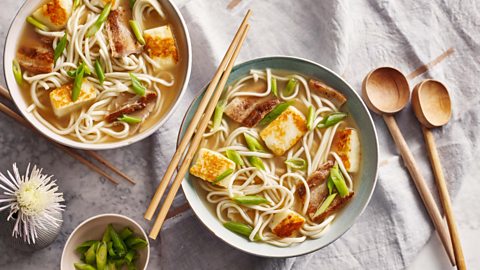
Udon, ramen, soba and somen noodles
Noodles make up a huge part of everyday Japanese eating. They vary not only in shape and size, but also in the flour they’re made from, which can be anything from wheat or rice flour to buckwheat or even potato and sweet potato flour.
You’re likely to come across four types of Japanese noodles. Ramen noodles are thin and wheat-based, usually slurped from a bowl of soup. Udon noodles are thicker, chewier wheat-based noodles, and served in soups, salads and stir-fries. Soba noodles are much more delicate as they’re made from buckwheat flour – they are great in soups and cold salads. Finally, there are thin, wheat-based somen noodles, which are also often eaten cold.
Which soy sauce to buy
Try to get your hands on a Japanese soy sauce (or ‘shoyu’). Shoyu can be light (‘usukuchi’), with a saltier flavour, or dark (‘koikuchi’), with a more rounded (though not necessarily stronger) flavour. A Japanese recipe calling for ‘soy sauce’ will usually mean dark, so a bottle of this or ‘all-purpose’ Japanese soy sauce (some of the most popular brands on British shelves are good all-rounders) is likely to be all you need. This is the opposite of Chinese recipes, where light soy sauce is for general purpose and dark is specified.
While Chinese soy sauces are traditionally made from fermented soybeans, which gives them a sharp saltiness, Japanese soy sauces tend to be made from a blend of soybeans and wheat, and are fermented for longer, which gives them a more nuanced flavour. Shoyus that are fermented for a long time can develop all sorts of interesting flavour profiles.
Tamari is another type of soy sauce you might see in recipes. Traditionally it was a by-product of making miso – as the soybeans ferment to make miso, they release a fermented liquid, which is tamari. It has a salty flavour, closest to Chinese light soy sauce. In the UK, tamari is often marketed as gluten-free soy sauce, and is usually 100 percent soybeans, though it’s always worth checking the label. If you need a replacement for tamari and gluten isn’t an issue for you, Chinese light soy sauce will do the job.
Omu-rice
Soy sauce is a core ingredient in this popular Japanese dish of an omelette filled with rice and topped with a red wine sauce or tomato ketchup.

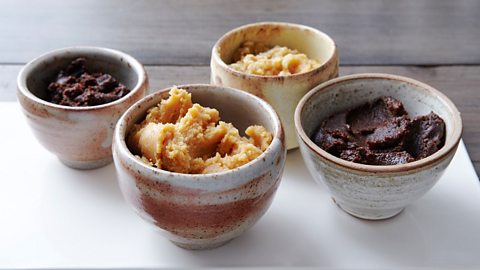
Choosing miso
There’s plenty to be written about different misos, but in essence, standard miso is a fermented soybean paste. It comes in various colours and flavours, from mellow white to punchy dark brown and red, but if a recipe just says ‘miso’, white miso is likely to be the best option.
To make miso, soybeans are cooked, salted and mixed with a specific mould called aspergillus oryzae or ‘kōji’, then left to ferment for months or even years. The fermentation breaks down the basic elements of the soybean into a range of salty, earthy and umami (strong savoury) flavours. The colour difference comes from the length of the fermentation, but generally the darker the miso, the stronger the flavour and the longer the fermentation.
Miso is almost always made from soybeans, but the kōji is often cultivated on rice or barley, which adds a different flavour to the mix. If you’re allergic to soy, you can find chickpea miso.
Sesame oil: roasted or unroasted
Rich, nutty sesame oil is delicious in marinades, sauces, salad dressings and more. A deeper colour typically means the seeds have been roasted before being pressed, which gives a richer sesame flavour but tends to burn at lower temperatures so it shouldn’t be used for cooking. Even light sesame oil can have a strong flavour, so use it sparingly.
Short-grain Japanese rice
Rice is the bedrock of Japanese cuisine, and with terms like ‘sushi rice’ and ‘sticky rice’ it can seem like there are lots of types. In reality, broadly speaking, only two are used – Japanese short-grain (‘uruchimai’) for most everyday cooking, and glutinous rice (‘mochigome’) for sweet dishes such as mochi.
Unless you’re making sweet dishes, Japanese short-grain is all you need. It has a much higher starch content than long-grains like basmati and jasmine rice, and this gives the stickiness that characterises Japanese rice dishes. It’s important to wash excess starch from the rice and to cook it gently so it doesn’t get mushy.
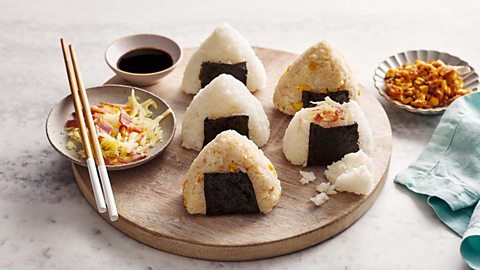
Onigiri
Onigiri are Japanese rice balls with a savoury, salty or sour filling, usually enjoyed as a snack or light meal. The fillings can be anything you like – mild cheddar and chopped cooked bacon, flaked salmon or edamame beans also work well
Sake versus mirin
Sake and mirin are both Japanese rice wines, but they are fermented for different purposes. Sake tends to have a higher alcohol content and is brewed primarily for drinking, though is often called for in dishes. Mirin is sweeter, with much less alcohol, and is brewed for cooking. ‘Hon-mirin’ is the real deal, while ‘aji-mirin’ has sweetness added artificially.
Chicken karaage
Sake flavours this Japanese fried chicken

Rice vinegar
Rice vinegar (or rice wine vinegar, they’re the same thing) is what you get when rice wine is converted into vinegar. It’s sweeter and more delicate than western wine vinegars. It brings a gentle tang and sweetness to Japanese dishes and salads, and is used to season sushi rice.
Shichimi tōgarashi
Often just referred to as ‘shichimi’, this spice blend is commonly used in soups and as a seasoning on rice and noodle dishes. ‘Shichi’ in Japanese is the number seven, which refers to the seven components that make up the spice mix – dried red pepper flakes, orange zest, black and white sesame seeds, ground ginger, seaweed and poppy seeds.
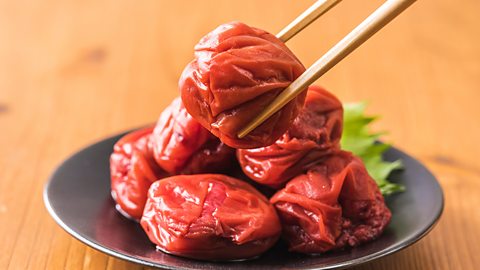
Umeboshi
Ume plums are picked in their thousands every summer and packed into barrels with salt, which extracts liquid from the ume. They are left to pickle in their own sour, salty juices (in a similar way to sauerkraut), then to dry and shrivel in the sun. The result is umeboshi – an intensely sour and salty pickled plum that is in a wide variety of traditional Japanese dishes. A small amount added to a dish (typically rice dishes) brings seasoning and depth of flavour.
Bonito flakes
Bonito flakes are small shavings of dried, smoked tuna. To make them, fresh tuna is poached, then smoked, then fermented and left to dry and before being shaved into the flakes. Called ‘katsuobushi’ in Japanese, bonito flakes have a strong, smoky, umami flavour and underpin a lot of Japanese dishes.
Bonito flakes and kombu are the main ingredients in dashi – a light stock used to make all sorts of Japanese dishes. Chef Shuko Oda mixes bonito flakes with soy sauce to make a filling for her onigiri rice balls.
Kombu and nori
‘Kombu’ is dried, edible seaweed. It is used with bonito flakes to make dashi, and is often cooked and eaten afterwards. In Japan, you’ll find kombu pickled, braised, made into tea and even ground into seasoning powders.
Kombu usually comes in large, dried sheets. Though we think of kelp and seaweed as being ‘seafood’, kombu doesn’t have a fish or seafood flavour. What it brings to Japanese dishes is a savoury depth of flavour.
Nori is the paper-thin seaweed square that is wrapped around sushi rolls. It is made from a different type of algae from kombu, and processed in a different way – the fresh seaweed is shredded before being pressed into wafer-thin sheets and dried. It has a mild seawater saltiness and umami, nutty depth of flavour. There are endless nori snacks in Japan, and it’s often blended and combined with sesame, bonito flakes and other ingredients to make a savoury rice seasoning called ‘furikake’.
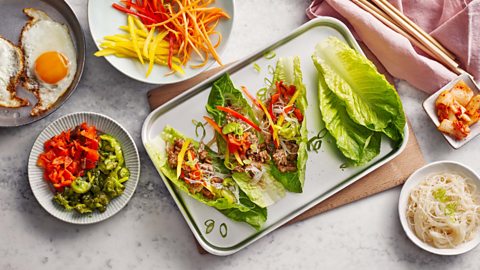
Lettuce wraps with miso pork
As long as the main components of this dish are present (miso pork, lettuce, rice, garnish) you can have as many other fillings as you like
Originally published July 2021