How to ice biscuits like a pro
Iced biscuits, with beautiful and bespoke designs, make great gifts for special occasions. Here's how you can make them at home.
By Kim-Joy
One-of-a-kind, perfectly decorated biscuits are often what you’ll see lining the displays of fancy bakeries. These painstakingly painted treats are popular as presents and for serving at parties – but they aren’t always cheap and they may be a little generic.
You can create your own thoughtful, personalised treats at home with very few special ingredients or tools beyond food colouring and your imagination. Even if you don’t think of yourself as particularly artistic or steady-handed, there are a few simple tricks to get a really impressive result.
Forget fancy equipment
Good quality, pricier piping bags have no place here. You want ones that are flimsier and easily scrunchable – they don’t have a visible seam running down the length which otherwise would get in the way when piping.
Alternatively, make your own environmentally friendly piping bags from a baking paper. They are a little bit more prone to leaking, which could give you rainbow, sticky hands.
Rather than using metal piping bag tips I just cut the tip off the piping bag instead. You can cut a smaller opening for detail work and a larger one for flooding (colouring in). If you have a piping bag with too large an opening, just put it inside another piping bag and cut a smaller opening on this one.
Always have a box of toothpicks (or something similar – like a stick of dried spaghetti) to hand to pop any air bubbles before the icing sets and to coax the icing into any tricky corners. I usually forget and will often shout over to my partner Nabil to get me one, mid-pipe!
The best kinds of biscuits to ice
Because the end result is about 50% icing, the biscuit itself shouldn’t be too sweet. A plain shortbread is a great choice, but dark chocolate or gingerbread biscuits are also delicious.
The icing and colouring
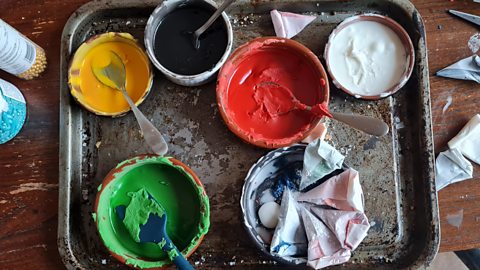
Royal icing is the best choice for drawing, fine lines, fun patterns and swirly effects. It’s made with egg white and icing sugar and sets hard so is unlikely to be squished once it’s fully dry.
When mixing your icing sugar and egg white, the aim is to incorporate as few air bubbles as possible, with no sneaky lumps of icing sugar. So, if you mix your icing with an electric whisk, try to mix on the lowest speed over a longer period of time to avoid incorporating air bubbles.
If you do have bubbles it’s fine – just pop them before the icing sets, otherwise they can create mini-craters. (A lot of people find the bubble popping very satisfying.)
If you want to cheat a little, royal icing is available ready-made, so you can buy it then add your colour or adjust the consistency.
You can use fondant icing to make your base, too. Roll a sheet of it and cut it to the same shape and size as your biscuit to make a background on which to pipe. Stick the icing on by brushing the back of the fondant with a little water before applying it to the biscuit and smoothing it down.
Good quality gel food dyes allow you to get vibrant colours without needing to add too much liquid (which could make your icing too runny). But not all gel food dyes are made equal. If yours isn’t concentrated enough use more to create deep colours.
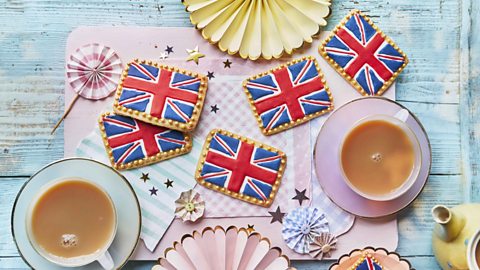
Glitzy flag iced biscuits
These iced biscuits use icing, glitter and sprinkles to make them dazzle

The consistency
The secret to keeping your icing from running off the biscuit is to get the consistency just right.
Once you’ve mixed up your icing in a bowl, drag a knife through it and count how long it takes to fill in and form a smooth service again. The nice ribbon trail should hold its form for roughly 15-20 seconds and then smooth out.
You often need to add a little more icing sugar or egg white to adjust the consistency, although add the icing sugar gradually, to avoid then having to crack open another egg.
You may want to make a stiffer icing (a gooey paste) to pipe lines and then a slightly looser icing to fill in, but once you feel confident, you can just stick with one – if it’s the right consistency, you can use this for both outlining and flooding. You will get a feel for the right consistency over time. If you’re not sure, just put a small amount of icing into a piping bag and test it out.
Line and flood
The way to get picture-perfect designs is to draw the outline of your design first and then colour it in. This will create a nice tidy line (like a lipliner) and help prevent the icing from running over the side.
Instead of dragging the tip along the biscuit like you would with a pen on paper, you only squeeze the icing directly onto the biscuit at the start (and potentially end) of a line, for the most part, make sure you’ve lifted the tip of the piping bag so it’s not touching the biscuit and guide the line into place from above.
The good thing is, if you make a mistake, you can just scrape it off and start again.
Once you’ve created an outline, it’s time to ‘flood’ it, which just means filling it in and keeping inside the lines. Then use your toothpick (or similar) to pop any bubbles and nudge the icing into any corners. Work quickly and do this before the icing starts to set.
If you want to create areas with a distinct line between them, let the first area set (which takes about an hour) before piping the adjacent area. Otherwise they might end up merging.
You may want to pipe on top of an iced background – for instance when I was creating Eurovision cookies and designing a detailed flag like the Union Jack. If you do this, then once again make sure the first layer has at least semi-set before you do the next.
If you’re not confident about piping, it helps to let the first layer set completely overnight, so that you can scrape off any potential mistakes on the second layer without affecting the first.
Setting time
The more humid it is, the longer your icing will take to dry out. But generally I find if I leave it out overnight (exposed to air, uncovered and never in the fridge), it will be completely set in the morning. A very low fan oven (the lowest it will go), a dehumidifier or a fan will help the icing set faster.
Royal icing can quickly form a hard skin on the surface, but still be soft underneath. So even when you can lightly tap the surface and not create an indent, don’t assume it’s set all the way through. This semi-set stage is fine for piping details on top, but not really for packaging and gifting.
Customising your biscuits
Now comes the fun bit: sprinkles and edible glitter! You can use chunky edible glitters that create good texture but don’t sparkle as much, or fine dust-like edible glitter, which has amazing sheen.
To make sure the fine glitter sticks, you just need to first dampen the surface of your set or semi-set icing with a brush and a very tiny amount of water. Often, the glitter will stay put long enough if you brush on with a dry brush.
Anything around the border, like little dots or sprinkles, will help make your design ‘pop’ because it’s like putting a frame around a picture.
And finally, remember, have fun with your designs and if, they all go wrong because of the consistency of the icing, or because you run out of piping bags, or all your colours merge, you can still have a great result if you cover it all in sprinkles and edible glitter!
Originally published May 2023