Baked beans, bao buns and pancakes: How footballers stay fuelled during the Euros
Some teams will be in Switzerland for more than a month, so let’s hope they like the food on offer…
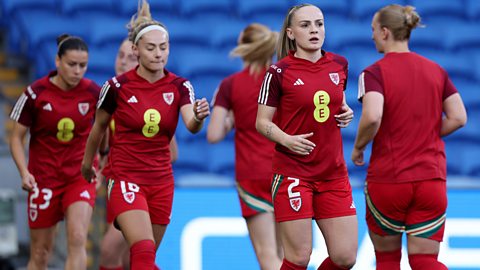
This article is part of the BBC's Women's Summer of Sport. Keep up-to-date with all the matches, competitions and sports news on BBC Sport, BBC Sounds and BBC iPlayer.
The Women’s Euro 2025 competition takes place throughout July and you can watch games live on BBC iPlayer.
Defending champions England will be there, alongside Wales who are competing at a major tournament for the first time.
Only one team will get their hands on the trophy and winners’ medals at the end of the month – but if it were up to us, all the teams’ chefs and nutritionists would get a fancy hunk of metal hung around their necks too. They’re the ones responsible for fuelling the squads.
“Our chef Greg is incredible,” says Wales’ defender, Lily Woodham.
“He makes going to play in another country a breeze,” adds forward Elise Hughes. “He flies out the day before and just sorts all the food out.”
Here’s how the experts make sure players are satisfied at mealtimes and successful on the pitch.
Eat more to play better
Dr James Morehan was the women's lead performance nutritionist for the Lionesses 2017-2021. He made it his business to get the players to eat more.
“We did in-house research looking at the [physical] demands of tournament football at international level versus the most intense club football demands. It’s about a 33-35% increase.
“You might have six or seven games within a short window – there’s no club exposure that mirrors that in women’s football, or in most sports. If players continue fuelling and recovering in the same way they do at club level, then a couple of days into the camp they’ll feel so fatigued.”
Make it fun
“We include players’ favourite dishes, theme nights, live cooking stations, and seasonal dishes to keep things fresh,” says Chanel Williams, nutritionist for the Football Association of Wales (FAW) and PAS Nutrition.
“Bao buns with pulled beef are a big hit in camp at the moment, so we’ve added them to our dinner menus – they’re a great source of protein and give us something to look forward to after a long day!”
The food and environment can be so uplifting that they inspire players to be more adventurous with what they eat.
Hughes agrees: “I used to be really fussy as a kid, just all beige food, white potatoes, plain chicken breasts. It was [international football] camps that helped me expand my palate. Now I eat anything, which is brilliant.”
9 meals and snacks for strength training
Inspired to adapt your diet to help you improve your strength? Click on this article and discover the dishes that experts recommend

Go crazy for carbs
When competing for Wales, midfielder Josie Green explains: “We’ve been in nutrition talks where they show you how many carbs you need to eat and it’s always a lot more than you’d think.”
Carb consumption among teams is something Morehan has investigated. In one 2022 study looking at the nutrition requirements of women footballers, he found many players weren’t getting enough.
“The Lionesses nailed protein and fat – but this came at the expense of carbohydrates. It was like trying to run a Formula One car but with a quarter of a tank of petrol.
“In one match, I only had one player in the starting 11 who hit the recommended intake of carbohydrate for matchday performance. It was a massive education piece for the team,” says Morehan, who points out that diet culture can cause people to go easy on the carbs. “Carbs don’t make you fat, they fuel winning performances.”
Foolproof spaghetti carbonara
Pasta is a popular choice the day before a game as it delivers on the carbs
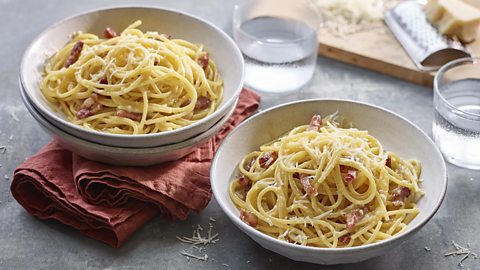
Morehan uses interesting tactics to up carb intake, focusing on the layout of the food at mealtimes.
“We’ll put carbohydrates directly next to each person’s plate. It’s all to do with nudge psychology – you go with what’s next to you.
“Likewise, if a chef has a live cooking station doing pasta dishes the day before a game, you’re going to get a massive increase in carbohydrate content.”
BBC's Women's Summer of Sport
Keep up-to-date with all the news from the Euros on the BBC's Women's Summer of Sport page

What players will be eating at the camp
Training day
“On training days, we incorporate more snacks between meals and around their sessions because they’re burning so many calories between the gym and the pitch,” explains Williams.
“Supplements-wise, a few of our essentials include protein shakes after training and hydration supplements pre and post sessions. These contain polyphenols to help with muscle soreness.”
Breakfasts on these days will be all about toast, porridge, eggs, fruit and cooked breakfasts of beans, mushroom, tomatoes – and broccoli.
Lunch and dinner will see the likes of beef stir-fry, chicken burgers and salmon with potatoes served up.
In between meals, athletes will snack on protein bars, rice cakes, and some fruity bakes, like banana bread.
The day before a game
“This is one of the most important days when it comes to nutrition – our main focus here is maximising our muscle glycogen (energy) stores ahead of the match, so all of the players’ meals, snacks and drinks have a higher carbohydrate content to help us achieve this,” says Williams.
Getting technical, Morehan says, “The goal on that day is to take players up to about six grams of carb per kilogram of body weight.”
On these days, carbs play a starring role. Pasta and jacket potatoes are popular choices, and lighter meats like chicken and turkey will be paired with plenty of carbs, including rice.
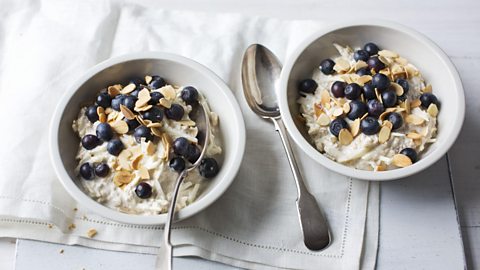
Overnight oats
The day before a match is a time when players need to carb up!
Matchday
“Our meal timings will change depending on kick-off time,” says Williams. “If it’s a later kick-off, the players will sleep in a bit longer for recovery and our meals will start slightly later. The pre-match meal is always three hours before kick-off to allow enough time for digestion.”
While it’s key the players have enough energy to play, it can be a balancing act. They don’t want to be so full they feel sluggish.
So, as well as their food, lots of players will have orange or apple juice before a game as it comes with 20g of carbs – “two glasses has a similar amount of carbs as a jacket potato,” says Morehan.
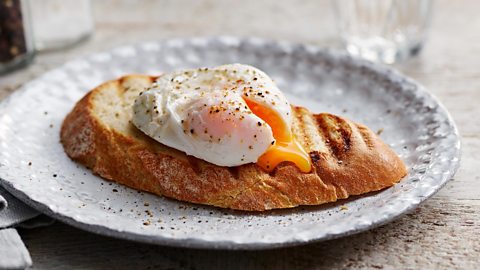
Poached eggs
Poached eggs are a popular breakfast choice, but if nerves make eating difficult, players might just have toast and juice
If there’s time for lunch, the players will opt for something light, avoiding high-fibre foods and anything spicy that could make them feel uncomfortable later when they’re running around the pitch.
“The stadium dressing room is stocked with snacks, hydration drinks and supplements like caffeine gels to support performance, which we top up at half time,” says Williams.
“Then afterwards there are recovery shakes and a post-match meal to help the players refuel before another week starts. This is especially important when there is a short turnaround between games!”
Watch Wales and England compete at the Euros 2025 live on BBC iPlayer
Want more? Visit BBC Food on Instagram, Facebook and Pinterest or watch the latest Food TV programmes on BBC iPlayer.
Originally published June 2025