How to recreate classic Christmas market treats at home
Love all the festive feels of continental-style Christmas markets? Inspired by Nigella’s Amsterdam Christmas special, we’ve put together the ultimate guide on conjuring up those festive flavours indoors.

Nigella is back on BBC One and BBC iPlayer this December, for a Christmas special set in the aptly festive and twinkly Dutch capital.
Nigella’s Amsterdam Christmas, which will hit our screens on 21 December, is choc-full of the sights, sounds and flavours of the world-famous city at the most wonderful time of the year. This, of course, includes its festive markets. “You can’t go to Amsterdam at this time of year without going to a few of their Christmas markets,” says the TV cook and food writer. “Just magical!”
If the cold, dark weather dampens the magic a bit for you though, or if getting to a market just isn’t an option, fear not – you can conjure up on a very similar flavour of festive spirit from the comfort of your own home. And Nigella herself is in full support of this option.
“What I love is that sense of cocooning at home cosily when it’s cold and dark outside. There’s a warm glow that comes from fairy lights and candles that is utterly transporting. All I want to add to that is good food, my family and my friends.”
Here’s what to make, so you can dish up all the festive feels of a continental Christmas market from your own cosy kitchen.
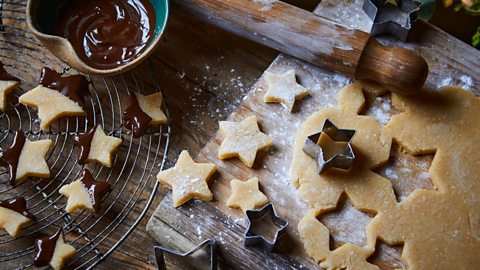
Lebkuchen
“In Freiburg there was always a Christmas market in town,” says Jurgen Krauss, former Bake Off contestant and author of recipe book German Baking.
The celebrity cook hails from the Black Forest in Germany, the country responsible Christmas markets (hence why so many food stalls are focussed on food from Germany). He has fond memories of eating gingerbread at the markets.
“Gingerbread is a big thing and there’s two types of lebkuchen. The first is soft and highly spiced with lots of lemon peel and either a chocolate coating or sugar glaze.”
These are straightforward to make: you heat honey and butter before adding to dough along with lots of spices, shaping it into flattened balls and baking for 15 minutes.
Lebkuchen
You can decorate these easy biscuits in lots of ways, including with chocolate or icing
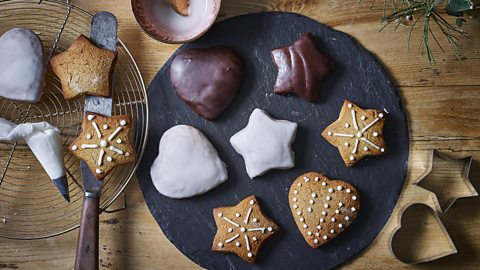
“The other is the large lebkuchen hearts, which is a completely different process and can take about five days to make,” says Krauss. “It’s a multi-stage process, but isn’t too daunting. You just need to make a starter with rye flour, molasses and honey, and leave that in the refrigerator for three to five days. It’s not something you can just throw together at the last minute!”
Pretzels
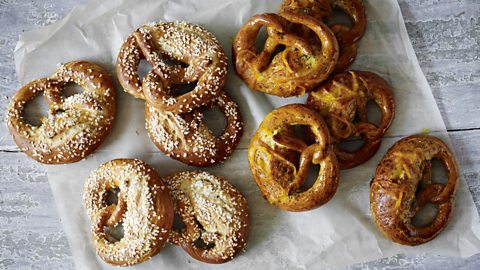
A shiny-crusted, pillowy soft pretzel is another of Krauss’ favourite market treats. He even teaches classes on how to make them. Although they can take a long time to make with traditional methods – you’d want to cold-proof the dough overnight – Krauss says you can cut that step and just let them rise for a while in a warm kitchen, meaning they can be ready in under two hours.
“First you make your dough, let that rise for an hour, then shape the dough into its signature style before letting them rise again for a short period. You then need to dip them in water with bicarbonate of soda and top with salt flakes before baking.”
Pretzels
Pretzels are pretty straightforward to make – the most time consuming part is perfecting the shape
Marzipan
“Growing up in Germany, the quality of the shop-bought marzipan was so high we would never make our own,” admits Krauss, who was a big fan of the versions sold at Christmas markets, shaped to look like small potatoes.
He says it can be incredibly simple to make: “You just really need to grind up almonds finely, add icing sugar and a little bit of rosewater.”
However, if you want to make something special, you can expand on this by adding flavours like lemon zest, brandy or kirsch and of course, chocolate.
Marzipan
Homemade marzipan is a revelation and certainly worth the small effort involved in making it
Currywurst and bratwurst
“A Bratwurst is essentially an umbrella term for any kind of sausage that’s suitable for frying or grilling,” says German food and drink writer Christie Dietz.
“If you’re at a Christmas market they'll all serve up a decently proportioned plain pork bratwürst with a crusty white roll and optional mustard and ketchup. However, there are countless variations, primarily regional ones often available too.
“Currywurst, meanwhile, is a dish that originated in Berlin in the 1940s and ’50s: a finely-ground, pre-boiled pork bratwurst served sliced and covered with tomato sauce and curry powder and usually fries.
Fancy cooking up your own bratwurst at home? “It can be treated in the same as any other grilling or frying sausage available in the UK,” says Dietz. “Oil or some other fat is necessary to prevent sticking in the pan, and it should be evenly browned on all sides. The main difference between a bratwurst and a British banger is that there’s no filler in them, so they are much fattier and juicier (and naturally gluten-free). For currywurst, grill or griddle the sausage for nice, charred stripes and slice it into chunks after cooking.”
As for currywurst sauce, it’s a good idea to use the best ingredients you can manage. “There is only a handful of them and it will really make all the difference,” says Dietz. “Tomatoes are the main ingredient, so opt for passata and tomato paste over ketchup if you can.
Glühwein (mulled wine) and boozy hot chocolate
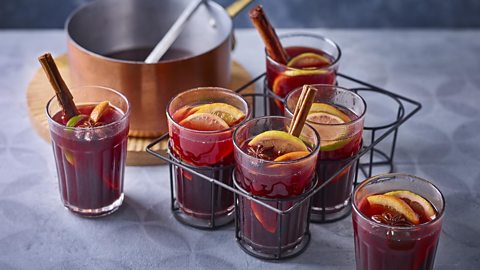
No Christmas market trip is complete without a hot, festive drink. For a classic mulled wine, Mary Berry advises you give your mix a quick boil followed by a slow simmer to extract all those lovely spice and citrus flavours. Alternatively, you could turn to your slow cooker and warm it on low for a couple of hours to let those aromatics fully infuse the wine.
Mulled apple cider is another great option if wine isn’t your thing.
In recent years, boozy, thick hot chocolates have also started appearing at Christmas markets and they’re easy to replicate, says Ryan Chetiyawardana, founder of the Lyan group of bars. He suggests gently heating a litre of whole milk before adding 10g corn flour, 100g golden caster sugar and 200g grated dark chocolate. “Whisk to dissolve and thicken but don’t boil. Decant into five mugs and add a glug of your chosen booze.”
You could leave out the alcohol if you prefer and, likewise, if you want a non-alcoholic mulled-wine, or winter cup, drinks expert Jassy Davis has a great recipe with a couple of unlikely ingredients.
“I use a mix of English breakfast tea and pomegranate juice. The tea is steeped for 20 minutes to make sure it’s strongly brewed, which gives it a robust tannic flavour. Combined with tart pomegranate juice, it makes a rich, gutsy stand-in for red wine.”
Winter cup
Packing a flask for the whole family? You can get all the flavours of mulled wine without the alcohol by making this hot drink
Watch Nigella’s Amsterdam Christmas on BBC One, 21 December at 8pm, or catch up on BBC iPlayer.
Originally published December 2023