Why 3D printed food is set to go mainstream
By Sue Quinn
For decades, sci-fi programmes and films have featured food replicators that generate meals at the touch of a button. But such technology is no longer the stuff of futuristic fiction – it’s here now in the form of 3D food printers.
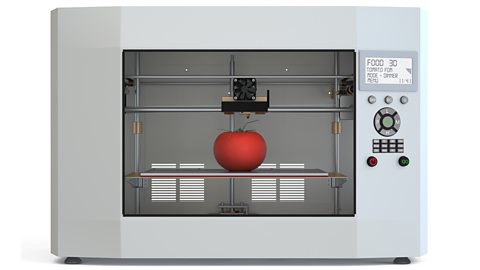
It was back in the ’80s when experimentation began with 3D printing. Originally designed to create prototypes and custom parts for manufacturing, it has been adopted in all kinds of industries over the last four decades – including food.
Meal bars tailormade for specific nutritional needs, healthy chocolate and fancy meals made from food waste have all been successfully created by 3D printers, meaning these futuristic machines could have game-changing potential in food production.
“3D printed food could transform cooking,” says Hod Lipson, professor of innovation at Columbia University and creator of the first 3D printer used for food. He and his team at the university’s Creative Machines Lab are not only printing the likes of dough, meat, vegetables, sweets and chicken – they’re also cooking it with lasers.
“The technology marries software and food,” Lipson says. “Both are big parts of our lives and neither are going to go away. I’d predict 3D food printers will be common in domestic kitchens in some form in five years’ time.”
If that sounds optimistic, consider this: a recent report by Zion Market Research predicted the value of the global 3D food printing market would triple to $1.65bn (£1.29bn) by 2030.
How is food printed?
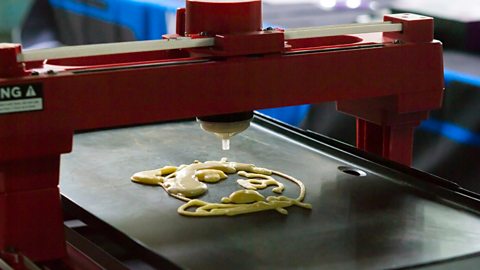
3D printers are machines that use complex software programmes to create three-dimensional objects from digital designs.
“The idea is that you load up a 3D printer – which is really just a machine with cartridges and nozzles – with printable ‘inks’,” Lipson explains. “These ‘inks’ are edible ingredients made into gels, pastes, liquids and powders, which are extruded through the nozzles.”
Dots of ‘ink’ are deposited on a surface in a pre-programmed shape, then multiple layers are added to build a three dimensional object. (That’s why 3D printing is also known as ‘additive manufacturing’.)
Until recently, 3D printers could not cook food, so ingredients were restricted to those that could be eaten straight off the printer, like chocolate. But Lipson’s team has developed a 3D food printer that also cooks with lasers, creating entirely new dishes and textures
Recently, his team printed a cheesecake with a base made from sweet crackers and a filling of chocolate spread, banana, cream cheese and icing. Not only was the dish a success, but it also tasted more complex and interesting than standard versions.
This raises the possibility that 3D printing could open up whole new ways to enjoy food, and it’s all to do with the printing process itself.
The future of printed food. audio
Scientists in America have created a seven-ingredient 3D cheesecake (Image: Jonathan Blutinger)
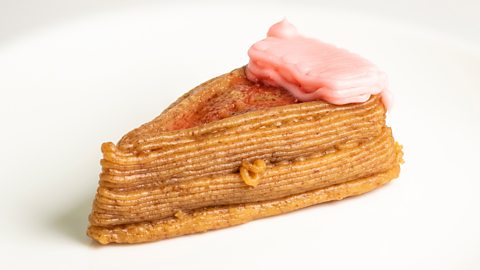
“Because of the way the cheesecake has been layered and constructed, you taste the ingredients in completely different ways based on how they’re interlaced in the food,” explains Dr Jonathan Blutinger, postdoctoral researcher in the Creative Machines Lab.
Nutrient-boosted food
Printed food can be totally customisable – not just in terms of looks, flavour and texture, but also nutrition. Cartridges can be loaded with required amounts of fibre, protein, carbohydrates and other nutrients, for instance. It’s this capability which the Zion report predicts will push it mainstream.
“This is especially applicable to people suffering from severe medical conditions like diabetes, where calorie and sugar intake has to be controlled,” the report says.
In fact, the US army has already trialled the technology to print meal bars that could optimize the performance of soldiers in specific situations or address the needs of individuals, while Nasa has funded research into ways 3D printers might make nutritionally optimised food in space, where cooking is not an option and storage is limited.
Healthier chocolate
New research into the way chocolate melts in the mouth could lead to 3D printers being used to make healthier bars that taste just as good as standard ones. Researchers at Leeds University believe this could be done by printing bars with high-fat layers on the outside and lower fat inside, which would reduce the overall fat content without lessening the silky, melting sensation that makes chocolate so enjoyable.
Professor Qingrong Huang, a food scientist at Rutgers University in the US, is particularly enthusiastic about this potential to customise chocolate. He’s developed a low-fat chocolate using the technology and is working on a low-sugar version, as well as bars containing potentially therapeutic ingredients such as orange peel, tea and turmeric.
He too believes that 3D food printers will be ubiquitous in the kitchen in the near future, and we will be able to print chocolate, meal bars and other foods in whatever shape, flavour or nutrient profile we desire.
“The major advantage of 3D food printing is that you can personalise food according to your nutritional needs or taste. The printer will sit in your kitchen right next to the coffee maker, and you’ll be able to make whatever you want.
“I call it a revolution in the kitchen.”
Greener food production
3D food printing could also transform industrial-scale food manufacturing, according to Dr Vincenzo Di Bari, assistant professor in food structure and processing at Nottingham University. Instead of enormous factories that serve a large area, food could be printed on a smaller scale, locally.
“Food manufacturing is centralised in huge plants and then distributed across the world, and we know from recent food shortages that these sorts of supply chains can be severely disrupted,” he says.
Smaller, regional 3D food factories could address this problem, he thinks, and at the same time lower the carbon footprint of our food.
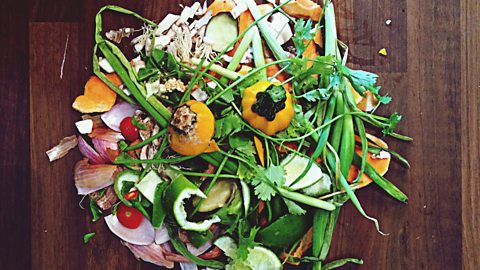
3D printing could also help cut food waste. Some companies are experimenting with ways to create dishes from food that would otherwise be thrown out, like vegetable peelings, stale bread and overripe fruit. Using the design capabilities of 3D printers, they’re turning unappealing waste into visually enticing plates of food.
The future
A small number of tech-savvy bakeries, chocolate manufacturers and sweet shops already use 3D printers to make elaborately designed products. And restaurants have experimented with the technology too.
Alternative meat producer Redefine Meat recently launched a plant-based ‘steak’ with the marbled appearance and fibrous texture of the real thing using a 3D printer.
But what about home kitchens? 3D food printers are available now, but mainly aimed at commercial use. One printer, for example, costs around €6,000 and is about the size of microwave. It’s being used by chefs and in nursing homes to make food for elderly people who suffer with dysphagia (swallowing problems).
“We do believe that 3D food printers will become a common kitchen appliance,” says Lynette Kucsma, co-founder of 3D printer manufacturer Natural Machine. The brand’s standard 3D food printers are already available to buy, but appliances that can cook as well as print are still in development, so don’t expect them to be in home kitchens in the very near future. “I would say we’re looking at 10–15 years for that,” she says.
Despite its potential and near readiness for domestic retail, Lipson doesn’t think the technology will ever replace conventional cooking: “3D printing is no way to make a salad,” he says.
But he does believe that before 2030, 3D printers designed for specific purposes – for example, making meal bars – will be commonplace. The technology is there, but the market is not yet ready for it, he says. For 3D printers to be an everyday appliance, they need to be affordable and printer-friendly ingredients and recipes readily available.
“It’s like having a music player without access to music,” he says. “We need the music store and the songs – but it will happen.”
Originally published April 2023