| 27 November 2014 |

|
|
| BBC Homepage | | |
| |||
| Contact Us | | |
ProfilesYou are in: Derby > People > Profiles > John Flamsteed: Astro Genius 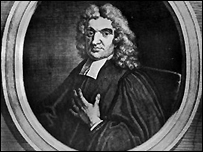 John Flamsteed John Flamsteed: Astro GeniusDerby's John Flamsteed was responsible for some of the most important astronomocal discoveries ever made - as well as a major fall-out with Isaac Newton! Denby-born John Flamsteed's impact on the world of science is still felt to this day. Born the son of a maltster in August 1646, Flamsteed was educated at Derby Free Grammar School and his prodigious talent for astronomy led to a dazzling career which never quite brought him the rewards and plaudits he deserved during his lifetime. His entry to Cambridge University was delayed by a crippling rheumatoid condition and it was while recovering that Flamsteed wrote his first brilliant paper on astronomy, called Mathematical Essays, which detailed a way of measuring the sun's approximate distance from Earth. 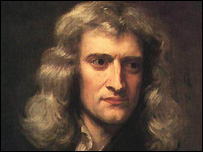 Isaac Newton He excelled at Cambridge following his arrival in 1670 and, inspired by a series of lectures given by Isaac Newton, continued his brilliant stellar observations. Then in 1675 came a huge moment when King Charles II appointed Flamsteed the first Astronomer Royal and asked him if he could fix longitude to make marine navigation safer. Flamsteed argued this would be impossible until more accurate star charts could be drawn up so the King agreed to build a new Royal Observatory at Greenwich for which Flamsteed laid the foundation stone. 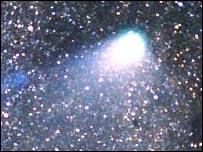 Halley's Comet It was while working at this new facility (largely from equipment he provided himself) that Flamsteed revealed revolutionary new findings on comets in 1677 which enabled Edmund Halley to identify 'Halley's Comet' and subsequently brought about all future comet identifications. A large part of his time at the observatory was spent building up a huge catalogue of stars with the aim of eventually publishing an epic volume detailing their positioning and characteristics. But Flamsteed was furious when Sir Isaac Newton, who regularly used his data for his own studies, grew tired of Flamsteed's insistence on double-checking every detail before allowing his data to be published and rushed out an error-strewn version of the 'Historia Colestis Britannica' in 1712. Feeling deeply betrayed by Newton and Edmund Halley who had edited the volume, Flamsteed spent a small fortune buying up as many copies as he could before publicly burning them at the Royal Observatory. Newton responded by removing all references to Flamsteed from his 'Principia Mathematica' despite the astronomer's huge contribution to the volume. Meanwhile Flamsteed devoted the rest of his life to completing his own 'Atlas Coelestis' which was published shortly after his death in 1719. 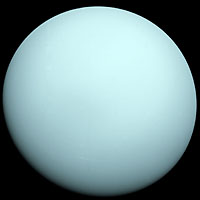 Uranus: Flamsteed thought it was a star Aside from his huge contribution to our understanding of the night sky, Flamsteed was also responsible for the earliest sightings of the planet Uranus. He spotted it from 1690 onwards but mistakenly believed it was simply a star which he named 34 Tauri. Numerous schools and colleges across Derbyshire have been named in Flamsteed's honour including the science block at John Port School, Flamsteed House at the Ecclesbourne School in Duffield and John Flamsteed Community School in Denby. But perhaps more excitingly, the next visitors to the moon might like to pay a visit to Flamsteed crater - it's just east of the Grimaldi basin! last updated: 27/08/2008 at 12:48 You are in: Derby > People > Profiles > John Flamsteed: Astro Genius |
| | About the BBC | Help | Terms of Use | Privacy & Cookies Policy |