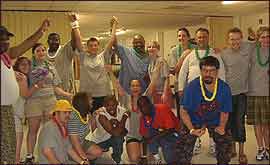
Even
the smartest of people can have preconceived ideas about certain
aspects of life, whether they are places, objects or people. A very
common preconception, even in today's society, is the one we have
about people with disabilities. This summer I had the opportunity
to work with some disabled adults on a camp in Virginia, USA; the
experience altered many things, my cynical preconceptions being
one of them.
Even
the smartest of people can have preconceived ideas about certain
aspects of life, whether they are places, objects or people. A very
common preconception, even in today's society, is the one we have
about people with disabilities. This summer I had the opportunity
to work with some disabled adults on a camp in Virginia, USA; the
experience altered many things, my cynical preconceptions being
one of them.
I
had wanted to participate in the Camp America programme for a
long time but never got round to it; last November however, I
decided I had put it off too long. A lengthy process of applications,
interviews, criminal record checks and general administration
followed, until my papers were finally sent to the US for the
placement process. Originally, I'd hoped my application would
be accepted by a camp that catered for children. I waited and
waited, but heard nothing. In March this year, frustration got
the better of me. Seeing as I hadn't been placed on a camp, I
decided to attend a recruitment fair in Manchester.
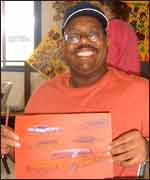 |
| "Camper
who was excellent at drawing cars and drew 184 in the week
that he was there. He had mild autism and was a fantastic
artist." |
Trailing
round the stalls, I was told, "We need lifeguards",
or "Do you have any horse riding experience?" Me, horse
riding? Yeah right! With much indignation about not being able
to find a camp that appealed to me, I found myself in the cue
for Civitan Acres, a camp based in Chesapeake, Virginia, that
catered for adults with special needs and a range of disabilities.
Following
a short interview, a grilling on why I wanted to work with adults
with special needs (that I blagged because I desperately wanted
to go to the states and was determined to get there anyway I could),
which I answered with comments like: "It will be a challenge",
"I've never done anything like this before and think it will
benefit my character," yada yada yada, and I found myself
placed - I finally had a job for the summer.
Working
with people with disabilities of intellectual and physical proportions
had never crossed my mind before. I had preconceptions about the
kinds of disabilities I would be working with. In all honesty,
I was bl***y scared. Would I be able to communicate with people
who were non-verbal, or had profound mental retardation? Would
I be able to understand the reasons someone with Autism did what
they did? Would I be comfortable with lifting a physically disabled
person, weighing 200lbs, onto the lavatory?
I
didn't particularly want to bathe, dress or carry out hygiene
routines with people who couldn't do it for themselves. I can
barely look after myself, let alone anyone else, but over time,
the idea grew on me. I wouldn't just be carrying out these kinds
of tasks; I would be having fun with people that would fully appreciate
the simple things in life. I would be making somebody's week just
by being there for them, offering them a shoulder to cry on, playing
in a swimming pool with them, or even just drawing pictures with
them. I would be the making of their vacation, and whatever preconceptions
I had about people with disabilities would have to be thrown in
the trash.
My
visa was successfully processed in May, my camp had been in touch
with details of what to expect when I got there, and on 18th June,
I found myself flying from Heathrow Airport to Norfolk, Virginia.
Throughout the journey, my mind was inundated with thoughts about
the coming weeks. I expected camp to be challenging, hard work
and very demanding, but ultimately, I expected to have a ball,
after all, how difficult could it be to entertain a few adults
with special needs?
My
first official interaction with the type people I would be working
with came the week before camp actually began. We visited another
special needs camp in Hampton, Virginia, called Sarah Bonwell.
On entering the room my eyes filled with tears. There were so
many amazing characters and all of them wanted to interact with
these foreign faces that had come to entertain them. Throughout
the day we participated in various activities, from face painting
to bowling, but the highlight had to be the dancing. Not one camper
remained seated and the effort they put in was just fantastic.
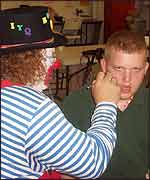 |
| "A
camper enjoying getting his face painted by the clown. This
was a major treat for the campers and they endorsed it with
so much enthusiasm." |
Seeing
how enthusiastic they became at the thought of a simple task or
activity made me think about how much I take for granted. I don't
think I can remember a time when dancing, bowling or face painting
provoked such a euphoric feeling. Usually, I take these activities
with a pinch of salt; as an everyday thing; something that occurs
regularly (well, maybe not the face painting), but for the people
we met that day, the activities were a release; a major part of
their vacation, and something that obviously didn't happen that
often. I went away from Sarah Bonwell with a sense of satisfaction,
overwhelmed at how appreciative and loving these people were.
Camp
work began the following week, and the preparation we had received
as camp counsellors was very little. Although our interactions
with the campers from Sarah Bonwell had provided us with a taster,
it was nothing compared to the work we would eventually be carrying
out. Our responsibilities were very weighted, and a camper's disability
would determine how much or how little responsibility we had to
take on. For example, if a counsellor was partnered with a camper
who suffered from mild mental retardation, was able to get around
and slept through the night, then their responsibilities would
be limited; ranging from monitoring their actions to ensuring
they were basically enjoying themselves.
On
the other hand, a camper who was extremely low functioning and
depended on a carer to feed, clothe, wash and dress them would
require a lot more attention. Therefore, the counsellor's responsibilities
would increase, with bathroom duties and dietary requirements
being the major priorities.
Not
only did we have to ensure that the campers were safe, satisfied
and were having fun doing the activities we had planned (these
included basketball, volleyball, baseball, swimming, drawing,
painting etc) during the day, we also had to look out for them
at night. Working at Camp Civitan was a 24/7 job, one where we
had to be 100% focused at all times. With this in mind, it's easy
to understand how my frustrations sometimes got the better of
me. There were times when I felt the only solution was to walk
away from an awkward position and not go back. There were times
when my campers became so reluctant to participate I just wanted
to cry. There were times when showering and assisting with toileting
my campers became so inhumane that I wanted to punch something,
lash out and leave. There were times when I took my frustrations
out on my fellow counsellors, or times when I secluded myself
from group activities during our weekends of free time...
More to come from Amy Farnworth will
she be able to survive at Camp Citivan...?
This
article is user-generated content (i.e. external contribution)
expressing a personal opinion, not the views of the BBC West Yorkshire
website.