|
| SEE
ALSO |
|
|
Sense
of Place
Remembrance
|
|
|
|
WEB
LINKS
|
|
|
|
|
|
|
|
POPPIES
|
|
|
|
Scarlet
poppies grow naturally in conditions of disturbed earth.
The significance of the poppy as a lasting memorial symbol
to the fallen was realised by the Canadian surgeon John McCrae
in his poem In Flanders Fields.
The poppy quickly became a lasting memorial to those who died
in the First World War and later conflicts.
|
|
| PRINT
THIS PAGE |
|
| View
a printable
version of this page. |
|
 |
|
|
Gerry explains:
 |
|
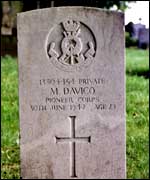
All
graves are marked by a memorial
|
"At
the exhibition there is a sculpture of white crosses in the sand
and poppies. It is made from everyday items found at home and signifies
the fact that everyone who died in the war has a monument."
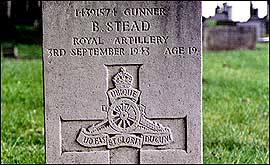
The colour photographs in the exhibition are taken at the Hirst
Wood and Nab Wood cemeteries in Shipley.
The exhibition coincides with the 2003 Poppy Appeal in Shipley and
includes a roll of honour, names of the regiments and details on
the Commonwealth Graves Commission which maintains the graves of
the 1.7 million men and women of the Commonwealth forces who died
during the two world wars.
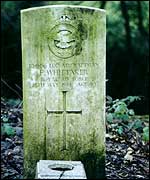 |
| The
photographs show graves in Hirst and Nab Wood |
There
is also a monument, rather surprisingly to the carrier pigeons who
were lost in action taking messages from the front lines to carry
status reports back to headquarters. The carrier pigeon would fly
back to its home behind the lines. When it landed, the wires in
the coop would sound an alarm.
A
soldier from the Signal Corps would go to the coop, remove the message
from the small canister hidden on the pigeon's leg, and then send
it to the right person.
 |
|
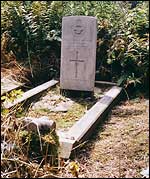
War
grave
|
If
the enemy soldiers were nearby when a pigeon was released, they
knew that the bird would be carrying important messages, and tried
their best to shoot the pigeon down so the message couldn't be delivered.
During the two wars in Britain it became illegal to kill pigeons
in case they were carrying a message."
|