|
In
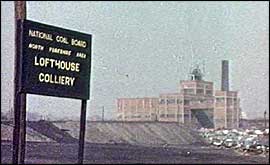
1973 800 men worked around the clock at Lofthouse Colliery in Wakefield
bringing coal out of its rich seams. It was a dirty, dark dangerous
job.
On
the day of the disaster, March 21st, 30 men were working 300 feet
down near old mine workings. Little did they realise that these
had become a reservoir containing 3 and-a-half-million gallons of
water.
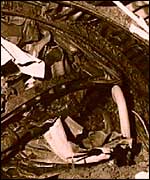 |
| The
colliery workings after the ingress of the water |
Checks
had been made before work had begun in this area but a crucial Victorian
geological notebook which could have revealed how deep these workings
were was never seen.
Former
miners remember that two to three weeks before the disaster water
was trickling down the coal face but this was attributed to a test
bore-hole.
The
shift on March 21st started like any other. Miner Keith Stone remembers:
"The ventilation just stopped. We got this eerie feeling that
the ventilation had turned round. We got this awful smell and then
within seconds a great wall of water came straight over the top
of the ripping."
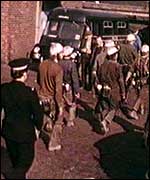 |
| Rescue
attempt - Day One |
Survivor
Malcolm Firth says the water "brought everything with it, boxes
that weighed a ton and it was swilling them down the gate. It was
swilling them all over the place."
Miner
Tony Banks says: "It just felt as though somebody had pulled
a big plug out. It went with such a force it just knocked us over."
Peter
Wood was the Lofthouse Colliery surveyor in 1973: "It was not
just water. It was slurry. It was like a thick sludge and that came
in at something like 750 feet head of pressure."
 |
| Relatives
wait for news |
The
miners took to their heels with the wall of water chasing them.
When the roll call was taken seven men were missing. For the families
above the ground the nightmare was just beginning.
The
week-long attempt to rescue the men, trapped in an air pocket, grabbed
the nations attention. The
rescue effort brought help from far and wide and political enemies
were amongst those who waited together.
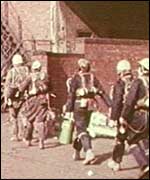 |
| The
underwater rescue team enters the pit |
Arthur
Scargill, President of the NUM (National Union of Mineworkers) reflects:
"We were up against odds that Id never encountered in
my life. For example, we brought in specialist underwater teams
of divers with very large aqualights in an attempt to try and go
through the slime and the mud to try and see if any of the men were
alive and, if so, get them back."

|







 Music
listings
Music
listings