|
Community
archives are collections of photographs, documents, stories, reminiscences
and video clips and it is the members of that community that choose
what goes into the archive.
Special
software (comm@net) has been developed to allow volunteers, many
of whom have never touched a computer before, to input the data
and create the archive.
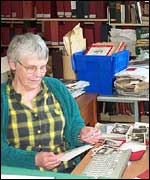 |
| A
volunteer working on the project in Bradford Library |
Many
different types of communities are getting involved with the comm@net
project. The first in West Yorkshire was set up in Batley and mining
communities, such as South Elmsall, are also involved.
While
some of the older community history archives can already be seen
on the internet the Bradford Archive, which to date consists of
around 800 images as well as memories and anecdotes, can at present
only be viewed at the Local Studies department at Bradford Central
Library.
There
are plans to network the Archive across the district's libraries
but already the project is being taken out to villages across the
district using a laptop and a large video screen. More than once
people who have come along have been surprised to see pictures of
themselves appear on the screen, although it may have been in a
school photo taken 50 years ago.
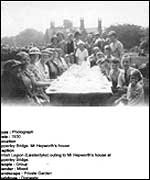 |
| An
image from The Community History Archive as it appears on the
screen |
People
telling their own history is nothing new in Bradford. More than
twenty years ago a major oral history project took place in the
city and over 800 interviews were completed before the funding disappeared.
The
Memory Bank emerged from a project initiated by Age Concern in connection
with Bradford Libraries.
Bradford's
Local Studies Librarian Carol Greenwood says: "It was a memory
sharing project based on the oral history tapes so that people could
share their memories and these were taken out into places like old
people's homes. We realised they also wanted something else because
people in their eighties and nineties could not hear so well and
we had the idea of putting other things with the tapes."
Objects
which people could handle such as skipping ropes, inkwells and darning
mushrooms were made into packs together with smelly things such
as mothballs and carbolic soap. Local history groups took the packs
into the homes and it was realised that they too had collections
of material but this was not accessible to other people in the district.
Images,
memories, sound and video can now be shared. Carol Greenwood says:
"The good thing about this is that it is the things that people
feel are interesting about their own community so they're selecting
what they think is important about the area where they live, or
where they used to live and I think that's important. They can describe
the photographs. If it is a May Day procession, for instance, they
can say how it came about, why they selected the May Queen, who
made the costumes, where they got the money from so it could add
to the picture and, of course, it's all searchable afterwards."
For
more information about the Bradford Memory Bank and Community History
Archive contact the Local Studies Department, 6th Floor, Central
Library, Prince's Way, Bradford.
|






 Music
listings
Music
listings