|
Martin
Parr is one of the best-known and influential photographers working
in Britain today and now a major exhibition of his work, previously
seen at London's Barbican, has come to Bradford.
The
exhibition spans the whole of Parr's career as a photographer from
his study of June Street in Salford in 1972 to more recent preoccupations
like Common Sense (1999), a close-up study of today's throwaway
culture with its images of hot dogs, toy cars and bubble gum.
Although
a southern suburban lad Parr had frequently visited his grandparents
before moving north to study at Manchester Polytechnic and living
for a while in Hebden Bridge in the 1970s where he produced black
and white photos, sometimes said to be his most empathetic,
of a
way of life that was even then disappearing.
Here,
amongst other things, is the Ancient Order of Hen-Pecked Husbands,
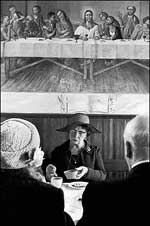
a local Jubilee Party and a study of the ageing congregation of
Crimsworth Dean Methodist Chapel. Parr says: "When I came to
Hebden Bridge I was very much interested in the documentation of
the community and traditional aspects of northern life. Having discovered
it first when I came to Bradford in the summers in the sixties,
it struck me this is a place to go. It is visually a very dramatic
town and I picked out the small Methodist and Baptist chapels because
they seemed to epitomise the traditional lifestyles that were in
decline so I felt very much as though I was photographing a type
of society that was declining which indeed it was. It's
another era. Now when I look back on it I am sure there are still
small chapels going but most of the ones I photographed are now
housing."
 |
| Steep
Lane Baptist Chapel, Yorkshire, 1976 (c) Martin Parr/Magnum
Photos |
The
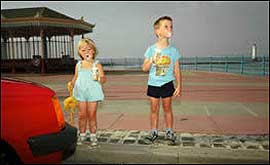
Last Resort, Parr's first major book, looks at the Merseyside resort
of New Brighton between 1983 and 1986. By then he had changed his
camera format using bright colour to depict day trippers at this
working-class resort that had fallen on bad times. He says: "I
was starting to question the whole idea of whether this black and
white photography nostalgic feel was correct for the time that we
lived in."
Throughout
his career Parr has concentrated on the ordinary and the everyday
and this has led to considerable controversy about how his work
should be taken. How does he view the subjects of his photos? What
is he actually saying about the daytrippers in the New Brighton
fish and chip shop?
He
comments: "The criticism came not from within Merseyside because
the photos were immediately shown at the Open Eye photographic gallery
in Liverpool and people went in, and they said, 'this is what it's
like' but as soon as the same pictures came south to London people
were up in arms and said this was exploiting the working classes
because they (the critics) were not aware of what life is like in
the north.
"Of
course, New Brighton is very shabby, very rundown, but people still
go there because it's the place where you take kids out on a Sunday.
That's
where the funfair is and it's still a treat but it has this backdrop
of litter and grot which of course lends itself to photography,
and I was pretty aware of that."
Complaints
about the photographer as a social tourist are not new. He says:
"Photography is by its nature exploitative. It's whether you
use this process with a sense of responsibility or not. I feel that
I do so. My conscience is clear."
He
adds: "I'm always outside of things but I'm part of things
to. Criticism is hypocrisy, society is hypocrisy. I'm a tourist.
I'm a consumer. I do the things that I photograph and can be criticized
of."
After
The Last Resort Parr moved down south to Bristol to look at the
upwardly mobile - it was the Thatcher years!
The
exhibition reflects many of the other themes explored by Parr over
thirty years including unlikely images of travel and tourism (Small
World), a series on fake cherry blossom in Tokyo shop windows as
well as a major study of studio portraiture in all its varieties.
One
project undertaken since this exhibition was put together is of
people on mobile phones throughout the world: "Part of what
I am doing now is to document the homogenization of the world. When
I started out as a photographer in the days of innocence in the
early seventies I was almost celebrating life, now I'm a critic
of it so that's how my role has changed but, you know, the world
had changed enormously in that time as well so I feel that it is
correct that I approach to the subject matter."
Parr
says if he has one motto it is the celebration of the ordinary and
the everyday: "I think the ordinary is a very under-exploited
aspect of our lives because it is so familiar."
If
you want to see what Martin Parr makes of the mundane then get along
to the exhibition. There are around 150 works and several installations
on display.
|