|
|
 |
Despite
being a very successful novelist you still spend a lot of time on
the road at events such as the Bradford Festival's Triple Crime
Bill. Do you think it's important that authors remain in touch with
their readers?
I think it's helpful for several reasons. Firstly, readers often
see things in the work that writers are not always consciously aware
of and it's interesting to hear another take on one's work. Secondly,
I think readers appreciate the chance to share their experience
both with the writer and with other readers. And thirdly, writers
spend most of their working lives shut away in isolation with no
real sense of whether what we're doing has any impact at all. It's
a wonderful crutch for the ego to hear readers talking about their
pleasure in the books - it's what gets me through the long dark
days when the words don't want to come out and play.
Why
did you start writing crime fiction?
I'd always wanted to write and I tried various forms - the literary
novel, the theatrical play, the radio drama - with limited success.
Eventually I was fired by my then agent for not making him enough
money. I'd always read and enjoyed detective novels and thought
I might have a last roll of the dice with one of those. Then a friend
sent me a copy of Sara Paretsky's first novel, Indemnity Only and
I was blown away. Here was a crime novel that had a great plot,
a strong female protagonist, an urban setting I could relate to,
and politics, both personal and social. I suddenly understood how
I could use the crime novel to tell stories that were more than
just intellectual crossword puzzles. So I started work on Report
for Murder and the rest is history.
 |
| The
Scottish Parliament: The roots of recent flowering of crime
fiction in Scotland "coincide with the start of the devolution
debate." |
You
come from Fife as does Ian Rankin. Recently there has been much
talk of Tartan Noir? Is there something about growing up in Fife,
or in Scotland, that you think might lead to becoming a good crime
novelist?
There is, I think, a unifying flavour to Scottish crime fiction
that sets it apart from the English variety. It's a psychological
darkness, an irreverence and black, black humour. The reasons for
that lie in the social, political and cultural differences between
the Scots and the English, which I suspect we are much more conscious
of than the English. Our tradition runs from James Hogg's Confessions
of a Justified Sinner, through RL Stevenson's Jekyll and Hyde and
Conan Doyle to William McIlvanney's Laidlaw. I think the recent
flowering of crime fiction in Scotland is partly political - its
roots coincide with the start of the devolution debate, when we
had to take a long hard look at who we are and what our place in
the world might be. At the same time, crime fiction elsewhere was
entering a second golden age and it was clear that the crime novel
was the place to go for writers interested in strong storytelling
coupled with social comment. The two strands found a natural marriage
and the results have been startling.
You
started your working life as a journalist and Lindsay Gordon, the
heroine of you first series of novels, was also a journalist. How
far has this experience influenced your writing?
Less that one might expect. Obviously it gave me a huge database
of characters and locations, and it taught me to write tight. But
that's about it, apart from the invaluable lesson that writing is
a job, not some muse-inspired self-indulgence. You can't postpone
writing a news story because you're not in the mood, so you learn
very quickly that no matter what else is going on in your life,
you should be able to get something down on paper. And once you
have something down, you can make it better.
You
moved to Manchester and subsequently created private eye Kate Brannigan.
Do you have any plans to write any more Brannigan books or do you
think Kate (as well as the other regular characters) was very much
of that time in Manchester?
I've recently been thinking again about writing another Brannigan
novel. She seems to be knocking at the door of my mind. I think
it would be very different from the previous six in tone, though
of course Brannigan's unique voice is what would link it to the
earlier books. But she'd be older and wiser, and reflect that Manchester
is a different city to the one she inhabited in the 90s.
Your
more recent novels would seem to be darker and more psychological
in their approach? How far is it true to say this is because you
want to investigate different themes that you felt would not be
appropriate to either the Lindsay Gordon or Kate Brannigan series?
I've always written the books that were loud in my head and
my heart. I generally know pretty early on in an idea whether it
fits one of the series or whether it's a standalone, and so I shape
the idea and the characters accordingly. I've always been driven
by what I was excited about writing, rather than by any perceived
commercial imperative to write any given book. (Why else would I
have returned to Lindsay Gordon in 2003? Certainly not for the money...)
Are
you happy with the way your Tony Hill novels have been adapted for
TV and with the casting of Robson Green?
Yes. I think they've done a great job of remaining faithful to the
essence of the books while still making wonderfully watchable TV.
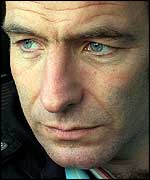 |
| Robson
Green plays Dr Tony Hill in the TV series Wire in the Blood. |
I've
heard a few people say they have found these books difficult to
read because of the way violence is depicted, particularly towards
women. How far do you think this criticism is justified?
Violence
is not glamorous and murder is not an entertainment. I write different
styles of books and the way I deal with the terrible things people
do to each other varies quite drastically from series to series
and book to book. When writing about a character like Tony Hill,
who is profoundly concerned with the roots of violence and with
confronting honestly what human beings do to each other, it is necessary
to confront directly what these acts are, what they mean and why
they happen. To gloss over them or sanitise them feels to me like
moral cowardice. I don't think I ever use violence gratuitously
- it always has a function within the book. I'm sorry some people
find these books hard to read, but they're not meant to be comfort
blankets. If you read them without flinching, you probably need
professional help...
On the issue of violence against women - two points. Firstly, it
is the case that women are disproportionately the victims of violence,
particularly sexual violence. It seems perverse to pretend otherwise.
And secondly, more than most other writers, I have also explored
the issues of violence against men.
Your
most recent book Stranded is a short-story collection. Where do
you see yourself going next as a writer?
To
hell in a handbasket! Seriously, I'll go where the ideas take me.
How
far do you think crime fiction is a genre which can be used to ask
most of the big questions that face us as people?
In recent years, the crime genre has pushed the envelope till the
corners are practically out of sight from the centre. The best of
contemporary crime writing demonstrates that we are lucky enough
to have a tranche of writers who deal with all of the big issues,
both personal and political. I don't honestly think there's anywhere
we can't go.
Chris
Verguson
Val
McDermid was in Bradford to take part in the Triple Crime
Bill with crime novelists Stella Duffy and Jenny Roberts
on Monday 20th June, 2005.
Other
writers coming to this year's Bradford Book Festival include
Helen Cross (the film version of her novel My Summer Of
Love is being screened during the Festival), comic writer
and former school inspector Gervase Phinn, poet Carol Ann
Duffy, actor Barrie Rutter and bespectacled poet John Hegley.
Box
Office: 01274 432000
|
|