What was it like to live in ancient Greece?
Life in ancient Greece was very different from modern day but it also had many familiar parts.
People worked, ate, played and gathered as families just we do now.
However, the homes, clothes and games all reflected ancient Greek traditions.
Exploring these details help us to understand how Greeks lived, learned and celebrated.
Important words for the ancient Greeks
| Keyword | Definition |
|---|---|
| Agora | The marketplace and meeting area at the centre of Greek towns, used for trade and discussion. |
| Citizen | A person who had rights and responsibilities in their city-state. In Athens, only free men were citizens. |
| Panathenaea | The most important festival in ancient Athens, held every year to honour the city’s goddess Athena. |
| Temple | A sacred building dedicated to a god or goddess, where sacrifices and offerings were made. |
Daily life in ancient Greece
Ancient Greece had a warm, dry climate, as Greece does today. Most people lived by farming, fishing and trade. Others were soldiers, scholars, scientists and artists.
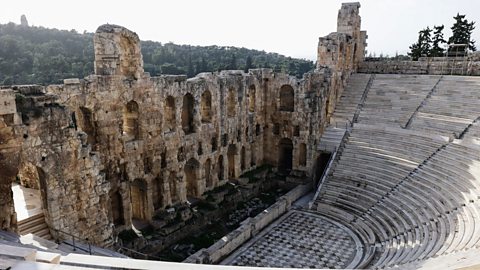
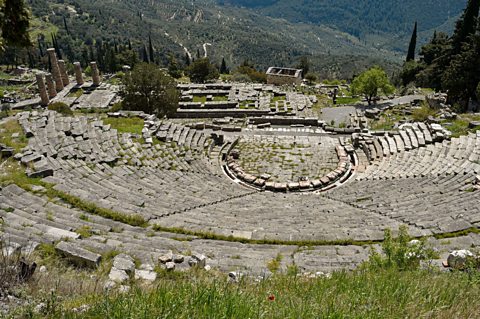
Greek cities had beautiful temples with stone columns and statues, and open-air theatres where people sat to watch plays.
Most people lived in villages or in the countryside. Many Greeks were poor and life was hard, because farmland, water and timber for building were scarce. That's why many Greeks sailed off to find new lands to settle.
How was religion part of daily life in ancient Greece?
The ancient Greeks believed in many gods and goddesses, and they thought these gods controlled everything in the world.
Temples were built in towns and cities to honour the gods and people offered sacrifices to keep them happy.
Religion shaped daily life with festivals, prayers and stories about the gods all being important parts of Greek culture.
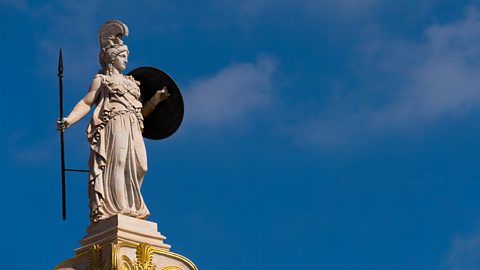
Zeus was believed to be the king of the gods and Athena was worshipped as the goddess of wisdom and protector of Athens.
Festivals celebrated the gods, such as the Panathenaea in Athens, which honoured Athena with parades, music and games.
Ancient Greek homes
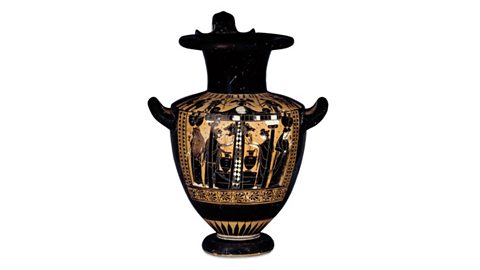
Ancient Greek homes:
- were built around a courtyard or garden
- had walls that were often made from wood and mud bricks
- had small windows with no glass and wooden shutters to keep out the hot sun
Homes didn't have much furniture inside them. However, wealthy people decorated their walls and floors with colourful tiles and paintings.
Many homes didn’t have a bathroom. There were public baths, but most people washed using a small bucket or in a nearby stream. Only wealthy people enjoyed baths at home.
At night, Greeks slept on beds stuffed with wool, feathers or dry grass. Most people went to bed as soon as it got dark. The only light came from flickering oil lamps and candles.
What kind of work did the ancient Greeks do?
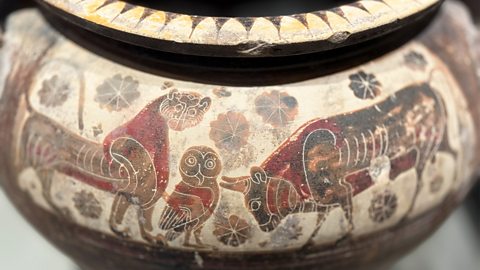
Most ancient Greeks were farmers who grew crops like wheat, barley, grapes and olives.
Some became traders, sailors or craftsmen, making goods or carrying them across the seas. Traders and sailors carried goods across the seas.
Enslaved people did much of the hard work in ancient Greece, from farming to household jobs.
The agora was the busy marketplace in each city-state. People went there to buy and sell goods but it was also a place where citizens gathered to talk about politics, news and community life.
What was Greek fashion like?
A Greek woman wore a long tunic called a chiton. This was made from a piece of cotton or linen. Over this, she wore a cloak draped from her shoulders, called a himation. This would be made from a thin material in summer and a thick material in winter.
Young men wore short tunics, while older men preferred long ones. Enslaved men often wore just a strip of cloth called a loincloth.
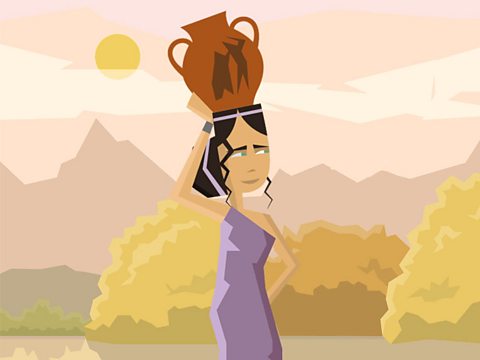
Many people walked around barefoot. Some wore leather sandals or, for horse-riding, high boots. Many people wore wide-brimmed hats in hot weather, to shade their faces from the sun.
Suntans weren't cool in ancient Greece, so women put white lead on their face to make their skin look pale. White lead is poisonous and can cause health problems but they didn't know that at the time.
We know the Greeks liked jewellery too, because bracelets, earrings and necklaces are often buried with dead people in their tombs.
Ancient Greek toys and games
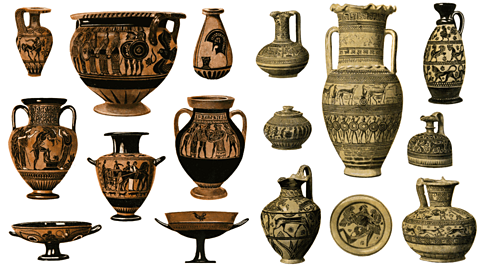
We know about some Greek toys from pictures on pottery vases and artefacts found by archaeologists.
Children played with small pottery figures, and dolls made of rags, wood, wax or clay - some of these dolls even had moveable arms and legs. Other toys were rattles, hoops, yo-yos and hobby horses (a pretend horse made from a stick).
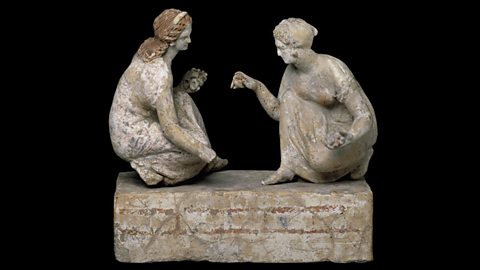
Children also played with balls made from tied-up rags or a blown-up pig's bladder. A game of flicking nuts into a hole or circle may be the ancient Greek version of marbles or tiddlywinks!
They also kept animals. There are pictures of children with pets, like dogs, geese and chickens.
What food did the ancient Greeks have?
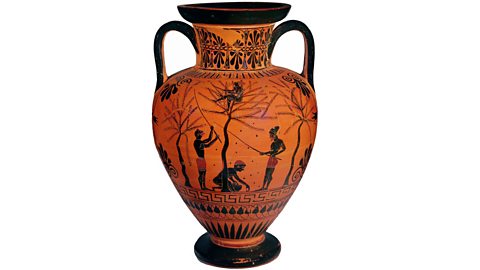
Take a look at some of the items the ancient Greeks might have eaten at each meal:
- Breakfast - fruit with bread dipped in wine
- Lunch - bread and cheese
- Dinner - porridge made from barley, with cheese, fish, vegetables, eggs and fruit
- Pudding - nuts, figs and cakes sweetened with honey
Everyone ate with their fingers, so food was cut up in the kitchen first.
Only wealthy people ate a lot of meat. They would eat hares, deer and wild boar killed by hunters.
Octopus and other seafood was often eaten by people in ancient Greece.
Men and women usually ate separately in ancient Greece. However, people sometimes ate together at festivals, feasts, and special gatherings.
Think like a historian

Have a look at the thinking points below and think about your answer to each question. You could even write them down on a piece of paper or discuss them with somebody else if you want to.
Why did the Greeks hold festivals like the Panathenaea and what do these celebrations tell us about the importance of religion in their daily lives?
What do Greek myths tell us about their beliefs and the way they explained the world?
How does the work people did in ancient Greece show the importance of farming and trade to their civilisation?
You might have thought about how the Panathenaea was held to honour Athena, the goddess of wisdom. Festivals like this show that religion was part of community life as well being a form of worship.
Perhaps you remembered that myths showed what the Greeks believed about gods, nature, and the difference between right and wrong.
Did you think about how farmers provided food like wheat, olive and grapes? Did you remember that traders and sailors brought in goods? All of these items were important to the citizens of the city-states of Greece.
Activities
Activity 1: Ancient Greek family
Click on the family below to find out a bit about their life
Activity 2: Quiz – Life in ancient Greece
Let's find out what you know about what it was like to live in ancient Greece.
Grown-ups corner
Are you a parent, carer or teacher?
Take a look at some of the links below on KS2 History which are packed full of knowledge, videos, quizzes and activities.
Ancient Greece: Everyday life in the city-states
Bitesize for Teachers
What was life like in Roman Britain?
KS2 History
Horrible Histories: Raid and Trade game! game
Play Horrible Histories: Raid and Trade KS2 History
More on Ancient Greece
Find out more by working through a topic
- count4 of 8
- count5 of 8
- count6 of 8
- count7 of 8