How did the Olympic Games begin?
The first Olympic Games were held in 776BC in Olympia, a special site dedicated to the god Zeus.
They were both a religious festival and sporting competition, bringing people together from across Greece.
Athletes competed to honour the gods, show their strength and win glory for their city-states. Each city-state was a small, independent community in Ancient Greece with its own laws and leaders.
There were no gold, silver and bronze medals. Winners were given a wreath of leaves and a hero's welcome back home. Athletes competed for the glory of their city and winners were seen as being favoured by the gods.
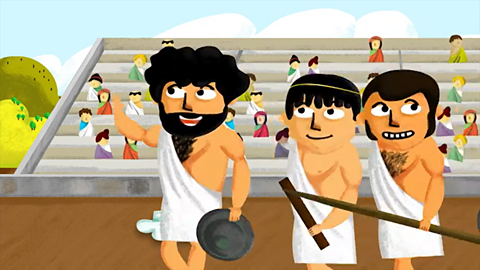
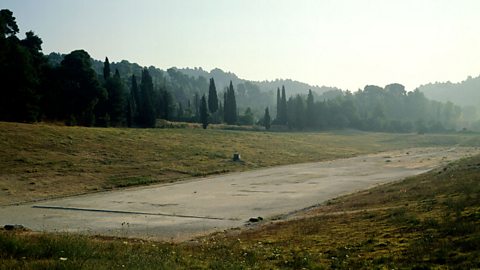
- The Olympic Games began over 2,700 years ago.
- The Games started in Olympia which is in south west Greece.
- Every four years, around 50,000 people came from all over the Greek world to watch and take part.
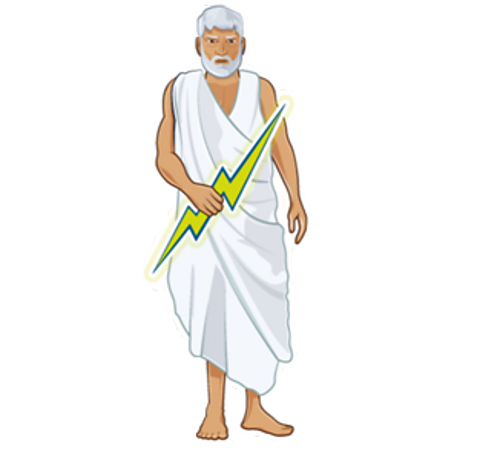
The games were also a religious festival, held in honour of Zeus, the king of the gods.
There were no gold, silver and bronze medals.
Winners were given a wreath of leaves and a hero's welcome back home.
Watch: What was it like to attend the Olympics?
The ancient Olympics wasn't just about the sport, it was a religious festival too. Find out what it was like to visit the ancient games.
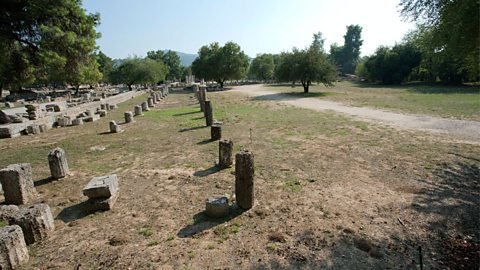
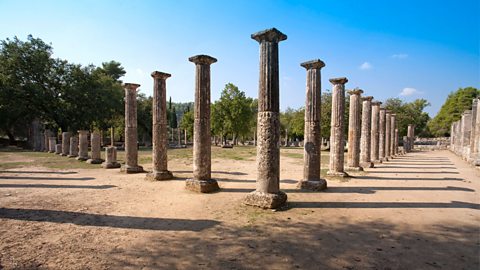
Olympia was not only a centre of sport but of culture, politics, and religion.
This was a man’s world. Women were forbidden from coming here on pain of death. And inside the stadium the athletes would stand naked before all of Greece and the gods.
Here they competed not for money but to honour Zeus, the most powerful god of all.
Every four summers, for over a thousand years, tens of thousands of Greeks would come to the games from across the Mediterranean, all converging on Olympia to experience the greatest spectacle of the ancient world.
We can’t be certain of what people saw when they came to this valley five hundred years before the birth of Christ but from fragments of written evidence, experts have been able to construct some idea of what would have happened once they arrived.
Even returning champions would have had to fight for space amongst the diplomats, philosophers and the thousands of spectators who descended upon Olympia.
For the athletes this was a time to concentrate and prepare for competition. And many young challengers would have sought support from the gods.
Local priests acted as judges, taking up special positions in the judges’ stand while the sun-scorched banks filled with expectant crowds. Just like today, before being called to compete, the waiting Pentathletes would have prepared mentally as well as physically.
The athletes knew that only five events separated them from immortal fame.
A religious and sporting event
Before the games began, messengers were sent out to announce a 'sacred truce' or a peace.
This meant that any wars should be stopped so that people could travel safely to Olympia.
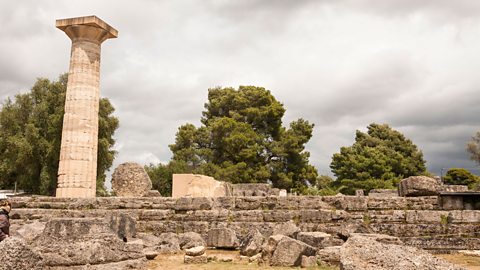
The entire games were dedicated to Zeus.
- The main event at the Olympics was a sacrifice.
- On the third day of the games, 100 oxen were killed and burnt on the Altar of Zeus.
Could women and girls go to the games?
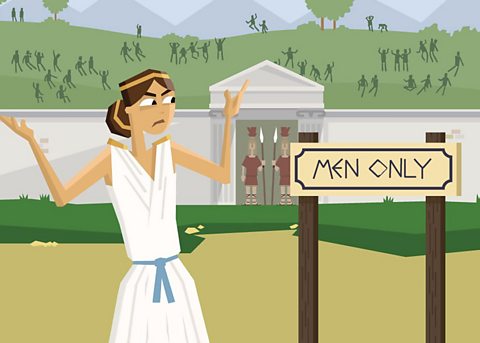
Only men, boys and unmarried girls were allowed to go to the Olympic Games.
Married women were not allowed.
However, women could still own horses in the chariot races at the Olympics.
Princess Cynisca of Sparta was the first woman to win a race as a chariot owner against men.
Unmarried women had their own festival at Olympia every four years. This was called the Heraean Games.
It was held in honour of Hera, Zeus's wife.
Winners were given crowns of special olive branches, the same as men.
Activities
Activity 1: Olympic sport events
Click on the athletes below to find out more about some of the sporting events at the ancient games.
Activity 2: Quiz – Olympic Games
Grown-ups corner
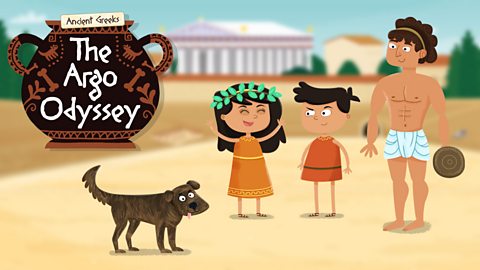
Argo the dog is missing! He was last spotted at the Olympics.
Play the game to take part in the pentathlon and save the bronze discus from the master of thievery.
Ancient Greeks: The Argo Odyssey
Bitesize: KS2 History
Horrible Histories: Raid and Trade game! game
Play Horrible Histories: Raid and Trade KS2 History
More on Ancient Greece
Find out more by working through a topic
- count10 of 15
- count11 of 15
- count12 of 15
- count13 of 15