If life leaves you feeling a little frazzled from time to time, moments of calm can be precious.
They can be found in all sorts of places, but one possible location is in your home. Even if you don’t have loads of space, or you live with a lot of people, there are still some straightforward methods - that don’t necessarily cost a lot of money - which can take you away from it all for a few minutes. BBC Bitesize spoke to psychologist Dr David Maidment from Loughborough University, who shared some tips and advice.
Keep some greenery in view
“Some people live in big, busy cities,” said Dr Maidment, “and might not always have access to lots of green space. But just having images of green space or plants and flowers [near us] has a very good impact on lowering anxiety and improving sleep quality.”

When we become stressed, our brain releases a hormone called cortisol. It sets off the ‘fight, flight or freeze’ reaction we may have to certain situations, such as - as Dr Maidment suggested - a constant flow of social media alerts demanding our attention. This is where turning your attention to a potted plant on a desk, or even a picture of some greenery, can help.
“It’s called stress recovery theory,” Dr Maidment continued. “It brings us back into equilibrium, into balance, again. One of the ideas is that we’re probably evolutionarily predisposed to enjoying greenery. There are some theories as well that the colour green is also very relaxing and that induces mental comfort. Again, that’s probably an evolutionary response that we’ve adapted over hundreds, if not thousands of years.”
A 2019 study in the USA supports this theory. Subjects who walked on treadmills surrounded by either the colour red, white or green, recorded a significant reduction in their heart rate while in the green environment. Blue, another shade from nature, is also said by colour psychology experts to have a calming effect, but it’s worth remembering that we all have our own unique reactions to different colours.
Have soothing smells in the air
Using scent to make people feel calm has been practised in countries such as China and India for thousands of years. There are different theories for this. One, from a 2018 study in Japan, suggests certain smells - like lavender - can act like a medication against anxiety, calming down activity in the brain.
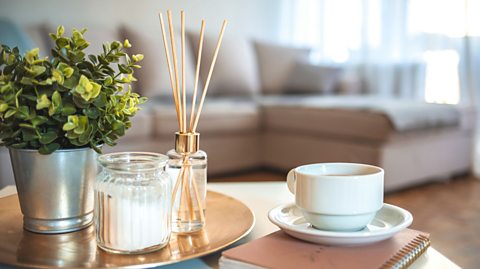
Dr Maidment suggested that different odours can also be linked to different memories: “I’ve got a reed diffuser in my office that I bought to relax because it can be quite stressful. It’s bergamot, lavender and patchouli. I like it to smell nice and I think some of these odours cast us back to when, maybe, we were younger or in a happier time.”
We’re all different, so the smells we like to have around us, will depend on our own taste, memories and experiences. Dr Maidment continued: “It does not need to be the same for everybody. It’s not a one-size-fits-all.
“I know that when I go to a shop with my wife, we always argue about which one we like! I like one smell, but she doesn’t as she thinks it’s too woody and she prefers a fresh-smelling scent. Find the scent you resonate with, that relaxes you - it’s more likely to have an impact.”
Make a nook for yourself
Creating a cosy nook may suggest an expensive building alteration to a corner of the home, but finding somewhere to squirrel yourself away doesn’t have to be that complicated.

Dr Maidment said: “What you’re doing there is that you’re focusing your energy on just one thing that relaxes you and you’re removing all the distraction. In our daily lives, we get distracted by so much stuff around us, our attention can get overloaded. What we want to do is almost deprive all of the different senses.”
A nook doesn’t have to be a specific space that you head to. If you can find somewhere that is relaxing, with soft furnishings, you can create your own cocoon - but make sure you give yourself plenty of breathing space.
Dr Maidment added: “If we overload our sensors too much, it reduces that relaxation effect. Being in a big expansive field of greenery is good, but actually, sometimes it’s nicer to be in that smaller area and cocooning.”
Lower your exposure to blue light
If you make your bed double up as your nook, it might also be worth considering the blue light effect. Blue light is a colour in the light spectrum that has high energy and is difficult for our eyes to filter. While it has benefits, such as increasing alertness and boosting our mood, it can also strain our eyes and make it difficult to sleep.
Blue light occurs in natural sunlight and is also found in TVs, laptops and our mobile phones.

Staying away from blue light when you need to relax could also be a benefit. Dr Maidment explained: “Some people suggest, the hour before you go to bed, don’t check your phone. Don’t look. You’ll be on your phone for a prolonged period of time.
“It applies to anything that’s a potential distraction - your laptop, your TV, anything that introduces that mental fatigue and takes our attention away from that relaxation state.”
Different ‘colours’ of noise
You may have heard about white noise which can be used to calm people if they play it in the background while they’re trying to sleep or relax.
As Dr Maidment explained, there are noises named after other colours - almost. Brown noise, his personal preference, is not named after the autumnal shade but a person. It carries many low frequency sounds - think of a waterfall rumbling or very heavy rain - and is connected to Brownian motion, discovered by the Scottish botanist Robert Brown in 1827.
Dr Maidment said: “Brown noise is a bit like static white noise, but has different frequencies.
“If I listen to Brown noise, it’s just a constant kind of hissing, kind of relaxing sound. The idea there is that those kinds of frequencies are meant to match, because your brain resonates frequencies. It relaxes you again, it’s getting you into that meditative state.”

Different noises relax different people. Some find the background sound of traffic and trains soothing, especially if they have grown up with it. Pink noise, similar to Brown noise, is a more random assortment of frequencies than white noise, and can be found in some birdsong.
Background noises that can relax and calm you are available on streaming services or other online platforms. Have a listen to different ones before deciding what works for you, then chill out to some calming sounds.
This article was published in July 2024
How to make the perfect study station at home
Studying at home might seem frustrating at first, but we're here to help.

Seven sensational facts about rainbows
Do you know there are invisible colours in a rainbow? Learn more fascinating rainbow trivia.