Your teenager is in their room revising… You tiptoe up the stairs to see how they’re getting on and hear heavy bass reverberating under the bedroom door… At which point you might ask yourself ‘should my child be playing music as they revise’? The answer isn’t as straightforward as you might think…
Bitesize Parenting has enlisted the help of Professor Catherine Loveday, who researches music and memory at the University of Westminster, and features on Radio 3 Unwind’s daily morning show Classical Unwind, to discuss what role music can play for your teenager when they’re studying for exams, and how you should approach the topic with them.
What happens to the brain when we listen to music?

Professor Loveday says listening to music can help with mood regulation. Whether you’re feeling hyped and stressed or you haven’t got the energy or motivation, music can help get you in the right state of mind to study.
“There’s a good body of evidence that music helps people feel more relaxed. It lowers stress hormones like cortisol, our heart rate changes… It can help with concentration and focus.”
How can music help with revision?
Professor Loveday says when it comes to revising, you can use music “before you start, during the work and afterwards”. Before they revise your teen could choose upbeat or calming music, depending on how they’re feeling. And afterwards they can use music “as a release”. This could be upbeat music for energy or dancing, or something more gentle to calm them. Catherine says “it’s about emotional regulation either end”.
In the middle, when your teenager is doing their work, music can help them focus, keep their mood up and sometimes get into an almost “meditative state”. But it does get more complicated because everyone is different, so listening to music when revising – and the type of music – will vary greatly from person to person.
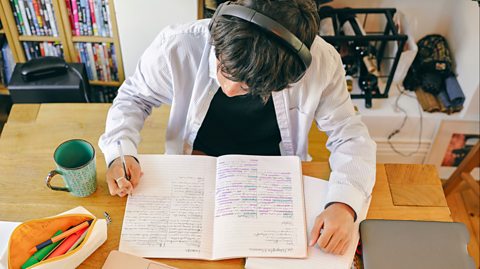
What impact do different genres of music have?
The genre of music your teen listens to whilst they’re revising is important. Professor Loveday says what music they can use to revise will be influenced by the task they’re doing.
“If it’s a complex task or language-heavy task, you do not want music with lyrics. If it’s a repetitive task, that’s less of an issue.” When it comes to revising, lyrics generally aren’t as good because they effectively take up "cognitive capacity”. In other words, lyrics are taking up space in your brain that you might otherwise use for more focused studying.
“It’s really about the interaction between the complexity of the task and the individual.” – Professor Catherine Loveday
There are also other things to consider for your teen, such as previous associations they have with the music they’re playing, which may distract them or cause them to daydream about something the song reminds them of. Again, a lot of this depends on your individual child. Catherine says there’s some research which suggests “more introverted people will be more distracted by more ‘busy’ music, whereas more extroverted people have less of that problem… It’s really about the interaction between the complexity of the task and the individual, both in terms of their current state and their cognitive style (i.e. way of thinking).”
When it comes to revising to different types of music, she says it’s about finding that “Goldilocks moment”, where music helps your child engage and keeps their mood up, but isn’t distracting or taking them away from what they’re doing.
How can music help if my child hates revising?
For children who find the thought of studying pretty onerous, Professor Loveday says music that boosts their mood – even if it’s slightly more distracting – is better than nothing. “If you boost the mood, your concentration gets better anyway. You learn more and you're more likely to get through a task. Even if you’re not doing it as well, it’ll get you through.” So, that Arctic Monkeys or Skepta being blasted out may have a role to play, although more on mood than overall focus!
Professor Loveday uses the analogy of running, which she doesn’t enjoy, but finds easier with music: “It’s something you don’t want to do, you know you have to do, you know you’ll feel better when it’s done, so what can you do to get you through it?”

How do I help my teen choose what music to listen to?
It all boils down to encouraging your teenager with their own metacognition – in other words, finding what works for them. Suggest they experiment by studying with and without music, and with different genres of music, and then reflect on what has and hasn’t worked (which is the essence of metacognition). This involves a degree of trust, but you can help them by asking them questions: ‘Did that Olivia Rodrigo album help you to focus? Were you more or less focused when you revised to Nicki Minaj or Hans Zimmer?’
If your teenager is engaging with you, you can also make musical suggestions…

What are the best types of music for revision?
Most teenagers probably don’t enjoy taking music advice from their parents, but there are certain types of music which work better for focus without distraction. As we’ve said, lyrics generally aren’t very helpful – though again, it will depend on your child.
Classical music is a popular genre for revision and one that’s been shown to help with focus and lower stress. Other instrumental forms of music can also help: ambient music, jazz, some film scores, instrumental versions of musicals and piano music.
Professor Loveday says piano music is almost like a household pet with its “comfort, familiarity and simplicity… it’s like a good friend, it’s not too offensive and doesn’t take too much attention”.
Repetitive, loopy music is good for concentration, which is why classical works. Professor Loveday mentions Ludovico Einaudi may be popular with young people (he’s one of the most-streamed classical artists in the world) because his ambient piano music is quite minimal and therefore easy to study to. She says, “it’s like one person sitting talking to you, rather than being in a crowd.” That may be a gateway to introducing your teen to the genre.
“[Piano music is] like a good friend, it’s not too offensive and doesn’t take too much attention”. – Professor Catherine Loveday
Film scores and instrumental versions of musicals or pop songs is another way to get your teen into more ‘revision-friendly’ music, but Professor Loveday cautions against music that has too many highs and lows or dramatic points – as film scores often do – as these can be distracting.
With instrumental versions of e.g. pop songs, it goes back to the emotional distraction. Many of Ed Sheeran’s songs, for example, are repetitive and loopy, so the instrumental versions may work for less demanding tasks such as highlighting text or creating to-do lists, but only if your child isn’t singing the lyrics along in their head or picturing the last time they danced to his songs with their friends!
How can I get my teen into classical music if it’s not their thing?
Finding classical artists that are trending (e.g. being used in TikTok videos) and those topping the streaming charts is a good place to start.
You can also try BBC Radio 3 Unwind’s Piano Focus playlist featuring special episodes designed with Professor Loveday to help you stay focused and block out distractions.
And if you want peaceful music to bring calm and help you de-stress you can also try Radio 3 Unwind’s Mindful Mix.
If you want your teen to understand how and when music can help them revise - Study Support have the answers here:Should you have music on while you revise?
This article was published in May 2026

Bitesize Parenting
Fun activities, real-life stories, wellbeing support and loads of helpful advice - we're here for you and your child.

How to support your teen’s wellbeing during their GCSE revision
Bitesize Parenting caught up with Young Minds to get some top tips on supporting teens with their wellbeing this exam season.

What not to say to your kids during exam season
Exam season is stressful enough, so here are some top tips to avoid unnecessary rows.

Help your child revise and prep for exams
LV General and his daughter Melliyah have tips to help your child get over revision wobbles and exam fears - based on advice from an educational psychologist.

Five ways to help your kids kick-start revision
If you're a parent, how you can support your teenager this exam season?

Revision and Exams - parents share their advice
Many parents will be concerned about whether their child has done enough revision and is coping well. Parents and carers who've been there before share their advice.