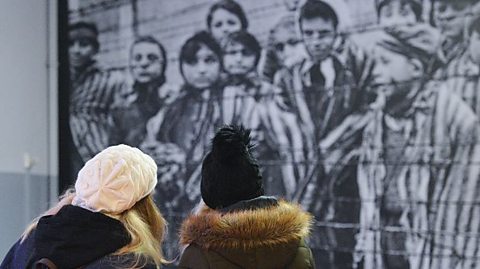
Every year on 27 January, the world remembers those who died under Nazi persecution during the Holocaust, as well as the victims of other genocides.
‘Be the light in the darkness’ is the theme for Holocaust Memorial Day 2021. The theme references the way in which individuals can make a difference in the fight against persecution and prejudice.
The Holocaust was one of the darkest periods in history and learning about it is much more than an academic pursuit. It’s about understanding human nature, how societies can respond to hardship and what happens when ‘others’ are systematically dehumanised and demonised. Learning about the Holocaust is a powerful weapon in the fight against the forces that allowed it to happen in the first place. Education is a light in the darkness.
Speaking through the Holocaust Educational Trust, survivor Marcel Ladenheim BEM said: “As a child, I survived the Holocaust. My father and many of my own community did not survive, simply because we were Jewish. Today, I am in my 80s and I do all I can to share my story.
“Knowing that young people have heard my story, will remember my family when I am gone, and will learn the lessons of the Holocaust brings me great comfort. The next generation must carry the flame of remembrance for the future.”
It can be tempting to think Holocaust education is purely the domain of schools and formal education, but individuals can make a huge difference too.BBC Bitesize has spoken to four young people who have made Holocaust education and outreach part of their life.
‘We have a platform in our pockets that we can make massive change on’
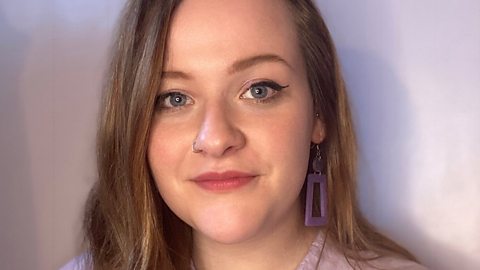
In 2020, 20-year-old Kirsty Robson from Glasgow co-founded Yet Again, a youth-led initiative promoting Holocaust and genocide education and commemoration. Leading up to 27 January this year, the organisation’s website has featured an article every day, authored either by genocide survivors, or by someone in the field of genocide studies. In a personal capacity, she has also worked to take Holocaust and genocide survivors into schools – something she describes with passion: “We believe that by listening to and hearing the stories of survivors you become a witness to their truth.”
Kirsty believes it’s essential to look at the Holocaust “not in isolation”, but in relation to other modern atrocities: “When you talk to [students] about the Holocaust and you talk to them about Bosnia, you show them that these things happened not very far from one another.
“For me it’s making sure they realise they have the power to make sure these things don’t happen again.”
With commemoration events happening virtually due to the pandemic this year, she sees an opportunity for these stories to be seen by a much bigger audience, and to be recorded for the future. She believes, despite its bad reputation, social media can be a force for good too: “We have in our pockets a platform that we can make massive change on from the comfort of our desk or bed.
“Activism and commemoration don’t have to be an in-person thing.”

‘We are the future. We are the ones who hopefully won’t make the same mistakes.’
The importance of digital media is something Jakob Riegler knows well too. For the past three months the 19-year-old has been working virtually with the Holocaust Memorial Day Trust (HMDT) from his London bedroom. Jakob is taking part in the Gedenkdienst (literally ‘memorial service’) programme, an alternative to Austria’s compulsory military service. The Austrian government describes the programme’s goal as “to promote the commemoration of the victims of National Socialism and the associated work of raising awareness and educating people.”
Preserving the memory of Holocaust events can take many shapes and forms. Jakob has been working to capture the activities to mark Holocaust Memorial Day across the country, as well as subtitling interviews with survivors. “I just basically help wherever I can,” he says.
While Jakob had learnt about the Holocaust at school, it was after finding out he could take part in this programme that he really delved into that period in history. He explains there are differences in commemoration in Austria and the UK: “While in the UK the big memorial day is on 27 January, the day of the liberation of Auschwitz, in Austria the bigger commemorative day is the day of the liberation of Mauthausen [on 5 May].”
He sees education as key to protect the future: “Especially now with less and less survivors still living… one of the most important things is engaging with young people. They, we are the future, we are the ones who hopefully won’t make the same mistakes.”
'Through art we are able to express our feelings and connect to the past.'
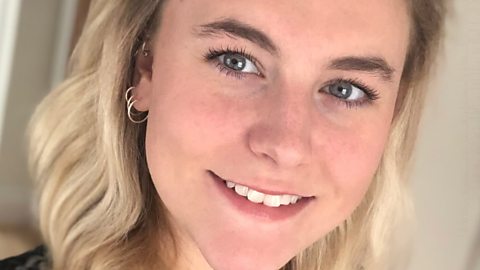
22-year-old Harriette Grimes from Bedfordshire is the winner of this year's HMDT photography competition for the 19-25 age category. She explains her picture The Shadow, which is based on exposure and light photography, builds on a concept she developed while studying photography as part of her A-levels.
Harriette chose to submit this image as she "could see the links to the memorial tradition of lighting the candles in the window, and the belief that the spirit of the lost influences us to this day even though they are a shadow of the past."
While at school, Harriette had also taken part in a project with a theatre group organising interactive theatre performances written by Holocaust survivors and telling the stories of victims.
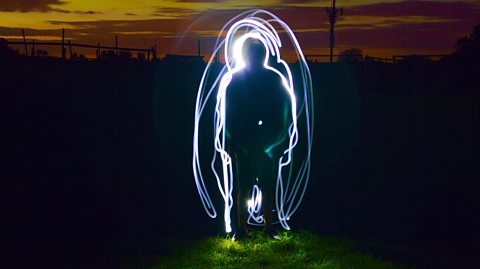 Image source, Harriette Grimes
She believes art can be "incredibly helpful" in preserving Holocaust memory: "Through art we are able to express our feelings and connect to the past.
"By joining in with art and photography, through projects and competitions, we are able to connect and inspire more people. This helps keep the memory of the holocaust alive, and get more people involved and connected to the memory itself."
Image source, Harriette Grimes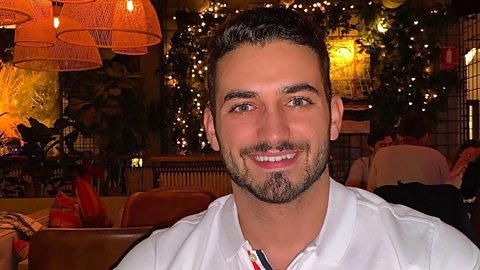
‘You can’t avoid anti-Semitism and racism because they don’t affect you’
In 2018, Alejandro Arguelles attended the Holocaust Educational Trust’s Lessons from Auschwitz Project. Visiting Auschwitz-Birkenau deeply affected him: “The trip really inspired me and really shook me,” he recalls. Soon after he became an ambassador for the trust, doing talks in both the UK and his native Spain.
Two years ago, while studying at Loughborough, Alejandro found commemorative events weren’t “enough for me”. So he decided to pitch the idea of a Holocaust Memorial Week to the university. In 2020, the university hosted a whole week of events, culminating in a trip to the Holocaust Centre and Museum in Nottinghamshire. This year, due to covid restrictions, a virtual conference will take place on 27 January.
Alejandro cites anti-Semitism and racism online as two crucial problems of our times, and believes their solution lies in engaging young people in a way that feels personal and authentic to them, including on social media.“The most important thing for young people to understand is that just because it doesn’t affect you or because it’s not something to do with you it doesn’t make it less important,” he says.
He believes future generations will have not only “a collective responsibility to keep the memory alive” but also a duty to “defend the truth” from those who deny the Holocaust ever happened.
“Each time you hear from a survivor you become a witness. You are a witness of the atrocities that you’ve heard about. And you must have a sense of responsibility to share that story.”
Finding my Family: Holocaust
A Newsround Special
What is Holocaust Memorial Day?
Why the world pauses every year to remember genocide victims.