
Many of us will have tried to up our baking game in these months of lockdown.
Whether it was banana bread, fairy cakes or full-on three tier gateux, getting to grips with a new creation has been a welcome distraction.
But what about something more simple, like making your own pizza base? It may look straightforward, but during the preparation, there’s a lot of science going on inside that dough.
And who better to talk us through that process than Dr Rahul Mandal. He’s a member of the Nuclear Advanced Manufacturing Research Centre at the University of Sheffield, but you may also recognise him as the 2018 winner of The Great British Bake Off.
Science? Baking? He’s got you covered in all respects.
If you don’t have a pizza dough recipe to hand, try this one from BBC Food.
1. Ace that base
When you see a chef in a pizza restaurant preparing the dough, there’s a good chance you’ve seen it being whirled and tossed through the air as it becomes more and more pliable. You don’t have to do that at home (especially if your kitchen has a low ceiling), but you can still bring in the same science without worrying about knocking crockery from the shelves.
Rahul explained: “There is a lot of factors involved. One of them is that you have knead the dough properly.”
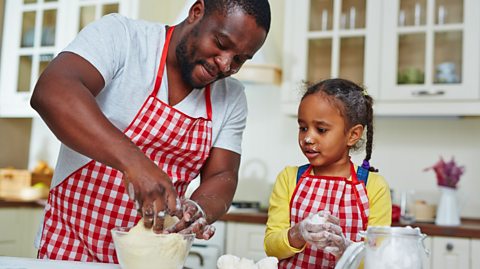
That means using a flour with a high protein content. There are two proteins within it, glutenin and gliadin, which do some important things when you knead. Rahul also suggests a ratio of three to five between water and flour. So, if your recipe needs 500g of flour, add 300g of water.
He continued: “The proteins are like springs. When you add water to them, they uncoil and they become long strands, which attach to each other.”
Those strands are gluten, and the more you knead, the longer those strands become. You can see them as sections of the dough are separated from each other as you knead.
Rahul added: “You basically make sure, through stretching and folding the dough, that you are making longer and longer molecules.”
2. Don’t be too kneady
If you ever find that your pizza dough becomes too sticky to handle, there’s a chance you’ve kneaded it too much.
Rahul said: “if you overknead any dough, the gluten strands start to break, and it can get sticky.
“The strands attach with each other, they like to form bonds with the next molecules, so their tendency is to make the dough elastic. If you put too much pressure on them, these strands tear apart.”
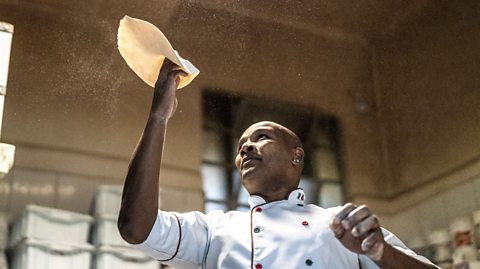
If your dough behaves itself and retains its elasticity, then you need to give it some time alone to prove.
This is where the yeast in the recipe kicks into action. Rahul said: “It’s a fungi which feeds on the carbohydrate in the flour, and farts out lots of carbon dioxide - and that gives a rise.”
So when you see that a dough has swelled in size after proving, that’s due to all the gas (or ‘farts’) produced by the yeast while it’s been given a chance to sit and chill for a while. Once your dough has proved, Rahul suggests separating it out into the number of bases you need to make from that one batch. Also, if you have time, letting your dough prove in the fridge overnight means the yeast reacts more slowly and helps boost the flavour of your pizza base.
3. Shape up and bake
One thing you won’t need when getting a pizza base ready is - according to Rahul - a rolling pin. The air pockets formed by the yeast are important and you don’t want to squish them flat before you reach the oven.
That’s why you’ll see chefs stretching and shaping pizza bases into shape rather than rolling them out. The science doesn’t stop there though. It carries on in the oven.
Rahul said: “In the oven, it gets the heat. The first heat gives the yeast its sharp rise.That’s where the yeast is crying out, “It’s heat, it’s so warm and cosy! We should jump up and down and dance!’ and they do, and this produces more gas, more carbon dioxide. They do that and it gives the first rise which gives really big air pockets in the pizza base.”
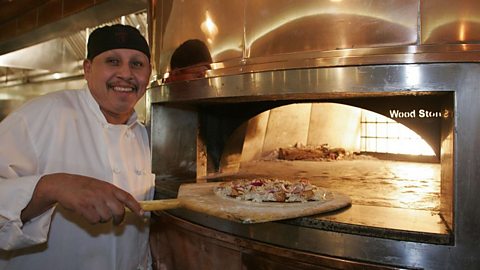
When the heat increases, the yeast dies away, but the gluten structure set up during the kneading process stays in place.
Rahul said: “It keeps the structure, like a scaffolding. The yeast is gone but the shape remains. Then, the more heat you give, the carbohydrates start to absorb more water, the cells rupture and start to create that bready texture.”
4. Keep a stiff upper crust
To make sure your pizza stays firm and doesn’t droop when you pick up a slice, Rahul said that the bottom of the pizza has to cook at the same pace as the top, which can be tricky in a regular oven.
Using a pizza stone can counteract this as it replicates the conditions of a traditional brick pizza oven. Made from ceramic, it sits inside a regular metal oven and, when heated up, starts cooking the base as soon as the pizza is placed on it. Rahul suggests using the grill to cook the topping and, if you’ve got the temperatures right, your pizza will never droop again. But please remember, if you’re not experienced in using a hot oven, please make sure you have help from someone who does if you want to try this at home.
Rahul knows just what it’s like to get a Paul Hollywood handshake for a successful bake. Hopefully your pizza bases are worthy of the same accolade. If not - remember to stop kneading!
Pineapple on pizza: Where did it come from and why do some of us hate it?
It's one of the most controversial pizza toppings around - why are we so passionate for or against a Hawaiian pizza?
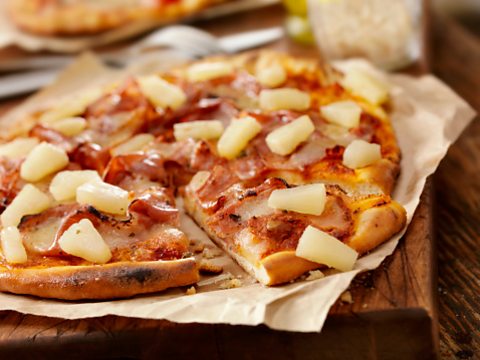
The takeaway treats that have become national treasures
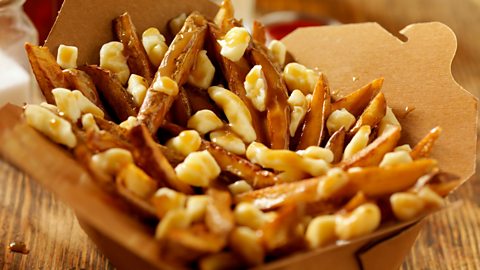
How poutine, kebab pizza and more found their way into a country's heart
Quiz: Bitesize taste of the world with Bake Off's Alice Fevronia
How well do you know some of the world's tasty treats? Find out on the Bitesize taste of the world quiz.