Most of us have things in our life that just work, without us even realising how.
The alarm that wakes us up, from either our phone, smart speaker or bedside radio. The furniture we sit on, the vehicles we travel in. Do we ever give them much thought?
So many of the items we use contain elements that were revolutionary when first invented, but perhaps we take for granted today. What would our lives be like, then, if these items didn’t exist? BBC Bitesize asked three scientists for their theories.
A world without the microprocessor
Professor Geoff Merrett, an electronics expert from the University of Southampton tells us that there are considerably more microprocessors on Earth than there are people. They are small black boxes with silver ‘legs’ attached to circuitry inside thousands of devices intended to improve our lives via the software contained within them. The first was patented in 1971.
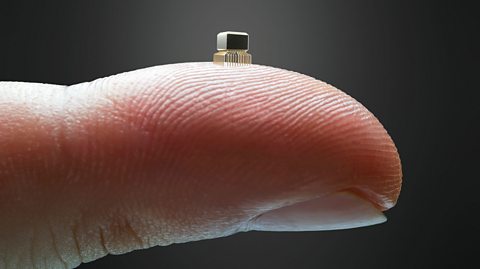
Prof Merrett explained: “Consider the first few minutes of your morning. I’m woken up by an alarm on my smart speaker (containing a microprocessor). I turn on the coffee machine (microprocessor), have breakfast while reading the news and checking messages on my phone (microprocessors), and load the dishwasher (microprocessor). I have a shower (microprocessor), get dressed and put on my smart watch (microprocessor), and get into my car (tens of processors).”
The microprocessor, Prof Merrett, says, is also responsible for landing the first astronauts on the Moon - with considerably less processing power than is in one of today’s smartphones.
It has enabled computers to work on advanced scientific breakthroughs and the ways people have kept in touch via different screens during the Covid-19 pandemic is all down to the microprocessor. It costs a lot to develop a new type of processor, but once it’s available, it can be programmed to work in many different devices. It’s this programmability Prof Merrett believes we would miss if the processor had never existed.
He said: “Without microprocessors, I think we’d have seen considerably slower technological innovation, and hence technology would be a lot less prevalent in our homes and lives. That’s not to say that technology would still be stuck in the 1970s; technology would still have advanced, and some of the electronic devices that we have would have been arrived at through other more specific means, but I don’t think we’d have seen technology as the commodity that it is today.”
He continued: “Would we have computers? Smartphones? Would there be tens of billions of smart and connected ‘internet-of-things’ devices in the world? Probably not.
“We’d likely also be a lot less technologically educated, learning to program computers is easily accessible – which in turn leads to future innovation!”
A world without the screw
Your skills with flatpack furniture may have impacted on your relationship with screws. The concept for this pin with a spiral thread dates back thousands of years. The Greek scientist Archimedes, born in 287 BC, credited with inventing a water screw that pumped water from one place to another and is still in use today, still bearing his name.
Dr Alexander Ellin of Teesside University’s school of Computing, Engineering and Digital Technologies says screws are “perhaps the most ubiquitous simple machines in use.”
And in connection to that, his theory suggests a world without screws would be one with much higher levels of waste.
Dr Ellin explained: “As well as being used for fixings in the construction, automotive, aeronautical, medical and electronics industries, they are also used in vices, presses, conveyors, pumps, extruders, augers [used to make holes in the ground] and even cork screws.

“If we didn’t have screws, things would have to be held together with glue, nails or rivets, or be designed to clip together. The advantage of screws over other methods is that they can be easily undone.
“If we didn’t have screws, therefore, it would be much more difficult to maintain things like aircraft, than it is with them.”
In the absence of a fastener that can be removed and the screwed back into place many times, Dr Ellin suggests that items would be more likely disposed of than maintained. He says there there is already one disadvantage to the screw in that its threads take longer to produce compared to other fastening methods.
He said: “In today’s throw-away society, speed, and therefore cost, of manufacture is more important to producers than maintainability so not having to produce screws may work to the advantage of suppliers.
“However, consumers might find that, as a result, things are much more difficult, if not impossible, to fix.
“As a result, in a world without screws, we might find there was a lot more waste as every time something broke it would have to be thrown away and replaced with something new.”

A world without the wheel
When talking about the wheel’s impact on our lives, it’s worth mentioning the axle at the same time. Prior to the axle, rollers, such as wooden logs, would have been used for transportation, but weren’t as effective for moving objects over long distances.
The earliest example of a wheel on an axle has been found on a potters’ wheel from Mesopotamia (an ancient part of Western Asia), dating back between 5,000 and 6,000 years. It’s the same principle applied to the wheeled vehicles we use today and, as pointed out by Dr Heather McCreadie, a physics lecturer at Aberystwyth University, in cogs too.
Dr McCreadie said: “The first things that flashed into my mind when presented with this idea [a world without the wheel] is no cars, no cogs, no clocks.”
She continued: “The Earth’s magnetic field is my area of expertise and I immediately thought, ‘what if the longitude problem was not solved?’ That led to the invention of the portable clock.”
The longitude problem involved sailors needing an accurate method to pinpoint their position on the east-west line of longitude while at sea. It was eventually solved by a man called John Harrison, who spent 20 years perfecting a timepiece - or chronometer - which kept the most accurate time possible, allowing a sailor to know exactly how long it was since they had left port. One thing a chronometer needed to work was cogs.
Dr McCreadie also said that the longitude problem didn’t necessarily need wheels to be solved, although we might have had to wait for newer technologies: “Lasers don’t need cogs and timings from atomic clocks would have solved this.” She also suggested that although ships’ rudders require wheels and cogs, one using a fulcrum and magnets could be used instead, so international sea travel would still be possible.
Another aspect of life without the wheel, Dr McCreadie suggests, is that it could look more like what we associate with science fiction films - although it’s dependent on other major scientific breakthroughs happening earlier than they did in reality.
She said: “What if electricity were utilised before wheels were invented? We could have three phase electric trains which hover on top of magnets. Why not?
“Research would be involved in hovercraft and perhaps we would already know how to utilise dark matter. An electric hover car that could travel anywhere may be a reality.”
So in a world without wheels, we may never see the stone-age car driven by The Flintstones, but Marty McFly’s hoverboards could be whizzing past us on every street corner.
Fabulous scientific facts - chosen by scientists
The finest undersea teamwork, metallic rain and the fish that could help us reach Mars

What does Star Wars get right about physics?
Don't worry, there's plenty it gets wrong too.

How does a bike stay upright?
Have you ever wondered how a bike stays upright? We ask a physics expert what keeps us rolling.