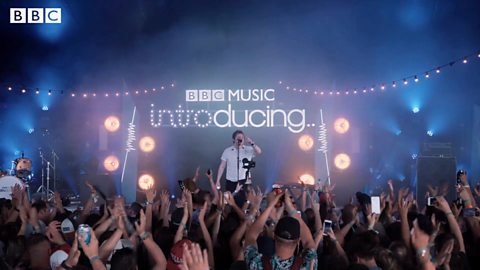
Glastonbury Festival is huge. It has grown as a festival and as a culturally important event - and this weekend it is live across the BBC.
But what is the story behind Glastonbury? Learn more about one of the world’s most famous music festivals, how it started, how the famous pyramid stage developed and how the event isn’t solely about live music.
Small beginnings
Worthy Farm in Pilton, Somerset, is the venue most people associate with the Glastonbury Festival. But between 1914 and 1925, there was another Glastonbury Festival, a cultural event, organised in the nearby town of the same name by composer Rutland Boughton.

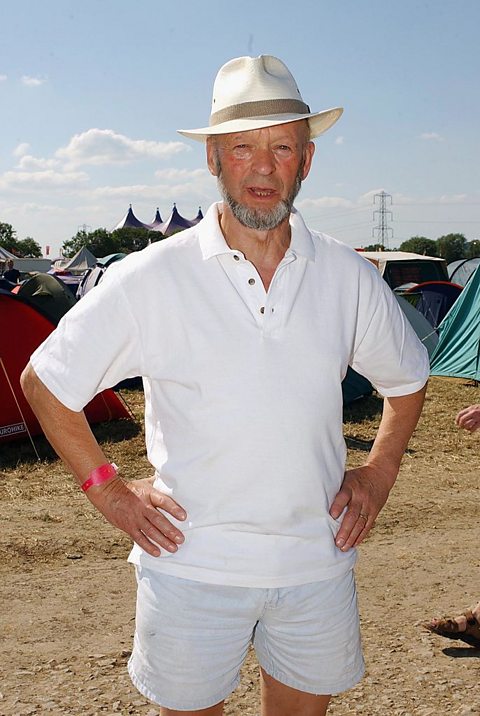
And the first pop festival organised at Worthy Farm by farmer Michael Eavis in 1970, the one that would evolve into the Glastonbury we know today? That was called (wait for it) - the Worthy Farm Pop Festival.
It began on 19 September 1970. By a complete coincidence, it was the day after guitar legend Jimi Hendrix died - and around three months later than the festival is traditionally held today. While more than 100,000 people attend Glastonbury in the 21st Century, 50 years ago around 1,500 people turned up, paying £1 per ticket - which included free milk from the farm. By contrast, the 2019 event had a capacity of 203,000 visitors, with tickets costing £248 and selling out in minutes.
In 1970, recent chart-toppers The Kinks and Wayne Fontana were advertised on the tickets as the headline acts, but both pulled out. They were replaced by a band called Tyrannosaurus Rex, who would later shorten their name to T-Rex. Fronted by Marc Bolan, they were one of the biggest groups in the UK in the early 1970s.
The following year, the date shifted to coincide with the June summer solstice. Re-named Glastonbury Fair, entry was free and the number of visitors swelled to 12,000. The event is now known, officially, as the Glastonbury Festival of Contemporary Performing Arts and tickets cost at least a couple of hundred pounds.
The three stages of the Pyramid
Glastonbury’s Pyramid stage is almost as old as the festival itself, introduced in 1971, when the event was back for its second year.

Constructed from metal and plastic sheeting, the Pyramid stage was deliberately placed on the Glastonbury-Stonehenge ley line (a network of lines which are said to connect sites with spiritual and cultural significance). In 1981, the decision was made to build a sturdier version of the Pyramid, one which could be used all year round. When famous acts weren’t performing on it, it could be used as a cowshed and a store for animal food. Using telegraph poles and Ministry of Defence metal sheeting as core materials, the new stage took two months to build.
That stage burned down in June 1994 and was replaced by a third version in 2000, inspired by the Great Pyramid of Giza. This is the largest of the three Pyramids, covering a space 40m by 40m and standing 30m high. It weighs more than 40 tonnes and is another permanent structure made up of environmentally friendly materials, in keeping with Glastonbury’s eco ethos. Acts that perform on the Pyramid stage vary from the world famous to the up-and-coming and have included Paul McCartney, Jay-Z, David Bowie, Dame Shirley Bassey and Dolly Parton.
Causes and messages
One of the driving forces of Glastonbury has always been to raise money for the festival’s chosen charities, plus awareness of those charities’ causes.
Currently, the event’s three charity partners are Oxfam, Greenpeace and WaterAid. In the early 1980s, the festival had strong links with the Campaign for Nuclear Disarmament (CND), with the organisation’s distinctive logo used on Glastonbury’s promotional material.
When the second Pyramid stage was launched in 1981, it was planned to have the logo at the very top of the structure but it proved too heavy to lift into place.
The links with Greenpeace and Oxfam began in 1992. WaterAid was added later in the decade and money is also donated to charities within the Glastonbury area.
In 2019, naturalist and broadcaster Sir David Attenborough appeared on stage at Glastonbury to speak about plastic pollution in the world’s oceans, which had been highlighted in his BBC series Blue Planet 2. An issue that had already sparked global debate, single-use plastic was banned from the Worthy Farm site in the same year.
Coming, weather or not
A year of steady rain at Glastonbury can hit the news just as much as a memorable headline act.
The festival site expanded in the 1980s as demand for tickets grew, which left campers spread further out. Tractors sometimes had to be used to rescue people stranded when wet weather would turn the fields into mudbaths.
One well documented ‘Year of the Mud’ was 1997. Glastonbury covered 800 acres by this point and many revellers were photographed dancing to the acts in their wellington boots rather than the latest fancy footwear.
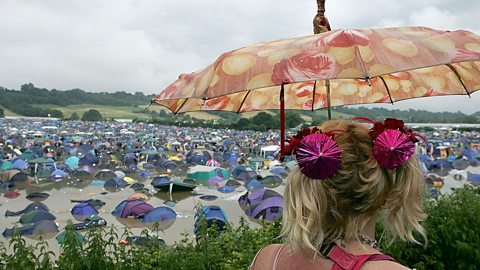
Torrential weather hit again in 2004 but the team at Worthy Farm had worked on improving the drainage which eased the situation. More and more waste was being recycled at the festival (32% in 2004) in order to prevent surrounding land and waterways being polluted. However, organisers were fined £12,000 over sewage leaking into a stream in 2014, killing fish and affecting the water quality.
When it’s not raining at Glastonbury, the sun can have just as big an impact on the event. In 1989, 2010, 2017 and 2019, the festival enjoyed soaring temperatures but that has also led to paramedics having to treat some revellers for heat-related conditions.
Showstoppers and chart toppers
In a 2017 poll by BBC Music, the 1997 set by Radiohead earned the title of the greatest Glastonbury headline gig of all time. It’s also been quoted as Michael Eavis’ favourite performance in the festival’s history.
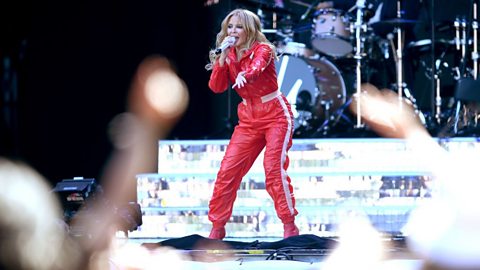
Pop acts are a regular part of the Glastonbury line-up today. In 2019 Kylie Minogue sparkled on the Pyramid stage in the coveted Sunday afternoon slot, 14 years after pulling out of the festival due to a cancer diagnosis. In 1984, The Smiths, fronted by Morrissey, were considered the first act reflecting current trends to break through on the Glastonbury stage, but many others would follow.
But whoever performs at the event, no matter how many albums they may have sold over decades-long careers, every act has to be aware of one thing. The local council is strict on music stopping by 12.30am, or they will impose a fine. Even a former Beatle isn’t immune. Paul McCartney over-ran in 2004 which led to a fine, although he reportedly paid back the amount Michael Eavis had to fork out. When Bruce Springsteen went over time in 2009, Michael said he was more than happy to pay the fine himself - he’d enjoyed the set so much
You can catch up on Glastonbury news here and there's coverage of Glastonbury live from Friday 27th June alongside highlights from festivals gone by here on iPlayer.
This article was originally published in June 2020. It was updated in June 2025
How Pride went from politics to pop
The visibility march that gradually became about the headline acts.
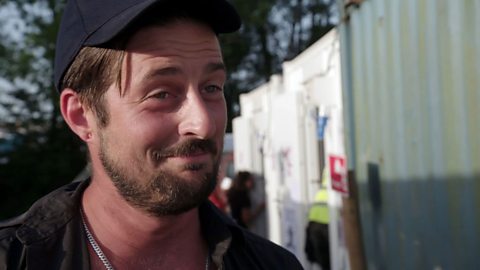
Willy: festival build manager. video
Willy talks about his journey from a musician to build manager for the Shangri-La area at Glastonbury.
Jobs at music festivals and in the music industry
Find out about people working in the music industry and at festivals like BBC Radio 1's Big Weekend, Glastonbury and Blue Dot festival.