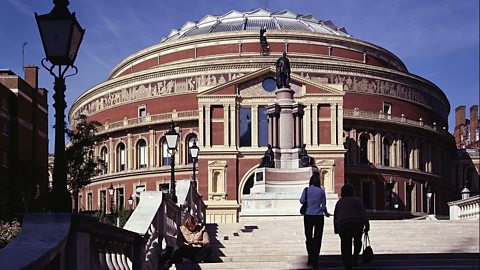
Each year London’s Royal Albert Hall welcomes thousands of classical music fans for the world-renowned BBC Proms festival.
The Proms is an annual eight-week festival that has taken place for more than a century. Each year some of the best and most loved classical music is performed to large crowds by talented composers and musicians.
But why is it called the Proms? How did it begin? And why is the Last Night such a big deal? We answer some of the questions you may have had but felt just too embarrassed to ask!
Why is it called the Proms?
The term ‘Proms’ is actually a shortened version of promenade concert, which refers to the festival’s origins.
A promenade concert was held in pleasure gardens and audiences were encouraged to move around the venue during performances. These concerts had been taking place in London since the mid-18th Century and the Proms were devised and named in their spirit, moving to indoor venues in the capital.
When did it all start?
The first Proms was founded by businessman Robert Newman and held on 10th August 1895. Newman wanted to create a classical music concert that wasn’t expensive and welcomed different types of people.
Before launching the event, Newman enlisted the help of established composer Sir Henry Wood and made him the lead conductor of the concerts. Together Newman and Wood organised the Proms and made sure to include a delicate balance of popular music and more complex pieces.

Wood conducted the Proms from its launch right up until he died in 1944, the same year that marked the 50th anniversary of the festival.
The original venue of the Proms was Queen’s Hall, near Regent Street in London. However, in 1941 the venue was bombed during the World War Two. Following the building’s destruction, the Proms were relocated to Royal Albert Hall, where the festival has taken place ever since.
To make the event accessible, some of the seats at the concerts were removed so that they could sell cheaper standing tickets, known as Promming, removing the expensive stigma from classical performances. To this day, Promming tickets are still available in the Hall’s Arena and Gallery sections and are only sold on the day of the concert.
What's all the hype?
The long history of the festival has turned the Proms into an iconic part of British culture and has gained an international reputation for its high quality of music and accessibility to new audiences. Many people are attracted to the Proms because of the relaxed atmosphere and mix of listeners it brings together.
Historically, there has been such a demand for tickets that many fans will queue overnight outside the Hall to try and buy a ticket for some of the bigger shows.
As a result of the festival’s popularity, Proms in the Park was launched in 1996. There was such a demand for tickets in the Hall, that a concert was organised in London’s Hyde Park and 28,000 people attended. Proms in the Park has become a regular part of the festival programme ever since.
Why is the Last Night such a big deal?
The Last Night of the Proms is the most popular concert of the festival as it not only marks an end to the eight-week event, but also because it allows audiences to patriotically celebrate British culture through music. Celebrations for this final performance usually take place across the country.

The feel-good factor of the Last Night began thanks to Sir Malcolm Sargent, the conductor who followed Sir Henry Wood, in 1947. Sargent's debut was the first-ever televised concert in Britain and the inclusion of patriotic music was a hit with the audience.
The Proms returned to screens in 1953, still conducted by Sargent whose engaging personality made him as much of a hit with fans as the music itself. He encouraged the waving of flags and banners at the Last Night - a tradition that continues to this day.
Is the First Night just as important?
Almost! The First Night of the Proms is a highly attended concert as it officially opens the festival. It is considered an honour to be selected to conduct this opening concert and the First Night is a hot ticket among classical music fans.
In 2021, Finland’s Dalia Stasevska has been announced as the conductor and is set to lead a special performance in tribute to founder-conductor Sir Henry Wood and his legacy with the Proms. Stasevska conducted the Last Night in 2020 in a show without an audience due to Covid-19, becoming just the second woman to be main conductor of the Last Night in history following Marin Alsop in 2013.
What are the rules or etiquettes for those attending?
To make the festival more accessible throughout the years, the Proms have removed many of the original strict attendance rules. For example, there is no longer a dress code, so tiaras and monocles can probably be left at home this year.
However, one rule that continues to divide Proms fans is around clapping. Some have argued that the audience should be allowed to clap because it is a natural reaction and a sign of praise to the musicians. Meanwhile, others have claimed that clapping distracts the musicians and can interrupt a performance.
Original composer Sir Henry Wood was in favour of applause, describing “that riot of noise and happiness” as a way of saying thank you.
Follow The BBC Proms this summer on BBC iPlayer and BBC Sounds.

10 pieces of classical music you didn't know you knew
Classical music is everywhere in pop culture if you look hard enough.
The remarkable first 150 years of the Royal Albert Hall
A venue that's welcomed pop stars, classical musicians and the world's first sci-fi convention
Myth or Maestro: the true or false classical music quiz
Test your knowledge of classical music myths with this true or false quiz.