Chances are, if you’ve ever looked up a recipe online and found one from across the pond, you might have been confused by some of the measurements.
While BBC Food will always attempt to steer you towards familiar measurements, American cooking instructions often call for 'cups' of ingredients.
And it’s not just the kitchen where different measurements can cause confusion. Our shoes are often measured in multiple completely different sizes and temperatures suddenly seem much higher in the United States.
BBC Bitesize gets the measure of measurements around the world.
What is a cup?
Used primarily in the US, a cup is a unit of volume, most often referred to in cooking. Whereas in the UK we’re more accustomed to recipes listing ingredients by weight (grams) or in volume (millilitres), US recipes tend to rely on the unit of cups.
Cups don’t measure weight, but work on volume – and this is where the confusion often comes in. While a standard cup is around 240ml, because of the different weights and volumes of some ingredients, it’s not that simple to work out. One cup of flour, for example, weighs around 120g, whereas a cup of sugar is almost 200g.
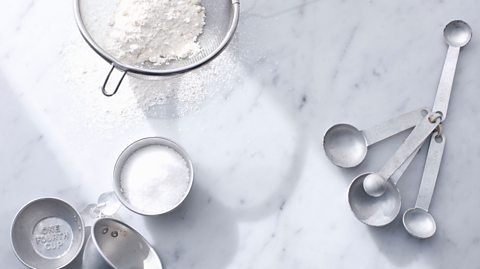
It’s similar to the much more familiar UK system of measuring with teaspoons and tablespoons. Sets of measuring spoons are often the most reliable solution to accurate cooking and baking - and sets of cups are also available.
It’s not just cups that could prove challenging to your cooking – there’s also confusion over the size of eggs, pints and sticks.
A medium egg in the UK would be labelled as a large egg in the US, while a UK pint at 568ml, is significantly more volume than its American counterpart (473ml). You’ll also see recipes call for sticks of butter – an amount that can be purchased in US stores, but is generally around 113g.
Feeling the heat
Once you’ve measured and mixed your ingredients and it’s time to cook you might then be thrown by the oven instructions and think – mine doesn’t even go up to 400!
Whether it’s an American recipe, or you’re on holiday in the US looking for weather updates, you’ll almost exclusively hear temperatures given in Fahrenheit.
Despite being used almost exclusively in the United States, Fahrenheit actually predates Celsius. The temperature scale was proposed by physicist Daniel Gabriel Fahrenheit in 1724.

Fahrenheit’s system sees the freezing point of water as 32°F and the boiling point of water as 212°F.
18 years after Fahrenheit’s scale was brought in, Swedish astronomer Anders Celsius proposed his own scale of Celsius, which introduced us to the more familiar freezing and boiling points of water of 0°C and 100°C respectively.
To convert the temperature from Fahrenheit \((^\circ{F})\) to the temperature in degrees Celsius \((^\circ{C})\), it's a simple case of using the formula:
\({c}=\frac{5(f-32)}{9}\)
where \({f}\) represents the temperature in \(^\circ{F}\) and \({c}\) represents the temperature in \(^\circ{C}\).
Act your age, not your shoe size
If you’ve gone to buy a pair of trainers, you may have got your hopes up and spotted a bargain in your size – only to realise you’ve been lured in by what turned out to be a US shoe size.
There are quite a few different systems in play as your shoe’s labels will show you – with variations in the UK, Europe, the US and across Asia.
In the UK and Ireland, measurements are based upon the mould used to make the shoe, known as a last.
The system, which dates back to the 13th Century, uses a unit of measurement known as a barleycorn, equal to roughly a third of an inch. The US shoe system works on the same basis, but their starting points are different. So for men, a UK size 4 is generally a US size 5, and so on. However, the system for women’s shoes is slightly different, and there can be a difference of between 1.5 and 2 shoes sizes internationally. So a women’s size 4 in the UK might be a 5.5 or a 6.

And of course, each brand has its own variations – meaning you might be a different size depending on which company’s shoes you buy.
Once you’ve got your head around the Atlantic variations, there’s then another completely different system in Europe.
On the continent, the system doesn’t use barleycorns to set its sizes, but the Paris point measurement. This is roughly two thirds of a cm and the sizes are worked out by taking the length of the last in Paris points – and then adding on another two.
This system is universal – so both a men’s and women’s size 4 in the UK would be an EU 37. Finally – there’s another method used in China, Japan and Russia, among other countries, known as Mondopoint.
This is perhaps the simplest of all – as the system is based on the average foot length and width in millimetres.
Jumping up in increments of 5mm, it means that UK size 4 would be somewhere between a 225 and a 230 – making the challenge of acting your age and not your shoe size a much more complicated instruction.
This article was published in June 2025
What are fruit flies and why are they in my kitchen?
A guide to spotting and preventing summer fly infestations.

What is an oasis? Five outstanding examples of oases from around the world
Join BBC Bitesze as we travel around the world looking at five different oases

I’m just a chill guy: Why are memes so popular?
Memes are an important part of the social media experience. BBC Bitesize is on hand to answer your meme-related questions.