Belgium, Switzerland, Bosnia and Herzegovina and South Africa are four countries which may have more in common than you think.
Aside from being 2026 World Cup qualified nations, they are all countries that boast a multilingual population.
Which raises the question, how do the football players of multilingual nations speak to one another on the pitch? BBC Bitesize spoke to Swiss football journalist Valentin Schnorhk to find out more.
Kim: How do players of a multilingual nation like yours communicate on the football pitch?
Valentin: When the coach is speaking to their players, they’ll speak first in French or German, then it will be translated. So people, so players are used to hearing it. For example, Granit Xhaka, who is from Kosovo can speak with Xherdan Shaqiri, who is also from Kosovo - they can speak Albanian.
Kim: Is body language important? Do players send signals to each other when they're on the pitch?
Valentin: I mean, when you are in a football team, you know the words or the gestures you can do to say something - if it's a go right or go left.
Kim: So it's the beautiful language of football is how everyone communicates on the pitch?
Valentin: Yeah. Football is quite easy to understand and at the end it’s only putting the ball in the goal.
Kim: So what happens in the likes of the Premier League then or La Liga, or Serie A? Do those clubs bring in translators?
Valentin: Obviously there's a lot of players from a lot of different nations in those top flight clubs. When you go to France, to Switzerland or to Spain, it's quite common that in the staff they have at least one or two people who can speak with a player.
Kim: And what are the advantages of being able to speak another language then Valentin?
Valentin: For the players, it's quite an advantage as well, because clubs in the Premier League or La Liga scouting players from Switzerland, they know that they can adapt, quite easily.
Kim: I suppose it also helps fans like you as well. So if you take the case of Trent Alexander-Arnold going to Real Madrid, that has gone down really well because he spoke in Spanish in his first press conference.
Valentin: Not all the players are keen on speaking other languages. Or it can be difficult for them to, to express themselves in another language.
Kim: And have you ever encountered any difficulties, Valentin, where language has maybe become a barrier or there’s been communication issues in your time as a football journalist?
Valentin: When I’m in, for example, a press conference, if in the room, there are only people from the Swiss German part the coach will speak in Swiss German, so we have to ask to please speak in the main German, so German from Germany - then we can cope with it. If not, we can’t get with this dialect. Which is so interesting when it's, you know, your country's language, but actually, it's hard to hear if you are from the French speaking part.
Kim: It's absolutely fascinating. Valentin, merci beaucoup for speaking to me.
Valentin: Merci.
What multilingual nations are participating in the World Cup and what do they speak?
Four languages are officially recognised by World Cup Group B contender, Switzerland. Swiss German is spoken by the majority of the population, followed by French, and then Italian, which is mostly used by those who reside in the southern region of Ticino. A further language, Romansch, which is a mixture of the three languages, is also spoken by a minority of Swiss natives.
In the same World Cup tournament group is Bosnia and Herzegovina, whose population speak Bosnian, Croatian, and Serbian.
When it comes to the most amount of languages recognised by a qualified team, South Africa comes out on top. Afrikaans, English, isiZulu and isiXhosa are among the 11 languages commonly spoken across the nation.
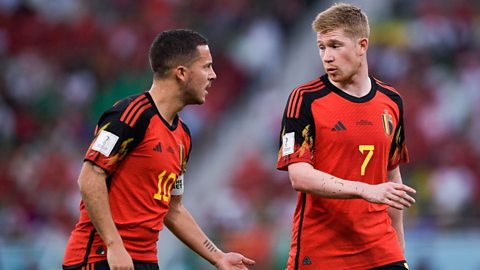
In some countries, the language you speak depends on where you live. For example, in the Belgium national team, former Manchester City midfielder Kevin De Bruyne was born in Ghent in the Flemish region, where they speak Dutch. On the other hand former international Eden Hazard grew up in the Walloon region, meaning he's a French speaker.
There are also a handful of bilingual nation teams participating in the 2026 World Cup. Countries with two official languages include South America’s Paraguay, whose population speak both Spanish and an indigenous language, Guarani. If you travel north, you will find co-hosts Canada, who recognise both English and French at federal level.
Communication is key
With up to four languages to choose from, members of the Swiss national team communicate in a variety of ways.
“When the coach is speaking to their players, they’ll speak first in French or German, then it will be translated, so players are used to hearing it,” Valentin explained.
This can differ from country to country. In 2018, BBC News reported that players on the Belgium football team spoke English both in the changing room and on the pitch - despite the official languages being Dutch, French and German. This was a move made to avoid the perception of favouring one language over another.
At club level, top flight teams across the Premier League, La Liga and Serie A may also have translators to accommodate players from different nations. “When you go to France, to Switzerland or to Spain, it’s quite common that in the staff they have at least one or two people who can speak with a player,” Valentin told Bitesize.
Valentin highlights that there are many benefits of being able to speak multiple languages, especially at club level. “For the players, it’s quite an advantage as well, because clubs in the Premier League or La Liga scouting players from Switzerland, they know that they can adapt quite easily,” he said.
But he also notes that languages can sometimes lead to communication challenges in the football world, particularly if different dialects are spoken. For instance, a German speaker in a press conference, may not understand the Swiss German dialect.
There are also other ways to communicate on the pitch when language isn’t an option. Valentin describes how body language can play an important role when trying to instruct players and their teammates. “When you are in a football team, you know the words or the gestures you can do to say something - if it’s a go right or go left,” he said. “Football is quite easy to understand and at the end it’s only putting the ball in the goal.”
This article was published in May 2026
Meet the Mini London Marathon winner balancing athletics with his GCSEs
BBC Bitesize sat down with Sheffield's Hallamshire Harriers runner Thomas Thake to discuss athletics, resilience and GCSEs.

What is it like to be the youngest player in the Netball Super League?
BBC Bitesize spoke to London Pulse's Gracie Smith to find out more about her love of netball and upcoming GCSEs.
'I’m just going to chase Messi around for a bit': Jamal Lowe's journey to the Premier League
Premier League striker Jamal Lowe spoke to BBC Bitesize about his journey from teaching assistant to professional footballer.