Diwali is one of the biggest religious holidays of the year, celebrated around the world by millions of Hindus.
A five-day Festival of Light, it usually takes place between mid-October and mid-November with the date changing each year. It marks the beginning of the Hindu New Year and is also celebrated by Sikhs and Jains.
In 2022, the festival begins on Saturday 22 October, with the main day of celebrations taking place on Monday 24 October.
BBC Bitesize explores the meaning of seven words that will help you learn more about Diwali and how people celebrate.
Ramayana
A key part of the Diwali celebrations for many Hindus is the telling of an epic poem known as the Ramayana. It tells the story of Rama, the Hindu god Vishnu in a human form, and his wife, Sita and explains how the festival began.
According to the Ramayana, Rama was banished to the forest for 14 years by his father and stepmother, so left his kingdom of Ayodhya with Sita and his brother Lakshman.
While in the forest, Sita was abducted by the demon king Ravana and taken to the island fortress known as Lanka. With the help of Hanuman, a god and monkey companion and devotee of Rama, Sita was rescued and returned home. The story signifies the ultimate victory of good over evil.
Diya
When Rama and Sita returned from Lanka at night, villagers lit rows of oil lamps along the streets to guide them home. These lamps are known as diyas or divas. Through this, the festival of Diwali was born.
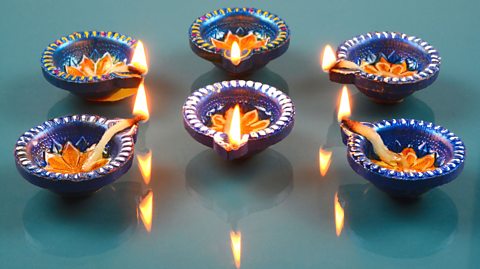
The word Diwali comes from the Sanskrit is an ancient language which belongs to the Indo-Aryan group and is the root of many, but not all Indian languages. It is now spoken by less than 1% of all Indians and is mostly used by Hindu priests in religious ceremonies. word ‘deepavali’, which means ‘a row of lighted lamps’. The deeper significance of diyas is that they symbolise light’s ability to overcome darkness, mirroring Rama’s ability to defeat Ravana.
To this day, people celebrate Diwali by lighting diyas or candles in their homes – a true Festival of Light.
Rangoli
During Diwali, families often make decorative patterns of diyas, lotus flowers and other designs out of coloured rice flour. This art form is known as rangoli.
These creative decorations are often a way to get children involved in preparing for the five-day holiday and to get excited for the celebrations that lie ahead.
The sense of family and community collaboration and spending time together is an essential part of Diwali, particularly as a key element of Hinduism is family harmony and unity. Families exchange gifts, enjoy a feast and often light fireworks.
Mithai
Among the gifts and the feast, you’ll often see plenty of mithai.
Mithai are Indian sweets, made from flour, milk, sugar and nuts and flavoured with other ingredients such as rose water or cardamom.
They’re often very sweet and are given as gifts, typically in elaborately decorated boxes.
Lakshmi
Known as the Hindu goddess of wealth, Lakshmi is honoured throughout the Diwali celebrations. It is believed she will visit the homes of the righteous and bless them ahead of the new year.
To prepare for her arrival, Hindus place diyas outside their homes to guide her at night, decorate porches with rangoli designs, and prepare plenty of mithai and savoury snacks.
Puja
A puja is a special prayer ritual where verses are recited, and offerings of fruit and other delicacies are given to the gods as a way of honouring them and seeking their blessings.

Several pujas are conducted by Hindus throughout the five-day festive period of Diwali. The main day of Diwali is known as Lakshmi Puja – on this day, pujas are held in honour of Lakshmi. In other religions, pujas are still carried out, in honour of other deities.
Annakut
The day after Lakshmi Puja is known as Govardhan Puja, or Annakut, which is the beginning of the Hindu new year.
Annakut means ‘a mountain of food’ – and food plays a central part in the day’s celebrations. Vegetarian sweet and savoury dishes are prepared and offered to the sacred images of various Hindu gods at temples and at home with the dishes arranged artistically.
One of the largest Annakut offerings in the world is held each year in London, at BAPS Shri Swaminarayan Mandir – popularly known as Neasden Temple – where thousands of people visit for blessings and to see the more than 1200 vegetarian dishes offered to the Hindu deity Bhagwan Swaminarayan - to whom the temple is dedicated - as well as other Hindu gods.
This article was first published in November 2021 and updated in October 2022

Dreidel, latkes and more
Six words to explore the Hanukkah story and traditions
How do young people in the UK celebrate Diwali and Bandi Chhor Divas?
Diwali is a festival celebrated by millions of people from three different faiths - but how?

The Seven Wonders of the World quiz
From the ancient to the modern, how much do you know about these famous landmarks?