When it comes to creating a gallery or museum, where do you start?
London's National Gallery was founded in 1824 when the British government took the decision to buy the art collection of the insurance broker and philanthropist John Julius Angerstein, following his death.
Those initial 38 artworks were put on display for the public in Angerstein’s London town house while a dedicated gallery was built in Trafalgar Square, still its home today. Since that first acquisition, the National Gallery’s collection has swelled to over 2,300 works and can be viewed free of charge.
BBC Bitesize takes a look at three of those early paintings which were bought for the nation.
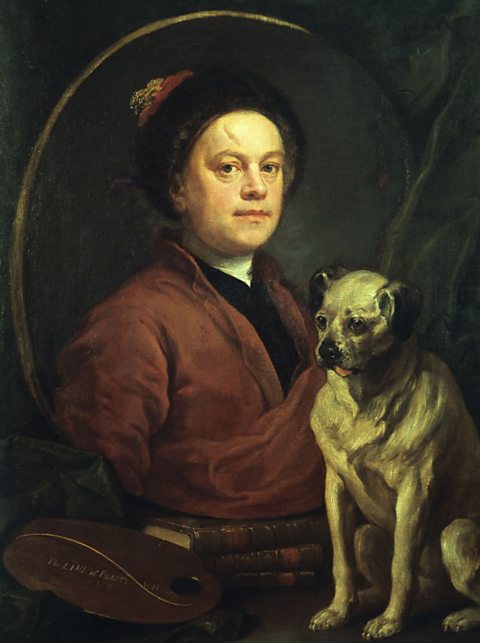
The Painter and his Pug, William Hogarth
Throughout history, artists have had their muses — the people, places and objects which have inspired them. For the English painter, engraver and satirist William Hogarth, his favoured muse was his dog, Trump the pug.
It is believed that Hogarth acquired Trump in the early 1730s, when the pug breed was heavily associated with the Netherlands. Trump’s name is possibly an anglicisation of Tromp, the surname of two influential Dutch admirals. He appears to be larger and to have longer legs than the modern-day pug.
So frequently does Trump appear in Hogarth’s works, that he is thought to be one of the most recognisable dogs in the history of art.
In this self-portrait (or rather a self-portrait within a portrait), Hogarth is drawing a comparison between himself and Trump the dog. He considered himself to have a ‘pugnacious’ character, meaning that he had a tendency to argue and quarrel with people. When his critics referenced Hogarth in their own work, a pug was sometimes used as a stand-in to represent the painter.
Elsewhere in the painting, you can see a stack of books written by William Shakespeare, Jonathan Swift and John Milton, three writers that Hogarth was influenced by.
While The Painter and his Pug was part of the original National Gallery collection, it can now be found at Tate Britain.
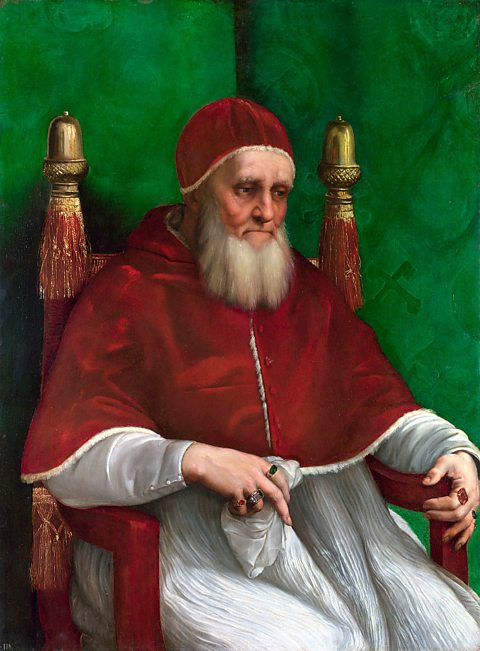
Pope Julius II, Raphael
From the style and decoration of the chair to his beard, this portrait of Pope Julius II is laden with meaning.
Nicknamed the Warrior Pope, Julius II (original name Giuliano Della Rovere) became the head of the Roman Catholic Church in 1503. He acquired that nickname as a result of his military efforts to regain territory which had previously belonged to the Territories in central Italy over which the Pope had sovereignty, between 756 and 1870..
However, Julius II also had a reputation of being a great patron of the arts in Rome, and is closely associated with famous A period of cultural, artistic and scientific rebirth in Europe, predominantly in the 15th and 16th centuries. figures such as Raphael and Michelangelo. In fact, it was Julius who commissioned Michelangelo to paint the famous Sistine Chapel ceiling and asked Raphael to both decorate his new rooms in the Vatican and paint this particular portrait.
The painting depicts Julius towards the end of his life, when he was battling a reoccurring illness. It was painted around 1511/1512 and was first displayed in 1513, following Julius’ death. We know the period in which it was painted because of the presence of the beard.
It was unusual for a member of the clergy to have a facial hair, but Julius called it his penitential beard. French troops captured the city of Bologna in 1511, and Julius subsequently stated that he would not shave again until the French had been expelled.
There are also hints of his family history within the painting. The gilded acorns which can be seen on the back of the throne-like chair are symbolic of his family, the Della Roveres. During the medieval period, Popes tended to come from a handful of different powerful families. Julius’ uncle was Pope Sixtus IV, a man who shared his interest in the arts and who had ordered the construction of the Sistine Chapel, which was named after him.
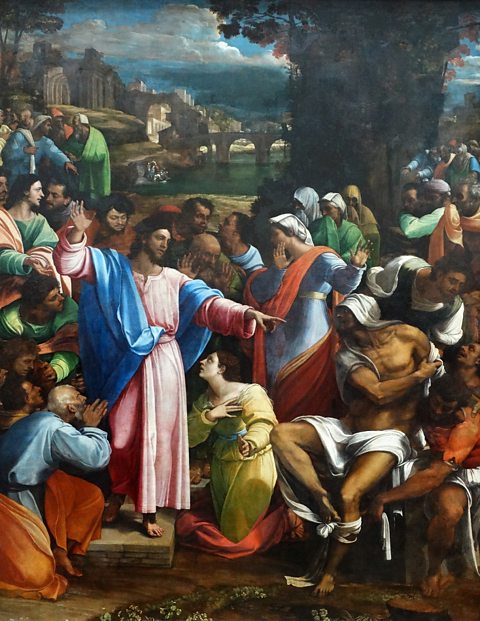
The Raising of Lazarus, Sebastiano del Piombo
When the National Gallery was formed, this painting was judged to be of such significance that it was given the honour of being assigned the first number in the catalogue - NG1. Based on the story of one of Jesus Christ’s last miracles, as told in the Gospel of John, it depicts the moment Jesus brings Lazarus of Bethany back from the dead four days after he was buried.
It was painted between 1517 and 1519 by the Venetian artist Sebastiano del Piombo (with the assistance of Michelangelo), at the bequest of Cardinal Giulio de’ Medici, who would later become Pope Clement VII. It’s actually an altarpiece, and Giulio intended for it to be displayed at the Narbonne Cathedral in France, where he was archbishop.
Giulio also commissioned an altarpiece from Raphael, which was entitled The Transfiguration and proved to be the artist’s last painting.
There was a clear artistic rivalry at the time, with Sebastiano and Michelangelo on one side, and Raphael on the other. When visiting Rome, Michelangelo sought to help Sebastiano with his painting by identifying how the figure of Lazarus (the man in the white cloth) could be improved and subsequently doing some sketches, which Sebastiano incorporated.
Sebastiano and Raphael approached their projects in different ways. Sebastiano would draw a section and then paint it, whereas Raphael preferred to do all his planning and drawing first.
In 1722, the altarpiece was acquired by Philippe, Duke of Orléans and moved to Paris. Out of concern that the painting would slowly degrade on the wooden panels, it was transferred onto canvas, in a process that actually caused a significant amount of damage. These days, it is rarely moved due to its fragility.
This article was published in February 2025
Looking for quizzes, amazing stories and fun facts?
Bitesize Topical has it all!

Five amazing ceilings from around the world
Amaze at the stunning artwork that can be found on ceilings worldwide, from stained glass to geometric tiles to informative paintings.
Five artists who popped up in their own creations
Have you spotted these painters, authors and film-makers in their own works?
Three incredible ancient frescoes that aren’t in Pompeii
From Egypt to Italy to India, join BBC Bitesize as we explore three stunning ancient frescoes that aren't in Pompeii.