It may sound like the grossest job ever, but it can make a huge difference to the lives of animals.
Poo contains loads of useful information about any changes that might be happening within an animal's body. It can even be used as a kind of pregnancy test, helping zoos to develop their conservation breeding programmes and boost the numbers of endangered animals.
Chester Zoo is the only zoo in Europe with a lab set up for testing poo, so we spoke to them to see how it all works.
Learn how Chester Zoo zookeepers and lab techs use poo to check up the health of the animals
Hi, my name is Rich. I’m one of the elephant keepers here at the zoo and we’re now here in our elephant area and I’m going to collect some of the poo samples.
What we do in the zoo, we’re able to identify whose poo is whose, through our camera system but also after a little while you’re able to make a good guess of whose poo is who just by looking at it and knowing which elephant is around.
Hi, I’m John, I’m the lab tech here at Chester Zoo. We use faecal samples in the lab to determine cyclicity in pregnancy, so this allows us to know when is optimal for mating and if mating’s been successful to help manage the species we have here at the zoo.
So, to do this we will look at progesterone of females and testosterone of males.
So, when we’re working on faecal samples it’s important to work our whose poo’s whose.
To do this we use a range of different tool. We can use faecal markers such as corn or wheat so we can physically see it in the faecal sample, or if it’s a species such as black rhino which tend to be solitary, they won’t be housed together so we know exactly whose poo is in that paddock. Additionally for the more herd species such as zebra or giraffe, it gets a little more complicated. So, we’ll use things like CCTV, or we go on ‘poo watch’ where we’ll stand and watch the animals and let the keepers know who’s going where to ensure we have the right sample.
So once we get the sample up to the lab, we start the extraction process. To do this we add a 95-methanol solution to it, and all this does is the alcohol helps it draw out the hormone from the sample. Then we leave it to shake overnight, just to mix up the sample.
Once we get this, we dry it down, we resuspend it into 1ml of ethanol and that’s our working solution.
The experiment we use is called immunoassay, so they are wells coated with a specific antibody depending on what you’re testing. So, like I said we’ll coat it with antibody to test for progesterone for females or testosterone for males. It’s basically like a pregnancy test for animals.
So, this work allows us to help with our conservation breeding programmes here at Chester and zoos around Europe.
The importance of using poo
Scientists have several ways of getting information about an animal’s health, but analysing poo is less intrusive than, for example, gathering blood samples. You might think all a zookeeper has to do is collect poo from the enclosure – well, in some cases, this can be easier said than done.
For animals sharing an enclosure, zookeepers have had to find ways of figuring out which poo belongs to whom – from ‘poo-watching’ (literally watching an animal until it relieves itself, so you know which sample is theirs), to adding food dye of different colours to feed, as that will show in the poo and tell you who it belongs to.
Some animals can take several days to digest their food, and so the resulting poo will contain Chemical messages produced by glands. They travel in the blood to a target organ where they take effect. from across that period of time. In contrast, a blood sample will only tell you about the concentration of hormones at that one particular moment
Poo is also relatively easy to store for future analysis. Chester Zoo has a huge walk-in freezer which contains over 100,000 poo samples!
 Image source, Chester Zoo
How the poo testing works
So you have the poo and know whose it is – now what do you do with it?
Within the poo there are the broken down remnants of hormones. By examining the balance of these hormones, scientists can determine whether any changes have occurred in an animal’s health. The study of hormones is known as endocrinology.
To begin with, the poo is added to a methanol solution as this alcohol helps draw out the necessary hormones from the sample. It is then left overnight in a machine which gives it a good shake, further mixing up the sample. After that the poo is dried down, resuspended in alcohol and placed into an A flat plate with rows of wells, which act like small test tubes.. Each well contains a specific antibody which can test for a particular hormone.
An antibody is a protein produced by an animal’s immune system that attacks foreign organisms (antigens) that get into the body. Imagine that an antibody is a bit like a lock and key. A specific hormone will attach itself to a specific antibody, the one it fits. This allows the scientists to identify how much of a particular hormone is in each sample because it singles out the hormone they want and ignores everything else in the sample.
Image source, Chester ZooA rather smelly pregnancy test
Depending on the species, if scientists are testing to see if an animal is fertile and in a position to conceive, they will be looking for any rise in A female sex hormone produced in the ovaries, which is responsible for puberty in females and the regulation of the menstrual cycle. levels. If there is a rise, the zookeepers can be informed and animals can be mixed as appropriate.
Alternatively, if the scientists believe that an animal may already be pregnant, they will be looking for a rise in the hormone Sex hormone produced by the ovaries and placenta.. Towards the end of the pregnancy, a drop in progesterone levels indicates that the animal is likely due to give birth.
Another type of hormone that can be analysed are glucocorticoids, which can provide an indication of how an animal responds to different stimuli, ranging from environmental, physical or social. This can help with assessing an animal’s wellbeing.
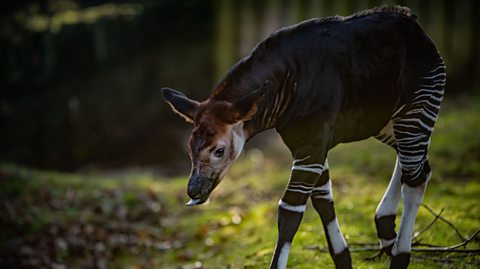 Image source, Chester Zoo
Testing animals right across Europe
Each month the scientists at Chester Zoo receive 300 poo samples from other conservation breeding programmes. Animals that have already benefited from this type of testing include Asian and African elephants, giraffes and several different species of rhino.
More recently, Chester Zoo celebrated the birth of a rare okapi, following a 14 month pregnancy. Named Kora in honour of a village within the Okapi Wildlife Reserve in the Democratic Republic of Congo, Africa, she is the result of a successful breeding programme that made use of this poo testing method. Okapi have distinctive black and white stripes on their hind legs which make them look a bit like zebras, but they’re actually more closely related to giraffes.
This article was published in April 2022.
Five well-known animals that went extinct in Britain
Elk, lynx and brown bears all used to roam across Britain.
The collective noun quiz: Do you know your herds from your hordes?
Test your animal knowledge with our crafty collective nouns quiz.
Three animals with an incredible memory
Discover the amazing memory capabilities of squirrels, elephants and dolphins.