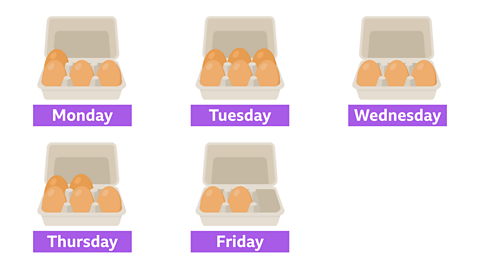
An ovoid is the three-dimensional realisation of an oval - what most people might simply describe as an ‘egg-shape’.
But when you look a little closer into the natural world, that traditional curvy shape we eat in chocolate form for Easter, or crack into a frying pan, isn’t the norm. Not all eggs are ‘egg-shaped’! Some creatures lay eggs which can look like anything, from a corkscrew to a flea, or even a see-through pouch. BBC Bitesize takes a look at (almost) a half baker’s dozen of these intriguing starter homes.
Sharks: Corkscrews and collagen purses
Different types of shark lay different shapes of eggs. There is no uniformity of shape with this species, which can be linked to their environment.
The horn shark is small and usually found in shallow water less than 40ft (12.2m) deep, hiding during the day and hunting for food such as crabs and sea urchins at night.
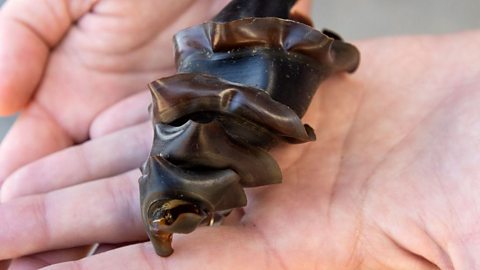
When a female horn shark lays her eggs, they are a distinctive spiral shape. It’s not just for aesthetic purposes, the ‘corkscrew’ form means they can be wedged into crevices and stay put until the pup inside is ready to hatch. It’s a process which can take between six and nine months.
Some sharks, and other fish such as stingrays and skate, also lay a type of egg that has the nickname mermaid’s purse. It is a rectangular collagen pouch which is tough enough to protect the embryo inside. Some skate can have up to seven embryos inside one egg at the same time.
Lacewing: Protecting their young
When the neighbourhood ants see the eggs that you lay as a tasty treat, you need to do something to keep them out of harm’s way.
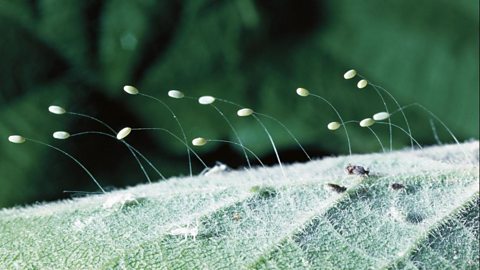
The lacewing is a flying insect that can often be found in UK gardens as it feeds on aphids, which can damage plants. Plant life is also where the female lacewing lay their eggs. They generate a thin strand of hardened mucus that either dangles from a plant’s stalk or stands upright, with the egg itself suspended at the end of the strand.
This puts enough distance between the egg and the plant to protect it from any hungry ants. As well as it being too far away for any of their legs to reach, the strand is too thin for the ant to climb up or down, giving the lacewing larvae a safe place to wait before hatching.
Surinam toads: Popping out to say hello
You may have seen trays of eggs on a supermarket shelf. Imagine carrying one on your back that actually incubated your babies!
That’s what happens with the Surinam toad. The females have a section on skin on their back which is covered in pockets. In these pockets, an egg can sit and wait in an ideal environment until it is ready to hatch.
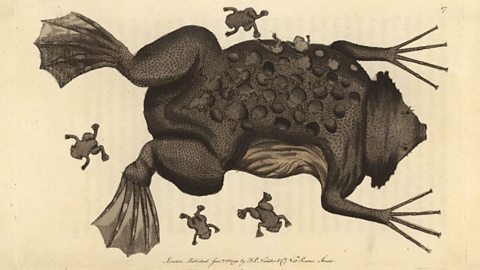
Hatching time is an intriguing sight, each baby toad (or toadlet) pops out of a pocket, fully formed and ready to go looking for food. An ‘eruption’ of young toads popping out of mum’s back may looks unusual - and perhaps make you feel a little queasy - but this method of carrying eggs means more of the infants hatch successfully. Other toads can lay hundreds of eggs at one time, with only a few surviving.
Whelks: Round in a spiral
At first glance, it’s easy to see why the whelk egg case has the nickname ‘the mermaid’s necklace’.
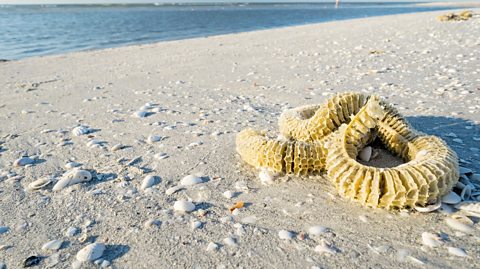
A string of connected disc-shaped capsules, there can be as many as 150 capsules in one casing, sometimes more.
Each capsule contains up to 200 whelk eggs, although not all will hatch. Each of the capsules contains an ‘exit’ which a baby whelk will use to leave the egg and head out to the sea. The whelk eggs that don’t hatch can also act as food for the newborns.
Jawfish: A bit of a mouthful
In nature, some creatures have a unique arrangement when it comes to looking after the kids. In the case of the jawfish, it happens before the babies are even born.
When a female jawfish lays her eggs, they are left inside the den of a male of the species. This isn’t the same as a cuckoo borrowing the nest of another bird, as the male will then take on the role of incubating the eggs over the course of around three to five days.
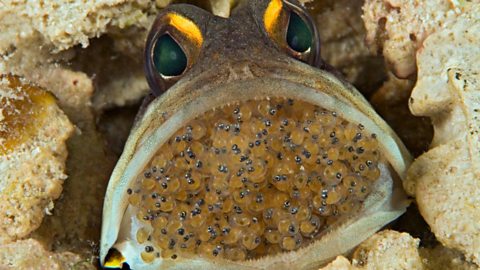
This involves scooping up the eggs inside their mouth, where they will remain until they hatch. It’s not just an open-and-shut case of keeping your mouth closed for all that time, the male will shoot the eggs out of his mouth on a regular basis and catch them again, which moves them about in a process known as aeration which ensures all the eggs get enough oxygen.
The incubation process means the male jawfish is unable to eat properly while carrying the eggs. It leaves him feeling weak, so once the eggs are hatched, he has a period of rest and recuperation.
This article was published in April 2025
Why does the date of Easter move around?
There's a reason why it's a moveable feast - find out why here.

'My science helped to tackle Covid - and keep the price of eggs down'
How a life in science can make a big impact on the world

What's the right number of eggs?
See if you can figure out the sequence and work out how many eggs there will be on Saturday.