Think of Native Americans, and there's a good chance you'll think of Thanksgiving.
The tale of how European settlers and Native Americans peacefully sat down to share a feast is a compelling one (more on that later), but often, that's all we know about Native Americans. As a holiday, it isn't even celebrated by all Native Americans.
Native Americans have lived in North America for thousands of years, and have their own rich history, including numerous celebrations and traditions. But have you heard of any of them?
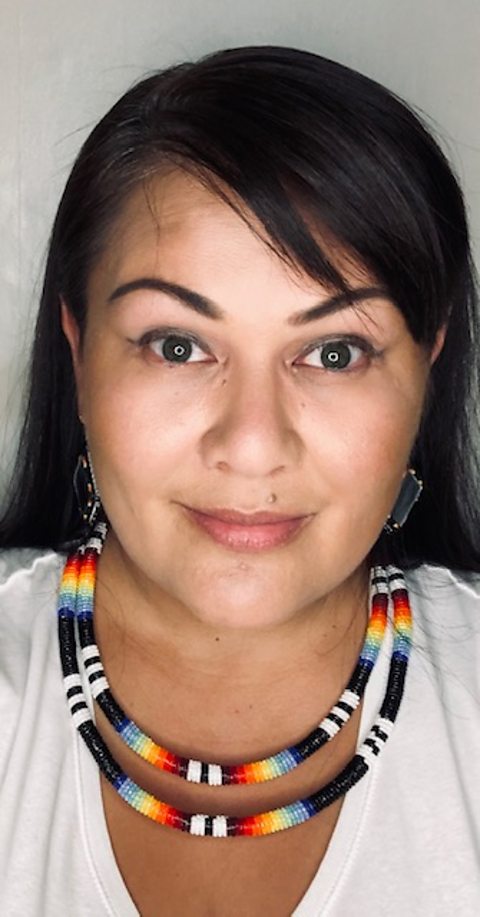 Image source, LeAndra Nephin
Celebrations in the Omaha Tribe
LeAndra Nephin is a member of the Omaha (pronounced Umoⁿhoⁿ) tribe from Nebraska, now living in the UK. She spoke to us about the festivals and ceremonies celebrated by her tribe.
Many Native American celebrations follow the natural cycle of the year, and so don't fall on the same date every year.
A key celebration for the Omaha Tribe is Mepa Honga, which takes place when the first thunders of the year are heard, typically in spring. For the Omaha people, this marks the start of the New Year, not January. As LeAndra puts it, they “see time and space very much based on the cosmos, the natural events that occur, like the weather change.”
Another big moment is the harvest celebration, known as Hedewachi. It’s generally held in August, during the time of the full moon.
Smaller, more private ceremonies will also take place throughout the year, such as birthdays and naming ceremonies. LeAndra says: “Each of us will have our white name, and then we have our Omaha name.”
Cedar ceremonies are performed to offer blessings, while the Wiping of Tears ceremony is observed after a person’s mourning period has ended. LeAndra adds that there is also a “feathering ceremony which happens to welcome an individual into the circle or into the powwow grounds to dance and participate.
“Halloween, Christmas, graduations, typical milestones of a person’s life will be celebrated, but will be celebrated with handgames or Gourd Dances.” In Gourd Dances there is little movement, with men dancing in an arena and women moving behind them.
LeAndra makes it clear however, that Native Americans are not one homogenised group. She states: “We are a group of people that share similarities, but there’s also this rich diversity amongst each of us, doing things slightly differently or completely different altogether.”
Image source, LeAndra Nephin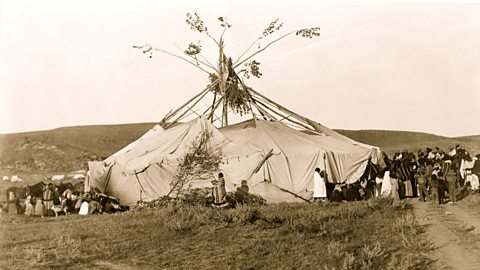 Image source, Buyenlarge
Sun Dance Ceremony
The Sun Dance ceremony is an example of a celebration that is shared across tribes, but will vary slightly in each one. It is primarily associated with Native Americans who live in the Great Plains region. It’s a ceremony that focuses on community prayer and healing. Dennis Zotigh, a cultural specialist at the National Museum of the American Indian, highlights that “each tribe has their own interpretation of how the Sundance came to their tribe.”
For the participating dancers, it can be quite a grueling experience, which is why the ceremony is often talked about in terms of sacrifice. Prior to the dance, they will each make a vow that is personal to them. Their family and spiritual mentors assist in their preparation for the event, including honouring key figures with clothing, horses and food.
A structure is erected specifically for the dancing, with its key feature being a central pole. Again, Dennis emphasises that “the importance of the center pole and its contents are interpreted by each tribe.” Similarly, there are different rules for how long the ceremony lasts.
As part of the vows, prayer and sacrifice in some tribes, participants will be pierced. Non-Native Americans have observed the ceremony, but this is not the norm.
In 1883, the Bureau of Indian Affairs enacted the Religious Crimes Code, banning a number of Native American ceremonies, including the Sun Dance. Some tribes continued in secrecy whilst other who obeyed the ban never resumed the ceremony. The ban was lifted in 1978.
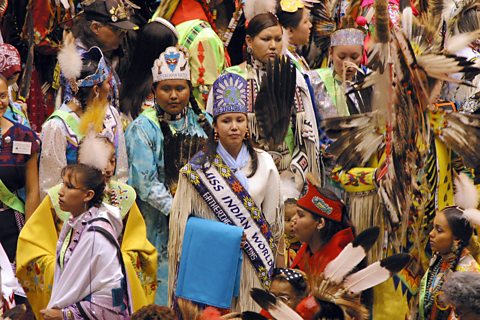 Image source, Phillippe Diederich
Gathering of Nations
The Gathering of Nations is the largest powwow in North America, attracting thousands of people each year. A powwow is a Native American gathering which typically features dancing, singing, socialising and a celebration of culture.
It’s held annually on the fourth weekend of April, in Albuquerque, New Mexico. Dennis highlights that “Gathering of Nations is a primarily social and competitive event. However certain elements of regalia, songs, dances and protocol may have spiritual significance.”
The powwow is opened with the Grand Entry, during which dancers dressed in traditional attire parade into the space. Sizable monetary awards are available in the various competitions and there’s a Miss Indian World pageant. In this, consideration is given to each participant’s personality, knowledge of tribal traditions and dancing ability.
Traders approved by the Gathering of Nations committee are able to sell their arts and crafts, and a portion of the event is devoted to honouring Native American horse culture.
There are hundreds of Native American tribes across North America, each with their own celebrations and traditions. These celebrations offer just a flavour of their rich cultural history and tradition.
So what about Thanksgiving?
Thanksgiving is a major US holiday, which takes place on the 4th Thursday of November every year.
It commemorates a time in 1621, when the English colonists, known as the ‘Pilgrims’, are thought to have shared a feast with the Wampanoag Native Americans, who had helped them survive their first winter in North America.
Thanksgiving is a beloved holiday for plenty of people in the US, but for many Native Americans, it presents a falsely positive view of the relationship between European settlers and Indigenous Americans.
In fact in 1637, 16 years after the feast supposedly took place, the settlers burned a Native American village, killing hundreds of people. The Governor of Plymouth, William Bradford, wrote that for “the next 100 years, every Thanksgiving Day ordained by a Governor was in honor of the bloody victory, thanking God that the battle had been won.” Any sense of harmony and collaboration was over.
European settlers stole Native American land and exploited its natural resources, as well as forcing Native Americans to replace their own culture and traditions with European ones, and introducing fatal diseases from which Indigenous people had no immunity.
In 1970 the United American Indians of New England declared Thanksgiving as their National Day of Mourning. Instead of celebrating, they hold a march and rally in Plymouth, Massachusetts, during which some choose to fast, in memory of their ancestors.
For LeAndra, Thanksgiving isn’t a time for celebration. She states: “I see Thanksgiving as a time of taking, exploitation and genocide. And for me, it’s really a day of mourning. I use that day… to reflect on those that we’ve lost to colonialism, and really just to meditate and offer good thoughts towards healing and reconciliation, and recovery of our Indigenous ways of living in kinship with the land, the cosmos of nature and in our community.”
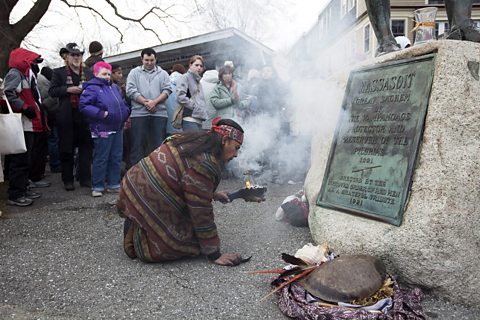 Image source, Boston Globe
However, LeAndra highlights that this isn’t every Native American's view of Thanksgiving: “There are Native Americans who do use that time to get together with family, and there’s this kind of decolonialisation that some do… They’ll look at doing traditional Indigenous foods, so food that they may have grown or harvested, and will generally use that time to buy specifically from Native American owned businesses, or to celebrate Native American people.”
Thanksgiving is a federal holiday in the US, and so some Native Americans take the opportunity to travel and visit family, or attend powwows. Others like to focus on the hospitality that the Native Americans provided, even if it wasn’t later returned, or the idea of being thankful. Thankfulness already has huge importance in Native American festivals, such as the Green Corn Ceremony, an ancient celebration of the corn harvest in late July or early August, with a focus on renewal.
In a Native American tribe, wealth and honour are measured by how much you give back to the community, rather than how much you are able to obtain.
LeAndra explains that there’s no judgement in how different Indigenous people approach Thanksgiving, it’s just an example of diversity among Native Americans. She adds: “November is Native American Heritage Month and throughout the month Natives will post photos or information to highlight the beauty of our culture.”
The day after Thanksgiving, well-known as Black Friday, is also National American Indian Heritage Day.
The marvellous universe of diverse superheroes
We take a look at LGBTQ+, Indigenous and anime superheroes.
Why is St Patrick's Day so popular in America?
The patron saint of Ireland's popularity in the USA and across the globe.
Bank holidays: Where do they come from?
Agriculture, religion and national identity have all played a role in creating holidays.