Gene Hackman: Two Oscars, A Badge and A Bad Attitude

Hackman as 'Popeye' Doyle in The French Connection
- Published
"I have trouble with direction, because I have trouble with authority."
Gene Hackman was never going to be a dreamboat like Robert Redford or Paul Newman.
As a young actor, he didn't have the piercing blue eyes, the chiselled jaw or the boyish golden locks. He didn't inspire much swooning, as a rakish Harrison Ford did, or fizz with the brooding intensity of Al Pacino or Denzel Washington.
He was never a leading man – his path to Hollywood legend started on the square clearly marked 'character actor'. Someone that knew his craft and carved out a distinct niche for himself. If you wanted an actor to play someone formidable, capable of being both ferocious and buttoned-up, by turns bristling and empathetic, Gene Hackman was your man.
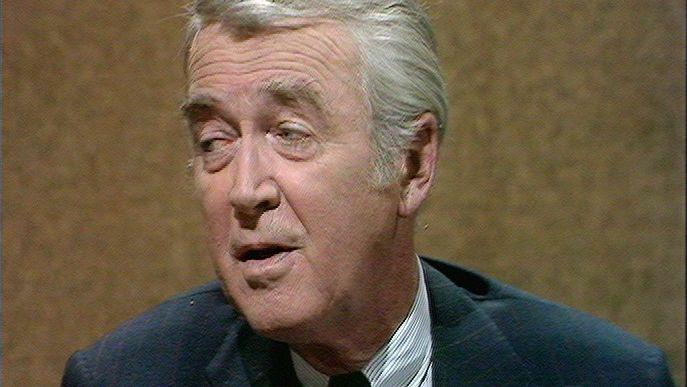
Gene Hackman talks to Barry Norman
Lawmen Barely in Control
Hackman's excellence in tough, grizzled roles saw him win two Oscars before he retired from acting in 2004.
The first was Best Actor in 1972 for the role of rage-fuelled, racist cop 'Popeye' Doyle in The French Connection (1971). This gritty 70s crime thriller was deliberately shot like a documentary, eschewing complicated camera movement and instead reacting to the actors. Hackman's naturalistic, physical performance was framed perfectly in that style. Sequences of Hackman tearing up bars, flinging suspects around and what is often regarded as the greatest car chase in cinema history made Doyle feel less like a cop, and more like a dangerous force of nature.
The legendary car chase in The French Connection explained
His later Oscar was in 1993 for his part in Clint Eastwood's revisionist Western, Unforgiven (1992). He played Sheriff 'Little Bill' Daggett, a tough-as-oak sadist, fond of his own voice. Like many latter Westerns, the film dispensed with the moral certainties of the genre, instead painting a horizon full of cowardice, hypocrisy and killing. Daggett was a lawman who would complain "haven't you seen enough bloodshed?" before personally horse-whipping suspects.
He was also nominated for his role in Mississippi Burning (1988), as a world-weary FBI agent ultimately on the side of right, but a million miles from his boss, a clean-cut, idealistic Willem Dafoe. Again, Hackman's character is willing to resort to his fists and bend the law in the hunt for greater justice, and they break the case when Dafoe agrees to do it Hackman's way.
Give Hackman a role as a man with a badge, a nickname and a disdain for the law itself, it seemed, and he would produce magic.
So what was it about Hackman that he could made these characters so compelling?
The Slog to Success
He had experience in uniform. He left home at 16 and lied about his age to enlist in the United States Marine Corps in 1947. He became a field radio operator and served for four years, in China, Japan and Hawaii.
He came to acting in his late twenties, studying at the Pasadena Playhouse. He and his room-mate Dustin Hoffman were voted joint "Least Likely to Succeed". (Ironic, then, that Hackman lost out on the 1989 Best Actor Oscar to Hoffman, for his lead in Rain Man.)
Whilst working at Macy's, Dustin Hoffman tried to sell Hackman's child to a flustered Christmas shopper
There was no early rush of success for Hackman as he, Hoffman and their friend Robert Duvall worked menial jobs and scrabbled for work. His first 'named' role was in 1964 in Lilith, a drama about a troubled psychiatric patient and a therapist. He was 34.
He had become known within the industry, but not yet by American audiences. His first Oscar nomination was for Best Supporting Actor in 1968, playing Warren Beatty's older brother in Bonnie and Clyde (1967). Another tough guy with an edge, toting a firearm.
Follow BBC Archive
1979: John Carpenter interview
- Published13 June 2024
Film '82: Jack Nicholson interview
- Published4 April 2024
"A Sensational Actor"
The year before the role that made him universally famous – 'Popeye' Doyle in The French Connection – Hackman had a second nomination for Best Supporting Actor. The film was I Never Sang For My Father (1970). And it was a role unlike his other Oscar nominated parts – a middle-aged college professor, struggling to shrug off the shadow of his domineering, ageing father. An urbane film about a father-son relationship beset by recrimination and abandonment, its climax is not a shoot-out but two men firing blame at each other.
It was this part that convinced producer Philip D'Antoni that Hackman would be right for the part in The French Connection. He considered Hackman a "sensational actor". He was all but alone in that. The director, William Friedkin, dismissed Hackman as a poor fit. The two consultant cops on whose real-life case The French Connection was based thought he was completely wrong. But crucially, they had no-one else.
Hackman and The French Connection director William Friedkin were often at each other's throats
Hackman himself struggled with the part initially. He hated the casual racism and nihilism of his character, and the attitude of the NYPD cop, Eddie Egan, that he was based on. As a consultant, Egan stalked about on set, and there were arguments and tantrums. Hackman wanted the racist language toned down – Friedkin refused. The two men would often be at each other's throats.
What Hackman was searching for, as his co-star Roy Scheider put it, was a way to make Doyle human. He looked for any opportunity to make Doyle a full character rather than a grisly stereotype. Freidkin's willingness to allow Hackman and Scheider to improvise their dialogue helped – Hackman took ownership of it. As the production rumbled on, Hackman got into the role. And in the end, it worked. His 'Popeye' Doyle was an unpredictable, foul-mouthed maelstrom. An Oscar-winning one.
"Pardon Me Boy, is this the Transylvania Station?"
But peek behind the big roles that made him famous, and Hackman's career was surprisingly varied and multi-faceted.
Mel Brooks explains how Gene Hackman fought to be in Young Frankenstein
He loved being in comedy and had marvellous timing, not only forcing his way into Mel Brook's Gothic horror parody, Young Frankenstein (1974), but embracing the bald-headed camp of villain Lex Luthor in Superman (1978). His sighing resignation to a world populated by bumbling henchmen is a perfect foil to his heroic, earnest nemesis, played by Christopher Reeve. He was originally cast alongside his friend Dustin Hoffman in The Graduate (1967), and many consider his last great role to be the crotchety patriarch in Wes Anderson's The Royal Tenenbaums (2001), for which he won multiple awards, including a Golden Globe.
Blind Hermits and Eavesdropping Spooks
In the same year that he appeared in Young Frankenstein, he was also in The Conversation, Francis Ford Coppola's intense, claustrophobic thriller about a wiretapping expert who falls into a world of conspiracy and murder. Hackman's character, Harry Caul, battles paranoia and his growing sense of culpability in this shadowy, secretive world.
The two roles are worlds apart. A blind, cigar-smoking hermit, scalding Frankenstein's monster with hot soup, and a quiet, technologically-minded man being crushed by his own guilt.
Hear more on BBC Sounds
The French Connection
- Attribution
Unforgiven
- Attribution
"Kneejerk Liberal"
Perhaps key to understanding why Hackman shone in those roles is found in his attitude to the characters. Aside from his struggle with the darker side of 'Popeye' Doyle, it's worth knowing that he initially turned down the part of the sheriff in Unforgiven.
Hackman, in person, is anti-gun violence (Friedkin described him as a "Midwestern kneejerk liberal"). By the time Unforgiven was on the table, Hackman was refusing such roles. He had sworn to his daughters that he would stop taking roles that glorified violence.
But Eastwood was adamant that he wanted Hackman and no-one else. He called Hackman and told him that the point of the film was not to celebrate heroic gunslingers, but to illuminate the brutality and darkness of the time. The violence was supposed to be repellent.
Hackman thought long and hard about it. He was in.
Gene Hackman on Wogan
Broken Men with Broken Dreams
Hackman always had an ambiguous relationship with his greatest characters. He didn't delight in how "bad-ass" these men were, how tough; he wasn't interested in machismo. He was interested in the root of their anger, understanding how they had become who they were. He brought exactly the same empathy and intelligence that he brought to his more gentle, quiet parts. Which undoubtedly helped make them so memorable.
Hackman never had onscreen movie star looks, and never considered himself a star, but an actor. There are relatively few interviews across his career, little celebrity publicity. He eventually retired from acting in 2004, after 80 films, only because his doctor told him his heart couldn't take any more stress.
In the late 80s, Hackman bought the rights to a best-selling crime novel. He wanted to adapt it – it was incredibly cinematic, and a movie of the film played in his head as he read it. He talked about directing it as well – and maybe even playing the central role. But as with Unforgiven, he talked to his family about it and they asked him not to do it – he had just been in the Mississippi Burning. Enough violence, surely.
He dropped out before the first draft of the script was finished. It would eventually become The Silence of the Lambs (1991). What Hackman might have brought to the role of Hannibal Lector, we can only imagine.
Explore more
- Published13 January 2025
- Published14 October 2024
- Published24 May 2024
- Published8 May 2024