
Parents' Notes
This site contains four History resources. It tells the stories of people who migrated during the nineteenth and twentieth centuries and lets users create their own stories and journey maps. The resource is aimed at children in the upper stages of primary school is also appropriate for pupils in S1 and S2.
Imrich shows the reasons for these migrations and looks at the impact of significant individuals, events and changes in work and transport on the lives of men, women and children from different sections of society.
The four activities are:
Sgeulachdan Imrich (Diaries)
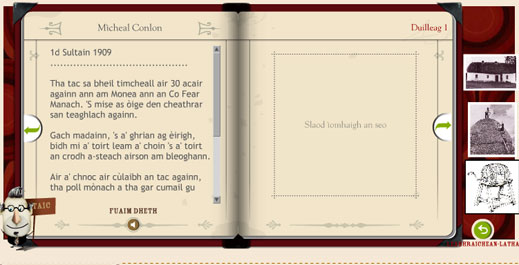
Read the fictional diaries of twelve children who migrated during the nineteenth and twentieth centuries. Their stories are illustrated with historical photographs and drawings and offer full audio support.
Cruthaich Leabhar-latha (Make a Diary)
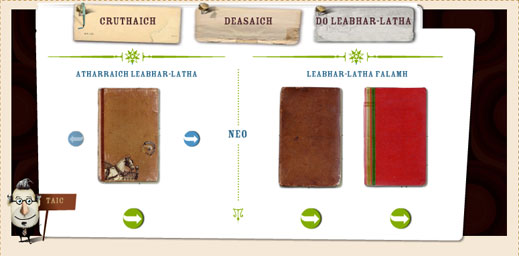
Make your own diary. Create your own text and illustrate it with historical photographs and drawings.
Mapaichean (Migration Map)
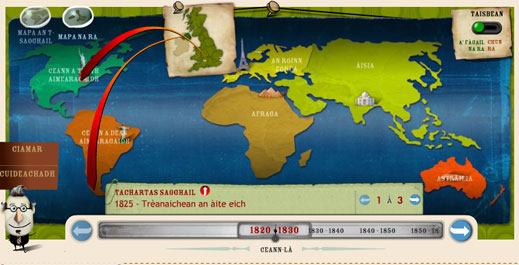
These maps hold a database of migrations to and from Britain in the nineteenth and twentieth centuries.
Cruthaich Map (Make a Map)
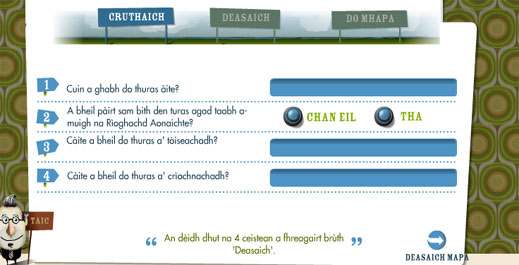
Use your details to create your own migration map.
Audio and Visual Help
Users can click on the Roghainnean (Preferences) button to:
• resize on-screen text and change text and background colours
• hear on-screen text being read out
• make captions available for most video and audio content.
The preferences are not accessible while you are in the Information for Parents and Teachers section.
You can also navigate most content using the keyboard.
Sgeulachdan Imrich (Migration Diaries)
Read the fictional diaries of twelve children who migrated in the nineteenth and twentieth centuries. The stories are based on real migrations and historical events.
The main content of the diaries is outlined in the following table and may help stimulate discussion.
The twelve diaries are:
| Diary | Migration | Year | Reason | Discussion Points |
| Kate O'Loughlin | Ireland to Liverpool | 1846 | To escape poverty | • Living conditions • Illness and the effect on families • Death • Work |
| Donald MacDavid | Scotland to Canada | 1856 | Highland Clearancesl |
• Difficulties with work • Highland Clearances • Views on the church • Role of the factor • Voyage to Canada • Illnesses - Cholera, fever • Comparison between Scotland and Canada |
| Emma Habershaw | Acton, England to Manchester, England | 1875 | Looking for a better life | • Living conditions • Health issues • Herbal remedies • Death • Cleanliness • Work in the mill |
| Molly Nicolson | Isle of Skye to Glasgow | 1882 | Economic hardship | • Living conditions • Rights • Fighting • Comparison between island and city |
| Edward Isaac | Redruth, Cornwall to Boldon, North East England | 1890 | Looking for a better life | • Addictions- drink, gambling • Fighting • Unpleasant nicknames • Faith |
| Angelo Giovannini | Italy to Scotland | 1898 | Leaving a hard lifestyle to look for better opportunities | • Occupations • Landowners • Travel |
| Mair Jones | Rhostryfan, Wales to Chicago, Ameirca | 1903 | Looking for a better life | • Poverty • Death • Rights • Cleanliness • Travel • New start |
| Aaron Rosenfeld | Ukraine to England | 1908 | To escape persecution | • Family • Living conditions • Food • Faith • Language - similies and idiom • Health • Travel |
| Mìcheal Conlon | Ireland to New York | 1909 | Looking for a better life | • Family • Living conditions • Travel • Work |
| Eileen Finn | Liverpool to Aberystwyth | 1939 | Wartime evacuation | • Second World War • Travel • Rural living |
| Freda Buckingham | England to Australia | 1952 | Economic reasons: Looking for a better life | • Living conditions • Peoples' Rights • Travel • Health • Comparative study of two countries |
| Awaale Samakab | Somàlia to Cardiff, Wales | 1990 | To escape war Note: There is a picture of a gun on the second page of Awaale Samakab's diary. |
• Life in Somàlia • Guns • Dangers - people, animals • Faith • Fleeing homeland • Refugee camps |
Click on a diary you would like to read. You can skip the introductory video and go straight to the diary if you wish.
Click on the map to see details of the child's journey and click on the diary to read it. The text in the diary is read out for you but this audio can be switched off using the "Fuaim Dheth" button.
Add a photograph or drawing to a diary page by clicking on one of the three pictures and photographs on the right hand side of the page and dragging them to the page. There is a short text caption and an audio description for each photograph and illustration which can be heard by rolling over the image.
Click on green arrow to turn the page.
Cruthaich Leabhar-latha (Create a Diary)
Create your own diary by either editing the text of an existing diary or by creating a new one from scratch. Use images from the existing diaries to illustrate your new one.
To edit an existing diary, click on the diary on the left of the screen. Use the blue arrow buttons to scroll through the different diaries and click on the green arrow button to edit one.
You can change the name on the diary cover and the text inside. To change the picture on the right hand page, click on the green "Tagh Ìomhaigh" button. The available photographs are grouped according to the diary where they appear.
To create a new diary, click on one of the two diaries on the right. Type a name on the cover and create your own text to fill the pages inside. Use the "Tagh Ìomhaigh" button to select a photograph or a drawing to place on the right hand page.
When you have finished, click on the Seall button to view your diary. Click on the Clò-bhuail icon to print your diary. The diary text and images print to full page size.
Mapaichean (Migration Map)
The world and UK maps in this activity show migrations undertaken during the nineteenth and twentieth centuries. The world map shows migrations to and from Britain and Ireland between 1820 and 1980. Migrations within Britain are shown on the map of Britain. The information about each migration is illustrated with historical photographs, drawings and film footage.
Use the Mapa an t-Saoghail (World Map) and Mapa na RA (United Kingdom Map) buttons in the top left corner to toggle between the two maps.
Toggle between migrations to Britain and migrations from Britain using the A' fàgail na RA (Leaving the UK) and Chun RA (To the UK) switcher in the top right corner.
Click on the blue arrow buttons beneath the map to scroll through the decades 1820 to 1980. The panel that appears above the timeline gives information about important world and migration events that occurred during that decade. Click on the white arrow on a red background button to read this information. Scroll through more than one event using the buttons within the panel showing a white arrow on a blue background.
Each red arrow on the map represents a migration. A red arrow with white dotted lines represents more than one migration.
Click on the red arrows to read a panel giving the following details of each migration:
• Càite & Cuin? (When and Where?)
• Cò? (Who?)
• Ciamar? (How?)
• Carson? (Why?)
The information about the migrations features historical photographs, drawings and film footage.
Click on Cuideachadh (Help) to get information about the section of the activity that you are in.
If you click on Ciamar (How) you will be taken through a number of steps showing you how to use this resource.
Cruthaich Map (Create a Map)
Create your own map showing a journey you have undertaken and giving information about your journey.
Answer the following questions about the journey:
1. When was your journey?
2. Was part of your journey outside Britain?
3. Where did your journey start?
4. Where did your journey finish?
5. How did your travel?
6. Who went on the journey?
7. Why did you travel?
Position the starting and finishing points of your journey by dragging each end of the red line to the correct part of the map.
Click on the Do mhapa (Your map) button to see your map. Click on the red arrow to view the information panel for your journey.
Add another migration to your map by clicking on the Cuir imrich eile ris button.
Click on the Clò-bhuail button to print your map in either colour or black and white.
 © 2015
bbc.co.uk/imrich