
Teacher's Notes
This website focuses on developing Gaelic language skills. It is primarily aimed at Gaelic learners working towards second and third levels of Curriculum for Excellence.
These notes outline some cross-curricular options which could be relevant at different levels, depending on Gaelic fluency. Some activities may also be suitable for learners at other levels, depending on Gaelic comprehension.
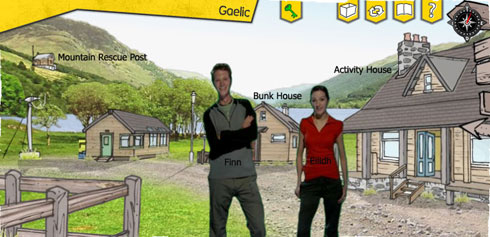
All content is achieved through three main characters Finn, Eilidh and Kate, based at an Outdoor Activity Centre. There are opportunities to visit different venues at the centre:
- • Activity House
- • Bunk House
- • Mountain Rescue Post
Through videos and drama the learners will:
- - develop Gaelic vocabulary
- - listen to a range of Gaelic structures and idiom
- - experience Gaelic through relevant, real contexts
- - raise awareness of outdoor opportunities in Scotland
- - develop life skills
- - raise awareness of Scotland's cultural and environmental opportunities
- - improve knowledge relating to sports in Scotland
- - learn about safety considerations for different sports
- - meet individuals who use Gaelic in their working lives
- - learn about European places and languages
Curriculum Links
The Curriculum for Excellence outcomes outlined could relate to the website content, depending on the focus. This is not an exhaustive list. These notes aim to stimulate further learning and teaching opportunities and to consider how the resource could be used for intended learning:
| Second Level | Third Level |
| As I listen or watch, I can identify and discuss the purpose, main ideas and supporting detail contained within the text, and use this information for different purposes LIT 2-04a | As I listen or watch, I can:
|
| As I listen or watch, I can make notes, organise these under suitable headings and use these to understand ideas and information and create new texts, using my own words as appropriate LIT 2-05a | As I listen or watch, I can make notes, organise these under suitable headings and use these to understand ideas and information and create new texts, using my own words as appropriate LIT 3-05a |
| I can show my understanding of what I listen to or watch by responding to literal, inferential, evaluative and other types of questions, and by asking different kinds of questions of my own LIT 2-07a | I can show my understanding of what I listen to or watch by commenting, with evidence, on the content and form of short and extended texts LIT 3-07a |
| I can make notes, organise them under suitable headings and use them to understand information, develop my thinking, explore problems and create new texts, using my own words as appropriate. LIT 2-15a | I can make notes and organise them to develop my thinking, help retain and recall information, explore issues and create new texts, using my own words as appropriate LIT 3-15a |
| I am developing my understanding of the human body and can use this knowledge to maintain and improve my wellbeing and health HWB 2-15a | I am developing my understanding of the human body and can use this knowledge to maintain and improve my wellbeing and health HWB 3-15a |
| I am learning to assess and manage risk, to protect myself and others and to produce the potential for harm when possible HWB 2-16a | I am learning to assess and manage risk, to protect myself and others and to produce the potential for harm when possible HWB 3-16a |
| I know and can demonstrate how to keep myself and others safe and how to respond in a range of emergency situations HWB 2-17a | I know and can demonstrate how to keep myself and others safe and how to respond in a range of emergency situations HWB 3-17a |
| I can listen to and show understanding of familiar instructions and language from familiar voices and sources LGL 2-01a | I can listen to and show understanding of mainly familiar language and instructions from a variety of sources where the sentences are longer and where there may be more than one speaker LGL 3-01a |
| I have worked on my own and with others to understand texts using appropriate resources. I can read and demonstrate my understanding of sentences and simple texts containing familiar language LGL 2-08a | I have worked on my own and with others to understand texts using appropriate resources. I can read and demonstrate understanding of more complex texts which contain familiar and unfamiliar language LGL 3-08a |
|
|
| Having explored the ways journeys can be made, I can consider the advantages and disadvantages of different forms of transport, discussing their impact on the environment SOC 2-09a | |
| By comparing my local area with a contrasting area outwith Britain, I can investigate the main features of weather and climate, discussing the impact on living things SOC 2-12a | |
| I can explain how the physical environment influences the ways in which people use land by comparing my local area with a contrasting area SOC 2-13a | |
| By comparing the lifestyle and culture of citizens in another country with those of Scotland, I can discuss the similarities and differences SOC 2-19a |
The Activities
To help consolidate ways to use this resource, information relating to video, drama and games content are outlined below. It explains different elements of the website.
The following support material is available on the website: glossary; subtitles and audio; a facility to switch between Gaelic and English text.
| Area/Character | Activities | Learning Content |
| Homepage: Finn & Eilidh's ID Cards
(opportunity to print and/or save personal information) |
When the cards are complete, users can use given vocabulary relating to appearance and clothing to create a caricature in the Mise game. Select an instructor to access the cards. |
Using Gaelic language to communicate |
| Mountain Rescue Post: Kate's ID Card
(opportunity to print and/or save personal information) |
Three choices to explore:
Click on the Kate character in the Mountain Rescue Post to open the ID card activity. |
Personal information:
|
| Mountain Rescue Post: Emergency Radio |
Access the Emergency Radio through the radio icon on the table in the Mountain Rescue Post. |
|
| Mountain Rescue Post: Map |
Interactive map identifying features in the local vicinity with text and audio. Select the map icon on the Mountain Rescue Post wall to launch the map, drag the viewer across the map by its red corner to see and hear the names of local features. |
Vocabulary relating to area surrounding Outdoor Activity Centre |
|
Activity House: Mise Game |
Mise Game - Using vocabulary relating to appearance and clothing to create a caricature. |
Language:
Appearance: skin, eyes, glasses, ears, mouth, hair Clothing: legs, body, coats, shoes, head Hobbies: team sports, other sports, music, other hobbies At home: my family, my home Click on the TV in the Activity House to launch the game. |
Activity House: Drama Videos |
Five dramas based on the Outdoor Activity Instructors Five levels; a game for each subject: Family Food - (healthy food and preparing for a race) Numbers - (buying a new canoe, canoeing) Time - (cycle race) Feelings - (hill walker rescue) Click a title on the Activity House notice board to watch a video. |
Words and phrases relating to each theme Everyday language Reinforcing Gaelic presented in the dramas and opportunities to learn new Gaelic words Assessment of understanding question at the end of each drama |
| Activity House: Helicopter Game |
The user is the pilot Level 1 - Family: locating family members Level 2 - Food: find different types of food Level 3 - Numbers: rescuing characters from numbered boats Level 4 - Time: identifying times Level 5 - Feelings: rescuing characters with various injuries Watch a drama video and correctly answer the question which follows it to access the helicopter game. |
Listening to Gaelic and following instructions in Gaelic |
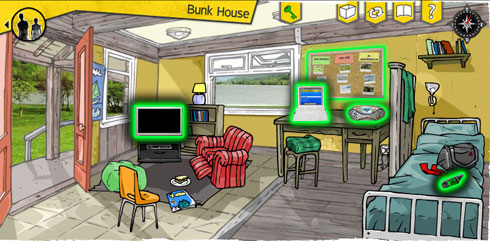
| Bunk House: GPS Receiver | Five videos following people who use Gaelic in their working lives. Lifeboat Coxswain - Donald MacLeod TV Director - John Smith MP - Angus MacNeil Teacher based in Spain - Gilbert MacMillan Arts Education Officer - Joan Robertson Click on the GPS lying on the bed in the Bunk House to launch the films. Use the arrow keys to navigate. |
Setting Gaelic in context as a language spoken on a daily basis and in a work environment. |
| Bunk House: Noticeboard - Sport Videos |
Nine sport videos:
Each video ends on an image which allows the user to explore Gaelic nouns relating to the sport featured in the video. To access the videos, select the Notice Board within the Bunk House. |
Commentary and graphics showing the following nine Gaelic verbs in their past, present and future tense. Verbs:Bhuail; a' bualadh; buailidh Ghluais; a' gluasad; gluaisidh Dh'èigh; ag èigheachd; èighidh Chuir; a' cur; cuiridh Dh'fhalbh; a' falbh; falbhaidh Dh'iarr; ag iarraidh; iarraidh Dh' fheuch; a' feuchainn; feuchaidh Dh' ionnsaich; ag ionnsachadh; ionnsachaidh Dh'fhàs; a' fàs; fàsaidh |
| Bunk House: Computer - Visitor Comments | Opportunity to read and listen to comments from visitors to the Dealas Centre. Video and commentary giving general information on the European city in which the vistior lives:
Opportunity to write and save comment Click on the television in the Bunk House to choose one of the three films to watch. |
Personal feelings and opinions Story-writing inspiration, similar to those by previous visitors History of the place: interesting places and beliefs Overview of the place and interesting buildings. Some history relating to the Olympics Paris scenes and information relating to sights and population |
| Bunk House: Television | Three videos containing a brief overview of Gaelic language, history and music Click on the TV to launch the films and use the tri-colour buttons to select a video. |
Insight to the Gaelic language in Scotland |
| Bunk House: Radio | Link to BBC Radio nan Gàidheal programmes via bbc.co.uk/alba. | Music, debate and documentary programmes from BBC Radio nan Gàidheal, the national Gaelic language radio station and a available through live stream or the listen again facility. Opportunity to listen to different Gaelic dialects and accents in a wide variety of contexts. |
 © 2015
bbc.co.uk/dealas