Identity, History and Politics looks at how art illuminates the current politics of the Islamic world.
Some visitors will follow its theme in detail while others will simply admire individual paintings and illustrations for their own beauty. Either approach works.
Some of the painters and illustrators featured have moved from their country of origin and it is clear some are influenced by living in the US or Europe.
 |
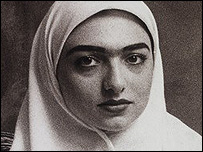
Three Uncles by Malekey Nayiny (Iran/France). Brooke Sewell Fund

|
But for anyone knowing little about the art scene in cities like Tehran or Cairo this is a good introduction to new Islamic art whatever its origins.
In some of the paintings the function of the Arabic text is very obvious. The Iranian artist Farhad Moshiri paints a water jar with lines on it from Omar Khayyam.
Khosrow Hassanzadeh's slightly Hockneyish self-portrait has his thoughts written over it like graffiti.
Political statement
But you might initially miss the verbal imagery in Sabah Naim's Cairo Faces.
Her large photograph of a Cairo street-scene is bordered top and bottom by hundreds of folded newspapers, in Arabic and English, each reporting the latest moves in international diplomacy.
|
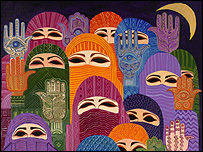
Hands of Fatima by Laila Shawa (Palestine). UK Copyright British Museum
|
Naim is suggesting how little the world of high politics can sometimes have to do with everyday life.
And in the striking X-Ray by Saudi artist Ahmed Mater al-Ziad, the words seem secondary to the ghostly central image.
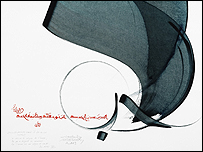
The poster image for the exhibition is Hassan Massoudy's graceful illustration of the word Love (al-hubb) extracted from lines of the 13th Century Sufi odes Turjuman al-Ashwaq and delicately executed on paper in pigment.
With relations between the Islamic world and the West now such a focus of attention some will see the mere act of staging Word into Art as a political statement.
Isabelle Caussé, who helped curate it, says that though many of the artists have been deeply influenced by the politics of the Middle East the museum's aim was simply to show to the world developments in modern art in a huge region whose culture remains unfamiliar to most people outside its borders.
'Word into Art - Artists of the Modern Middle East' continues at the British Museum in London until September 2nd. Admission is free.
 Home
Home

~RS~q~RS~~RS~z~RS~18~RS~)
 BBC NEWS CHANNEL
 News services

 E-mail this to a friend
 Printable version
 Enlarge Image