
This new find is unlike most anglerfish
|
Scientists exploring the depths of the mid-Atlantic ridge were excited to uncover a wealth of new species, including a bright red squid.
The two-month long, Norwegian-led expedition is part of the international Census of Marine Life (CoML).
The 10-year census, which began in 2000, aims to record all known marine life, in an aquatic "Doomsday Book".
The latest study used deep-sea probes to explore the undersea mountain ridge, running between Iceland and the Azores.
Mountain range
A team of marine scientists set out on 5 June to investigate the marine creatures living along the Earth's largest mountain range. The mid-Atlantic ridge rises to 1.3 miles above sea level in Iceland and the Azores, but is submerged in-between.
The expedition, which covered 4,000 miles and passed twice along the entire length of the underwater ridge, used a variety of sophisticated equipment, including underwater robots and video cameras, as well as a manned submersible.
The pioneering trip, which was the first of its kind, uncovered 300 new species of fish, and around 50 species of squid and octopus.
|
Hundreds of exciting new species have been found by the census

|
One of the new fish that the marine scientists hauled aboard their boat, was similar to an anglerfish - which has a kind of in-built "fishing rod" to attract prey.
However, the researchers say the fish is not quite like other anglerfish - which are yellow and flat, and usually live on the sea bed. The new find is brown and bloated and was discovered in mid-depths.
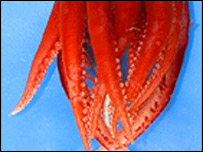
Scientists are also inspecting a bright red squid, which was found at a depth of about one mile, to decide whether it is a new species.
The decade long census, which will be completed in 2010, is divided into seven parts. As well as the mid-Atlantic ridge, scientists are examining the Pacific shorelines, the Gulf of Maine, hydrothermal vents, coastal salmon runs - and more.
 Home
Home
~RS~q~RS~~RS~z~RS~28~RS~)
 BBC NEWS CHANNEL
 News services


 E-mail this to a friend
 Printable version
 Enlarge Image