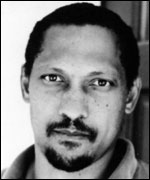
Newsnight Review discussed Erasure by the American academic Percival Everett.
(Edited highlights of the panel's review)
EKOW ESHUN:
It's a great book. It is all about
inversions and parodies. What it is
fundamentally saying is it is asking readers
to look through black eyes. It is talking
about the duality of black experience and
saying that when you are black you get to
look through your own eyes and skin, but
equally look through white eyes and how
white people tend to see black people upon
the colour of their skin and assume they
know who they are, that they know had
they are about. That is the position that
Monk Ellison is in. He is taking it merely
his body and skin colour, so he tries to
push against it and the novel plays with the
whole form. For instance, the fact that he's
called Monk Ellison partly in relation to
Thelonious but also in relation to Ralph
Ellison, who wrote The Invisible Man and
this is a take-off of Native Son and it is the
same sense of that duality. So the book in
its ideas is playing with the whole thought
of the physical and mental. It is philosophy
and the outside of the body and that is what
makes it so clever.
PAUL MORLEY:
I felt it was an interesting treatment of a
great book, but it is seemed very sketched
out and as a piece of writing in terms of the
potential post modern construct and the
playing around with form, I felt it was the
first 10% of something that could have
been quite interesting but it didn't follow it
through. Whether he was referring to
Bartez or going into the Jerry Springer
world . He could have disguised that and
say that the book wasn't written with full
research, but I didn't get lifted away. There
was a little hint of a great piece of writing.
JEANETTE WINTERSON:
He's ambitious with the form, but part of
the problem that for me it does seem to be
over literary and over self-conscious in the
wrong way. It reads like every creative
writing exercise that has ever been set.
LAWSON:
Except much funnier?
WINTERSON:
Yes, it is a good read. Take it in the bath
and you'll drown yourself. It is entertaining
and clever, but whether or not it has any
transformative power, I doubt. It didn't
take me to a place I haven't been before.
LAWSON:
It made me think that, how about you?
ESHUN:
You are missing some of the point of the
book. It isn't just a conceptual exercise. It
works in two ways, level of ideas in terms
of the way of trying to think beyond, but
equally it is a very human book. It
is how he begins to construct his own
world and comes alive as a human being
beyond the gaze of other people, both
white and black.
WINTERSON:
Can we trust a guy who said there is
something wrong with the world out there,
but not wrong with the world in here?
LAWSON:
The thing
that impressed me is he can do the
emotion. There is a scene with the old
family maid and he asks her what she will
do after the mother is dead and she said I
am going to look after you and that is real
writing.
WINTERSON:
I feel he pulls back from the emotional
writing. I don't know whether it is lost or
he's scared.
ESHUN:
Equally, you are talking about anger and I
think a lot of the anger is justified. It is
bitterness against the world and he has
channelled all the frustration he sees, not at
his career and not the books of his that
haven't sold, but more about the books that
do sell. More really about how blackness
and culture is seen generally by the world
around it, as something that fundamentally
is troglodyte and childish.





 E-mail this story to a friend

~RS~a~RS~Domestic~RS~q~RS~~RS~z~RS~12~RS~)