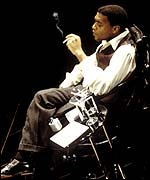
Newsnight Review discussed a revival of Noel Coward¹s 1920s shocker The Vortex.
(Edited highlights of the panel's review)
MARK LAWSON:
In 1924, Coward had to plead with the
sensors to get this on because it was
considered shocking. It is not now, but
does it still have some power?
JEANETTE WINTERSON:
Unfortunately not, but that is the fault of
the production. We know Coward's plays
are protected, but this is an ordinary dull
Coward. Chiwetel Ejiofor does his best,
but he is forced to play hysterically all the
way through. When you get to the final
scene that cannot work, because in the final
scene you are all guns blazing, there is
nowhere to go. That is the fault of the
production. Bette Bourne is great, playing
the homosexual, Chiwetel Ejiofor is
wonderful, Francesca Annis does her best,
but always let down by the production.
Surely there is a way in the 21st century to
look at Coward and make him as sharp,
sassy and relevant as he was it then.
IAN RANKIN:
It is an odd choice of play. Having said
that, this was the first time I had seen Noel
coward in the theatre and it was a
revelation because the first two acts were a
lot of public glitter, but it darkens
considerably in the third act. It is like a
long day's journey into a private darkness.
I was reminded curiously of Eugene
O'Neill in the last act, because it was a
doper's son who had not made much of
himself confronting his deluded mother.
The dialogue got muscular in the last act. It
is a play about smoking. This play has
been bought on by Forrester, because you
could not put it on anywhere but Britain
because you cannot smoke in America.
The funniest line in the play is when
someone said, "Where's Nicky?" "Oh,
he's in the smoking room." The entire
auditorium by this point was full of smoke.
It was like watching the play through a fog.
It was brilliant if you have the patches on,
take them off and go and see the play.
MARK LAWSON:
This is what is known as colour blind
casting, we are not supposed to take notice
of the fact, and no-one does in the play,
that a black man has two white parents.
Can it work?
PHILLIP HENSHER:
It is a strange thing to do in a realist play.
You forget a decision like that quickly, it
stopped troubling me after a bit. Like the
others I was more troubled by the play. I
think it looks more modern than it is. The
dilemmas look fairly 1990ish with all the
cocaine and adultery, but the solutions are
preposterously 1920s. There is a problem
with a Noel Coward play without jokes in
it. Without the wit or the comic bravado,
you are left with howling misogyny and
long conversations about whether she loves
him more than he loves her. I am sure we
all agree it is a subject beneath our
contempt.
MARK LAWSON:
On the casting, it hadn't bothered me when
Adrian Leicester played Hamlet, but it
seemed problematic to me here because it
is about social observation and attitudes
towards other people. It changes the nature
of the play at points, because this man is
astonished that his mother has had an
affair. Yet what you're looking at would
have been one of the explanations for what
happened.
JEANETTE WINTERSON:
I think Michael Grandage was nervous, he
did not know how to do it in a way to
make an impact. I think the casting was
gratuitous in the wrong way, it does not
help the actors or the production. You do
notice it, I could not stop noticing it.
PHILLIP HENSHER:
I was the same, because he shouts:
"mother, look at me, I'm different from
you", and you go, "yeah, colour-wise to
start with". I never did get past that. I also
thought the sexual ambiguity that Noel
Coward would have brought to the role
was missing, because in this production he
is played too straight.




 E-mail this story to a friend

~RS~a~RS~Domestic~RS~q~RS~~RS~z~RS~14~RS~)